When the Formula 1 paddock gathers at the Autodromo Nazionale di Monza, the circuit summons one of motorsport's most profound human decisions. On September 2, 1956, the World Drivers' Championship came down to an unprecedented act of sportsmanship inside the Ferrari garage—a moment born from a turbulent season of technical upheaval, mid-race car swaps, and fierce competition.
The 1956 campaign served as a reset for Grand Prix racing, shaped by the tragedies of the preceding year. Following the catastrophic 1955 Le Mans disaster—where Pierre Levegh’s car crashed into the barriers and exploded, taking 84 lives—defending champions Mercedes withdrew completely from all motorsport. Simultaneously, Lancia’s Formula 1 program dissolved following the death of two-time champion Alberto Ascari in May 1955 and mounting financial strains. An internal struggle left Gianni Lancia in a minority role, forcing the manufacturer to sell off its racing assets. The Lancia D50 monopostos designed by Vittorio Jano were transferred directly to Ferrari in Maranello.
From Le Mans Ashes to Maranello's Scavenged Weapon
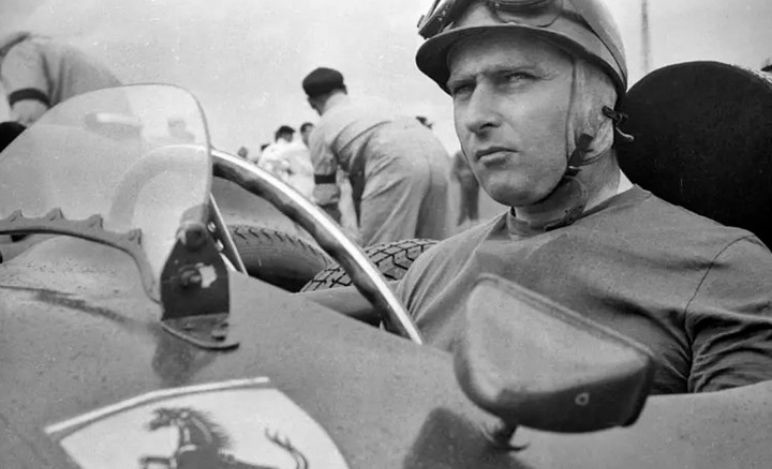
Ferrari engineers refined Jano’s baseline design to create the Lancia-Ferrari D50A. Scuderia Ferrari secured three-time world champion Juan Manuel Fangio to lead their assault, while his chief rival Stirling Moss moved to Maserati. What followed was a volatile championship battle across Europe:
- Argentina (January 22): Starting from pole, Fangio suffered a mechanical failure after 22 laps. Ferrari ordered Luigi Musso to hand over his car. Assisted back onto the track by spectators after an excursion, Fangio chased down Moss—who suffered an engine failure with 18 laps remaining—to take a shared victory with Musso despite Maserati's protests.
- Monaco (May 13): Fangio took pole but damaged his car. Ferrari placed him in Peter Collins’s car, allowing Fangio to secure second behind race winner Moss.
- Belgium (June 3): Fangio took pole and led comfortably until a transmission breakdown handed Collins his first career Grand Prix victory.
- France (July 1): Another pole position for Fangio was hampered by a lengthy pit stop for repairs, leaving him fourth while Collins claimed his second straight win.
- Britain (July 14): Moss took pole, but Fangio prevailed in a head-to-head duel to win as Moss retired.
- Germany (August 5): Fangio delivered a dominant display on the Nürburgring Nordschleife, securing pole, leading every lap, setting the fastest lap, and taking victory to build a 30-to-22 point lead over Collins.
The Monza Pit-Lane Drama and Collins's Sacrifice
Entering the season finale at Monza on September 2, 1956, Collins retained a narrow path to the title: he needed to win the race with the fastest lap while hoping Fangio failed to score. Tensions escalated when Fangio’s D50A suffered a steering failure, forcing the championship leader out of his car while Moss led ahead of Musso and Collins.
Ferrari management instructed Musso to stop and surrender his car to Fangio, but the Italian driver ignored the team order to push for victory on home soil. In the ensuing chaos within the garage, Fangio’s manager Marcello Giambertone argued with Sporting Director Eraldo Sculati, who exited the pit box. Giambertone took charge of the situation and spoke with Collins when the young Briton made a pit stop.
Demonstrating remarkable fair play, Collins—a close friend of Enzo Ferrari's late son, Dino—voluntarily stepped out of his car and handed it over to the 45-year-old Fangio. Collins remarked that he was "ancora giovane"—still young—and would have future opportunities to contend for titles. Fangio drove Collins’s D50A to the finish line, securing the points necessary to claim his fourth World Drivers' Championship—his only title achieved with Ferrari.
1956 World Championship Campaign Overview
| Grand Prix | Date | Pole Position | Race Highlights |
|---|---|---|---|
| Argentina | Jan 22 | Juan Manuel Fangio | Fangio and Musso share victory after mid-race car swap |
| Monaco | May 13 | Juan Manuel Fangio | Moss wins; Fangio finishes second taking over Collins's car |
| Belgium | June 3 | Juan Manuel Fangio | Fangio transmission failure opens door for Collins's maiden win |
| France | July 1 | Juan Manuel Fangio | Collins secures second straight win after Fangio pit delays |
| Britain | July 14 | Stirling Moss | Fangio takes victory in direct fight as Moss retires |
| Germany | Aug 5 | Juan Manuel Fangio | Fangio dominates Nordschleife to take 30–22 points lead |
| Italy | Sept 2 | Juan Manuel Fangio | Collins yields car to Fangio, sealing Fangio's 4th title |
Hatmakers and Trading Cards: Monza's Local Heritage
The passion surrounding Monza extends beyond the circuit boundaries into the town's civic history. Long before engine notes echoed through the parkland, Monza was internationally recognized for its hat manufacturing industry. Local sporting culture was equally shaped in the town's public spaces.
On June 24, 1929, during the feast day of San Giovanni, crowds gathered in Piazza Trento e Trieste and outside Caffè del Tamburon. Amid discussions on hat production techniques and political chatter, a group of young men enjoying cold drinks pulled a trading card from a cigarette pack. The card featured La Dominante di Genova, a Serie A club during the 1928–29 season. Driven by local practical spirit, the group collected 10 lire each to buy black-and-blue jerseys, founding their own club—La Dominante—and establishing a sporting tradition that mirrored the town's passion for competition.
Sources
These sources formed the evidence pack for this article. Links open the original publisher; inclusion does not imply endorsement.
- unracedf1.com original
- stahuj.cz original
- arriva.com.hr original