The skepticism that clouded the Madring project throughout the spring has begun to evaporate. For months, the narrative surrounding the new Spanish Grand Prix was one of uncertainty; as recently as mid-June, the circuit was described by observers as a mere building site, with organizers facing intense pressure regarding its ability to meet the September deadline. However, with the conclusion of F3 testing, the transition from a construction zone to a professional racing venue appears complete.
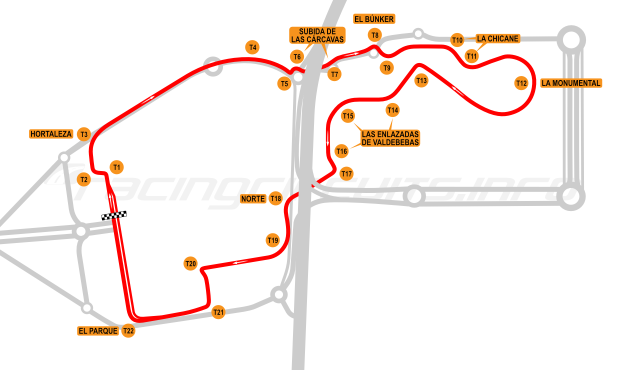
The Madring is not merely another addition to a crowded calendar; it is a high-stakes technical experiment. Designed by Carsten Tilke, the 5.474 km circuit represents the first new Tilke-designed Formula 1 track since the cancellation of the Hanoi project. By blending public roads with private land near the IFEMA exhibition centre in Valdebebas, the layout adopts a hybrid permanent-street circuit profile, drawing direct parallels to the architecture of the Miami International Autodrome.
The Physics of La Monumental
If there is a singular point of contention for the drivers arriving in Madrid this September, it is the semicircular Turn 12, aptly christened 'La Monumental.' This section is a structural anomaly on the current F1 calendar, featuring a staggering 24-degree (24%) banking. The turn stretches half a kilometre in length, forcing drivers to endure roughly six seconds of sustained lateral load while racing through the curve.
The sheer scale of the turn is matched by its spectator potential, with approximately 45,000 fans expected to witness the cars navigate the bank. This technical centerpiece, combined with a tunnel section and a long DRS straight, creates a circuit that demands both high-speed stability and precise mechanical grip. With straights capable of seeing cars reach 340 kph, the margin for error in the subsequent technical sectors will be razor-thin.
A Return to the Spanish Capital
The debut of the Madring marks a significant shift in the Spanish racing landscape. While Madrid has a history with Formula 1, it has been nearly 40 years since the city last hosted the pinnacle of motorsport at Jarama, located 30 km north of the city. The move to a purpose-built, central venue like Madring is intended to modernize the experience, utilizing the city's infrastructure to provide seamless access via public transport.

Beyond the asphalt, the organizers are betting on the atmosphere of Madrid to cement the race's longevity. The circuit is contracted to remain on the F1 calendar through at least 2035, a massive vote of confidence in the venue's viability. The integration of Madrid’s culture—from its leafier open spaces like the Retiro to its traditional tapas bars—is being leveraged to create a weekend that extends far beyond the 22 corners of the track.
Technical Profile: Madring Circuit
- Total Length: 5.474 km
- Corner Count: 22
- Top Speed: 340 kph
- Key Feature: La Monumental (24-degree banked turn, 500m long)
- Layout Type: Hybrid Street/Permanent
- Location: IFEMA, Valdebebas
The logistical scale is equally ambitious. Official hospitality packages are designed to offer privileged views of the banking and the garages, while the 'Ticket+' programme has already seen its exclusive accommodation and grandstand bundles sell out. For a project that faced protests and doubts regarding its very existence just a year ago, the sheer scale of the current preparation suggests a venue ready to make a permanent impact.
Evidence-Led Forecast
Tactical Pattern: Expect a race defined by extreme thermal degradation. The combination of high-speed 340 kph straights and the heavy loading of the 24-degree 'La Monumental' bank will place immense stress on the rear tires. Drivers will likely struggle to balance the aero-efficiency required for the DRS straight with the mechanical grip needed for the technical, varied corners.
Decisive Matchup: The battle between high-downforce specialists and low-drag efficiency seekers. Teams that can optimize their car to handle the high-G banking without sacrificing straight-line speed will hold the advantage.
Strongest Counter-Case: The hybrid nature of the track—utilizing both public roads and private land—could introduce unpredictable surface grip levels, potentially neutralizing teams that rely on a highly sensitive, low-ride-height aero setup.
Sources
These sources formed the evidence pack for this article. Links open the original publisher; inclusion does not imply endorsement.
- gpfans.com original
- hospitality.madring.com original
- formula1.com original
- f1-fansite.com original