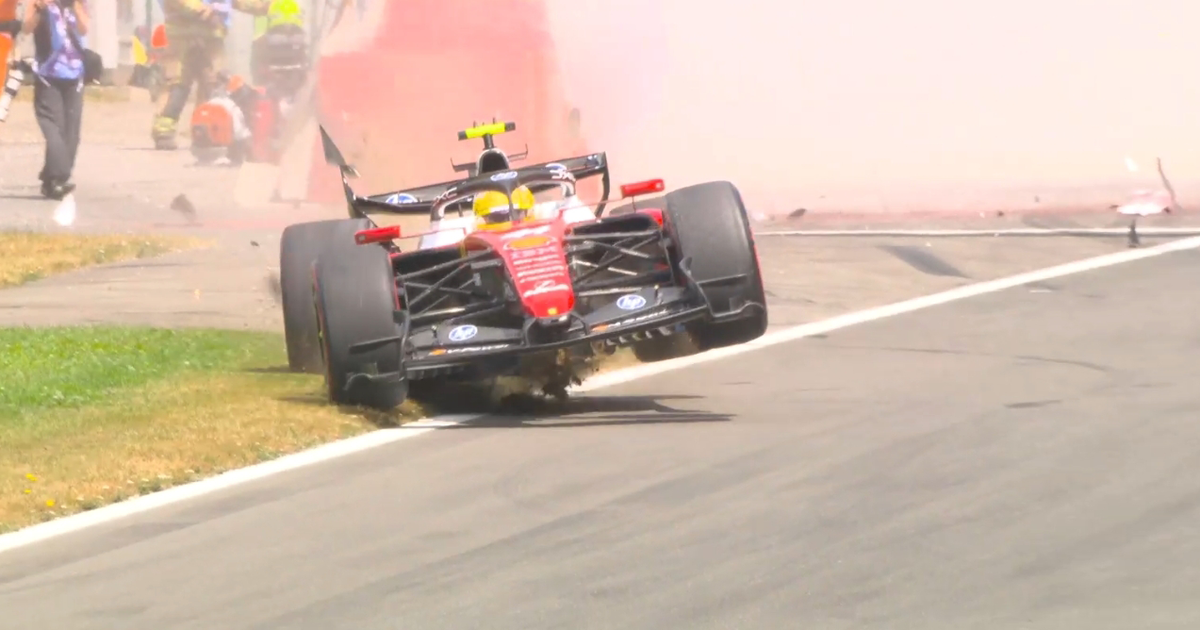
The radio call came a beat before the red flag. Lewis Hamilton, halfway through what should have been a final push lap in third practice at Spa-Francorchamps, ran wide out of the Fagnes chicane, flailed through the gravel and kissed the outside barrier with his right-rear wheel hard enough to rip the corner of his SF-26 apart. Yeah, I've destroyed the car, mate. I'm sorry.
His engineer's reply was calmer than the situation deserved: No problem.
That was the entire transcript of one of the more disorienting afternoons of Hamilton's 2026 season. By the time the rest of the field filtered back to the pit lane to begin qualifying preparations, the seven-time champion was still behind a trackside wall, watching the session tick down while his mechanics, somewhere down the paddock, were already being told they had until 3 p.m. local time to put a fully functional car underneath him. The clock, not the lap chart, became the day's primary competition.
The Fagnes Mistake and the Garage Clock
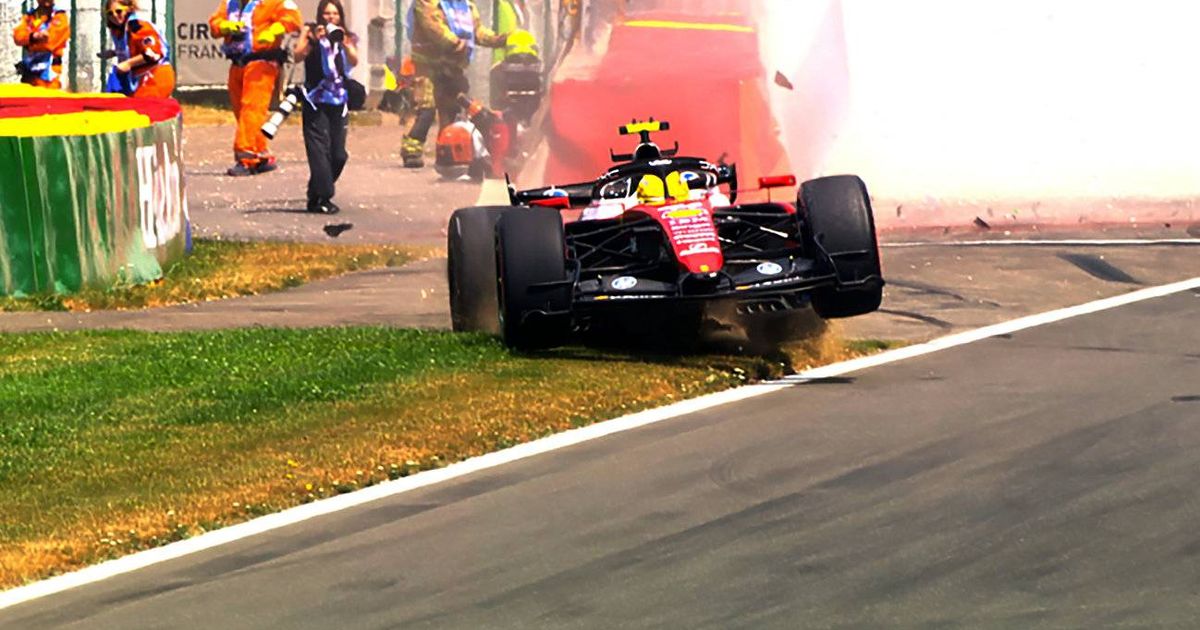
The crash itself was almost a frame-by-frame copy of Pierre Gasly's Friday shunt in the Alpine. Hamilton came off the slippery exit of the Fagnes chicane, the rear stepped out over the kerb, and instead of letting the car wind down he tried to keep throttle in. There was no grip to save him. The car slid across the gravel, the right-rear corner made contact, and the wheel assembly was left hanging on by its tether tethers. The rear wing was torn up. The suspension was gone. The session was over before the chequered flag.
Ferrari confirmed within the hour that the team believed it could have the #44 ready in time for qualifying, but the brief was brutal: rebuild the rear corner, replace the wheel and its assemblies, refit the suspension, and reset the bodywork — all while the rest of the grid was being marshalled through parc fermé. There was no margin for a re-fit mistake. There is no pit lane practice session between practice and qualifying at Spa.
What the Timing Sheet Actually Said
The cruelest detail of the afternoon is that Hamilton's pace was not the problem. Before the off, he sat P5, four-tenths clear of a rapidly-improving Kimi Antonelli at the top of the order and, more pointedly, ahead of Charles Leclerc in the sister Ferrari. On a single lap, in the car that had just been adjudged good enough for a genuine shot at the front rows, he was the faster of the two scarlet cars. That is the part that should keep Toto Wolff-adjacent strategists up at night on Ferrari's behalf, and the part that should keep Fred Vasseur awake for an entirely different reason.
The pace gave the story its texture. A driver who was four-tenths off the ultimate benchmark and ahead of his own team-mate does not normally need an apology. But the moment his rear clipped the wall, the timing sheet became academic. The chase switched from tenths to minutes, and the lap that mattered became the one that would not happen until well after the team had hauled his car back together.
Penalty Math and the Inherited Grid
The other story of the day is the reshuffling the grid is about to receive, regardless of what Ferrari manages to do. Defending champion Lando Norris carries a 10-place penalty into qualifying. Red Bull's Isack Hadjar and both Aston Martins — Fernando Alonso and Lance Stroll — are also sanctioned. The arithmetic, in other words, is unusually generous: even a middling qualifying lap from Hamilton, delivered from a clean car, could put him higher on the grid than his raw pace should earn.
That makes the repair window a leverage window. If Ferrari can put him out for the start of qualifying, and if the SF-26 keeps the pace that had it ahead of Leclerc before the crash, then Hamilton inherits a real shot at starting inside the top ten on a circuit where overtaking is famously possible, especially if Sunday's rain forecast materialises. If the crew cannot, the whole weekend collapses into a pit-lane start and a recovery drive through traffic.
A Rebuilt Season Meets a Familiar Spa Sting
The context only sharpens the embarrassment. Hamilton has, by any honest read, enjoyed a small revival in 2026. He ended a long win drought at the Spanish Grand Prix. His team-mate Leclerc broke out of his own funk at Silverstone a race later. The car, with its upgraded rear suspension, was supposed to be a credible top-three proposition on a power circuit like Spa. Instead, on the morning of qualifying, the most dramatic moment of the day is a single radio call and a half-mile tow job back to the garage.
Spa has not always been kind to him in recent years. Twelve months earlier, at the 2025 Belgian Grand Prix, Hamilton was knocked out in Q1 by a track-limits infringement at the same high-speed Raidillon complex that punishes over-commitment — the kind of error that, when repeated twelve months later through the Fagnes chicane in a different corner, suggests a circuit that simply refuses to let the same mistake pass twice in the same direction. The punishment at the chicane is more dramatic: a wheel on tethers, a body on a truck, and a team staring at a stopwatch.
The Hours Between
What happens next is no longer a driving question. The decision tree belongs to the mechanics, the engineers, and the spare-parts truck. Antonelli, fastest in FP3, has pole-position pace in his hand. Leclerc has the more reliable of the two Ferraris. Hamilton has, at most, an outside shot at salvaging a top-ten grid slot and the kind of wet-Spa afternoon that turned Verstappen's 2023 charge into a one-stop masterclass.
There is a particular kind of dread in a Formula 1 paddock when a championship-winning car is on a flatbed in the closing minutes of final practice, and a particular kind of relief when the rebuilt shell rolls out of the garage with minutes to spare. For Ferrari, the Saturday is not yet lost. But the margin for error is now measured in bolts, not in tenths — and on a circuit like this one, that is the most expensive currency a team can spend.
Sources
These sources formed the evidence pack for this article. Links open the original publisher; inclusion does not imply endorsement.
- expressnews.com original
- beaumontenterprise.com original
- bbc.com original
- racingnews365.com original
- americateve.com original
- grandprix247.com original
- Associated Press original