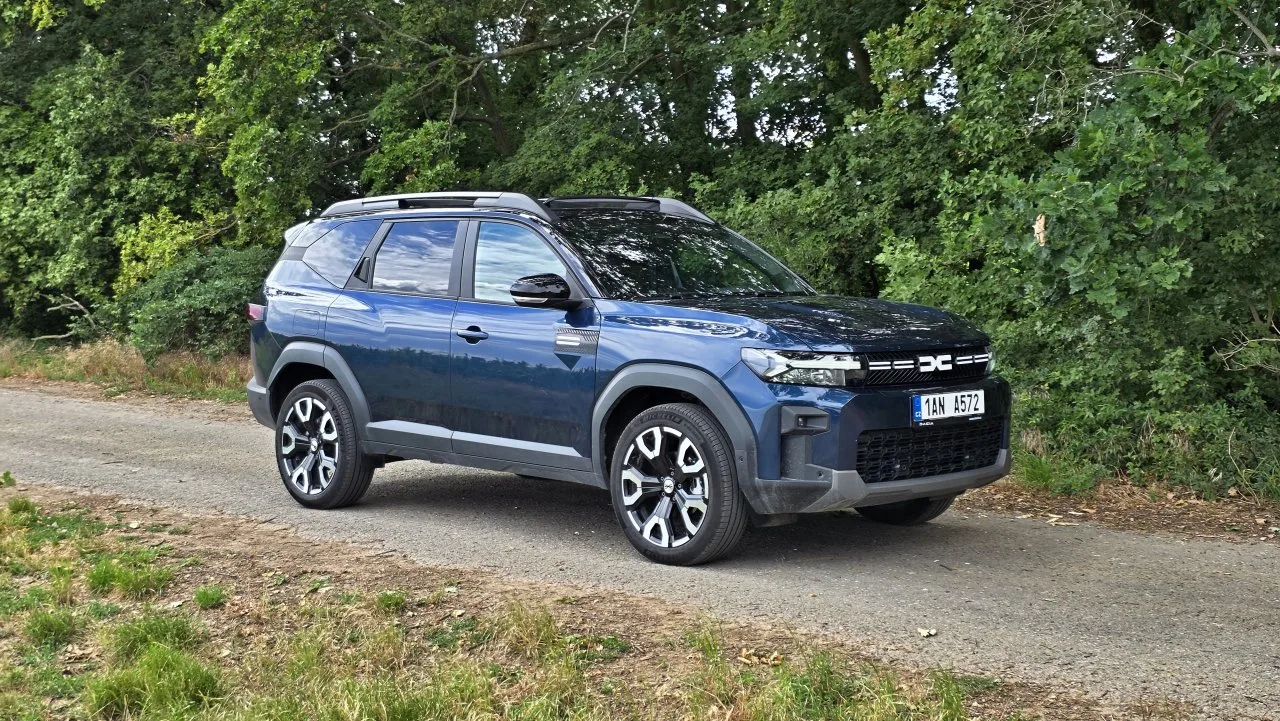
When Dacia expanded its footprint into the larger family SUV segment, it brought along a powertrain strategy designed to disrupt traditional cost structures without abandoning mechanical ambition. The result is the Dacia Bigster Hybrid-G 150 4x4—a vehicle occupying a lonely niche as one of the very few models on the market combining a full hybrid architecture, liquid petroleum gas capability, and all-wheel drive.
Measuring 4,570 mm in length with a 2,702 mm wheelbase, the Bigster dwarfs its sibling, the Duster. It capitalizes on its larger footprint to offer generous passenger volume and a standard boot capacity of 556 liters, expanding up to 1,856 liters with the rear seats folded flat. Yet, beneath this utilitarian packaging lies an intricate powertrain layout that demands careful scrutiny from buyers weighing long-term running costs against refinement.
The Mechanical Blueprint: Two Systems, Zero Mechanical Linkage
The core innovation of the Hybrid-G 150 4x4 variant lies in its complete absence of a traditional driveshaft connecting the front and rear axles. Up front, a 1.2-liter turbocharged three-cylinder engine handles petrol and LPG combustion, producing 103 kW (140 hp) and 230 Nm of torque. It drives the front wheels via a six-speed dual-clutch automatic transmission.
The rear axle operates independently via its own electric motor, which generates up to 23 kW and 87 Nm. This rear motor is paired with a dedicated two-stage transmission capable of completely decoupling the electric motor when all-wheel drive is unnecessary, thereby eliminating parasitic drag. Energy is supplied by a 48-volt lithium-ion battery with a 0.84 kWh capacity, replenished dynamically via regenerative braking. Combined, the system yields a total output of 113 kW (150 hp), pushing the SUV from 0 to 100 km/h in 10.4 seconds up to an electronically capped maximum speed of 180 km/h.
| Powertrain Component | Specification | Operational Role |
|---|---|---|
| Front Combustion Engine | 1.2L Turbo 3-cylinder (Petrol / LPG) | 103 kW / 140 hp, 230 Nm; drives front axle via 6-speed DCT |
| Rear Electric Motor | Dedicated Electric Drive | Up to 23 kW, 87 Nm; features 2-stage box for decoupling |
| System Battery | 48V Lithium-ion (0.84 kWh) | Regenerative energy capture and urban EV propulsion |
| Combined Output | Hybrid System | 113 kW / 150 hp total system performance |
Refinement Realities and Powertrain Trade-Offs
While the hardware configuration is clever, testing reveals that the complexity of blending multiple energy sources comes with distinct behavioral trade-offs. Reviewers note that the powertrain propulsion is not entirely smooth. Launch sequences can occasionally feel jagged, and the transition points where the internal combustion engine engages or disengages during transit are perceptible.
The dual-clutch automatic transmission compounds this at lower speeds, where gear selections lack absolute seamlessness. However, once the vehicle gains momentum on open roads or highways, the mechanical dialogue softens into a more relaxed character. Reviewers observe that the chassis is tuned for comfort rather than dynamic cornering agility, soaking up road irregularities capably despite wearing large 19-inch wheels on top-tier trims like the Journey.
The Economics of Dual-Fuel Range
The true justification for the Hybrid-G setup emerges at the fuel pump. Equipped with a 50-liter petrol tank and a matching 50-liter LPG tank, the Bigster boasts an immense theoretical combined driving range approaching 1,500 kilometers, though real-world routing routinely clears the 1,000-kilometer mark without strain.
Driver operation requires deliberate manual input. Unlike factory setups that automate fuel transitions entirely, the Dacia system requires the driver to engage LPG via a physical dashboard switch explicitly. Testing disparities highlight the consumption delta: driving exclusively on petrol yields an average economy between 5.5 and 6.5 liters per 100 kilometers, whereas switching to LPG increases volumetric consumption to roughly 7.0 to 8.5 liters per 100 kilometers depending on the testing cycle and highway velocities. Despite the higher volume burned on gas, the lower price point of LPG preserves the economic advantage.
Off-Road Competence and Terrain Control
Away from paved surfaces, the electronic four-wheel-drive system punches above its weight class. Supported by a ground clearance of approximately 219 mm and a Terrain Control rotary selector featuring snow, mud, sand, and "Lock" modes, the vehicle intelligently apportions torque between the front combustion unit and rear electric motor. Even if individual wheels lose purchase or briefly leave the ground, the electronic architecture manages traction efficiently, though its longer wheelbase and reduced departure angles relative to the Duster require greater vigilance in severe terrain.
Market Positioning
Pricing for the Bigster Hybrid-G 150 4x4 starts at 699,900 CZK for the Expression trim, while the road-focused Journey and adventure-oriented Extreme specifications both command 750,900 CZK. For families prioritizing cabin space, long-distance touring range, and low operating costs over silk-smooth powertrain transitions, Dacia’s ambitious hybrid-gas crossover carves out a pragmatic, highly distinct space in the mid-size SUV landscape.
Sources
These sources formed the evidence pack for this article. Links open the original publisher; inclusion does not imply endorsement.
- auto-mania.cz original
- fdrive.cz original
- dacia.de original
- sauto.cz original