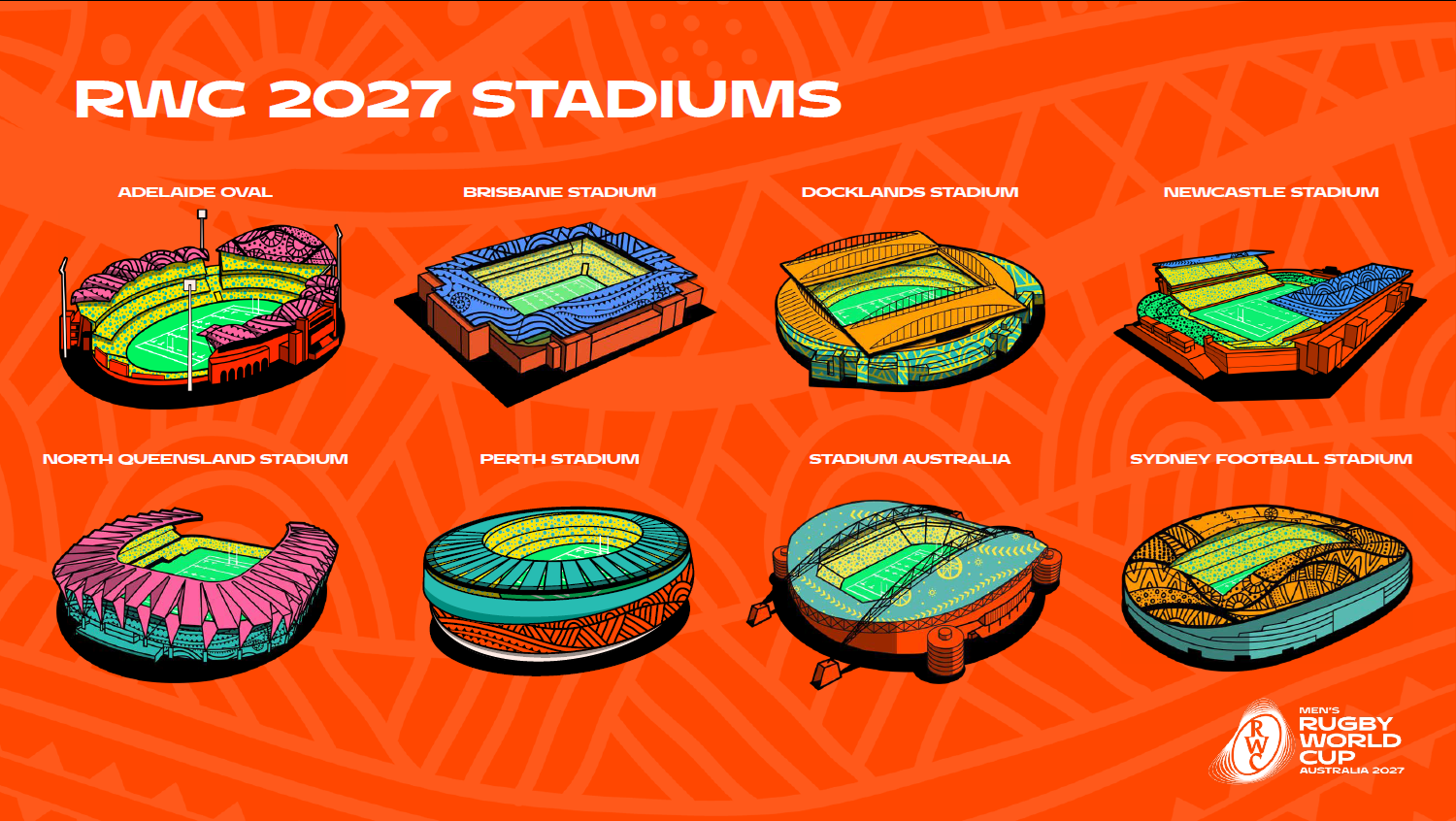
When Australia opens the 2027 men's Rugby World Cup against Hong Kong on October 1, 2027, the occasion will mark a structural shift for international rugby union. Expanding from 20 to 24 teams, the tournament spans 52 matches across seven host cities over six weeks, targeting a combined attendance of 2.5 million spectators alongside 250,000 international visitors. Tournament managing director Chris Stanley and organizing authorities have finalized a venue distribution model that balances top-tier metropolitan stadiums with regional outposts making their World Cup debuts.
Because the men's Rugby World Cup generates roughly 90 percent of World Rugby's operating revenue for each four-year cycle, the footprint is designed to balance broad ticket accessibility with maximum yield from corporate hospitality and premium seating. Organizers restricted the host network to eight purpose-fit stadiums across the country to concentrate crowds, streamline team logistics, and ensure high venue utilization throughout the expanded group stage.
Metropolitan Scale and the Two-Venue Sydney Anchor
Sydney serves as the operational center of the tournament, using two distinct grounds to host 13 total fixtures. Stadium Australia in the city's west, purpose-built as the 80,000-seat centerpiece of the 2000 Olympic Games, anchors the late stages. The venue will host eight fixtures, including two pool matches, two quarter-finals, both semi-finals, the third-place play-off, and the final on November 13. By staging its second World Cup final, Stadium Australia joins Auckland's Eden Park, London's Twickenham, and Paris's Stade de France as the only venues to host the men's final twice.
In central Sydney, the 42,500-capacity Sydney Football Stadium at Moore Park provides an urban contrast. Rebuilt in 2022 on a site used for sport since 1903, the venue will hold three pool matches—highlighted by the Pool A meeting between Australia and New Zealand on October 9—along with two round-of-16 knockout ties.
Perth's Western Opener and Melbourne's Guaranteed Roof
The tournament begins on the western coast. Perth Stadium, a 60,000-seat arena opened along the Swan River in 2018, will host the opening match between Australia and Hong Kong on October 1. Perth will stage seven matches overall, comprising five pool fixtures featuring teams such as New Zealand, Ireland, and the United States, plus two round-of-16 games.

In Melbourne, organizers selected the 53,000-capacity Docklands Stadium over the 100,000-seat Melbourne Cricket Ground, which had prior commitments including a September NFL regular-season game. Docklands Stadium offers a climate-controlled environment, with its retractable roof set to remain closed for all eight assigned fixtures. The roofed arena will stage six pool matches and two round-of-16 encounters featuring France, New Zealand, and Ireland.
Heavy Knockout Duty in Brisbane and Adelaide's Historic Return
Brisbane Stadium emerges as the workhorse venue of the tournament outside Sydney, hosting 10 matches—the highest individual tally of any stadium. Known historically as Lang Park, the 52,500-seat venue will stage six pool matches, beginning with England against Tonga on October 2, followed by two round-of-16 matches and two quarter-finals.
Adelaide Oval returns to the World Cup hosting rotation after featuring in earlier tournaments. Staging continuously since 1873, the 53,500-capacity ground will host six pool matches, headlined by defending champions South Africa opening their title defense against Italy.
Regional Debuts and Commercial Ticket Structure
To widen rugby's domestic footprint beyond state capitals, two regional venues are staging Rugby World Cup matches for the first time. North Queensland Stadium in Townsville, a 25,000-seat facility opened in 2020 featuring a roof design inspired by the native pandanus plant, will host four pool matches featuring Tonga, Canada, Georgia, and Spain. Meanwhile, the 30,000-capacity Newcastle Stadium, situated two hours north of Sydney, will host four pool matches featuring Japan, Fiji, Italy, and Samoa.

| Stadium | City | Capacity | Match Allocation | Key Fixtures |
|---|---|---|---|---|
| Stadium Australia | Sydney | 80,000 | 8 Matches | Final, Both Semi-Finals, 3rd Place, 2 QFs |
| Brisbane Stadium | Brisbane | 52,500 | 10 Matches | 2 Quarter-Finals, 2 Round-of-16, 6 Pool Games |
| Docklands Stadium | Melbourne | 53,000 | 8 Matches | 2 Round-of-16, 6 Pool Games (All under closed roof) |
| Perth Stadium | Perth | 60,000 | 7 Matches | Tournament Opener (Aus v HK), 2 Round-of-16, 4 Pool Games |
| Adelaide Oval | Adelaide | 53,500 | 6 Matches | South Africa v Italy (Title Defence Opener), 5 Pool Games |
| Sydney Football Stadium | Sydney | 42,500 | 5 Matches | Australia v New Zealand, 2 Round-of-16, 3 Pool Games |
| Newcastle Stadium | Newcastle | 30,000 | 4 Matches | Pool Stage Debut (Japan, Fiji, Italy, Samoa) |
| North Queensland Stadium | Townsville | 25,000 | 4 Matches | Pool Stage Debut (Tonga, Canada, Georgia, Spain) |
The ticketing layout reflects the commercial targets required by World Rugby. Organizers set aside one million tickets priced under $100 to sustain domestic attendance, while 750,000 tickets were absorbed across initial presales. Top Category 1 tickets for major pool games—including Australia vs. New Zealand, England vs. Wales, and Ireland vs. Scotland—were priced at $635. Category 1 seats for the final at Stadium Australia were set at $1,950, surpassing the top-tier €950 ($1,537) price point established at the 2023 final in France.
blockquote>From iconic national arenas to vibrant regional hubs, each venue has been chosen for its ability to deliver world-class facilities and electric atmospheres that will showcase the very best of our game.
Evidence-Led Forecast: Ticketing Demand and Venue Logistics
With main public ticket releases approaching, ticket absorption across the eight venues will test the commercial appetite for an expanded 24-team footprint. High-demand metropolitan matches in Sydney, Brisbane, and Perth are projected to sell out rapidly during presale windows, driven by established local spectator bases and visiting international supporters.
The primary uncertainty lies in regional venue fill-rates for non-tier-one pool clashes in Townsville and Newcastle. However, by capping venue capacities at 25,000 and 30,000 in those regional centers, organizers have minimized the risk of low density, ensuring compact crowds and controlled operational overheads before the tournament shifts focus exclusively to Brisbane and Sydney for the quarter-finals onward.
Sources
These sources formed the evidence pack for this article. Links open the original publisher; inclusion does not imply endorsement.
- theguardian.com original
- uk.sports.yahoo.com original
- ecr.co.za original
- bbc.com original