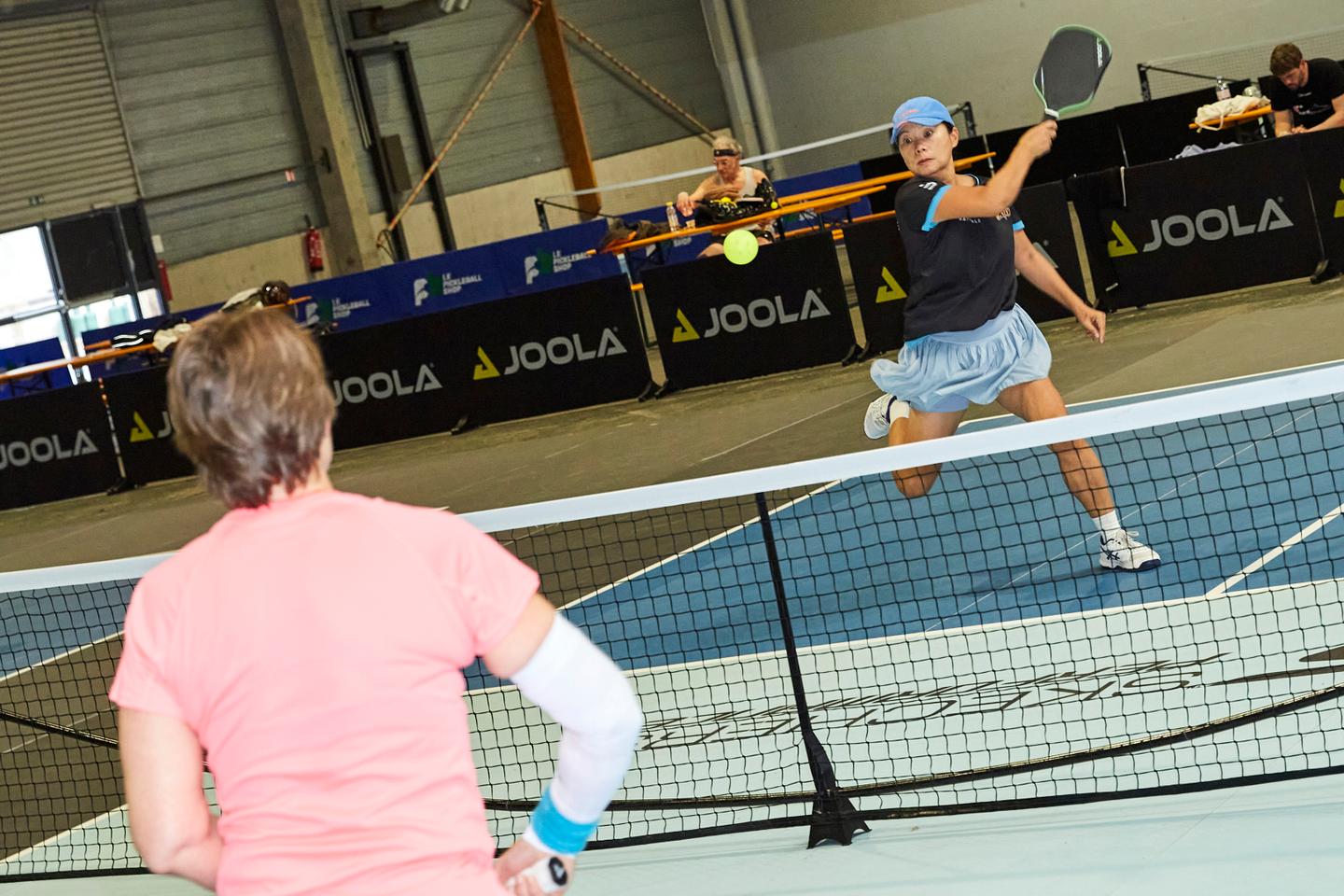
The distinctive, rapid rhythm of hollow plastic meeting solid paddles—a steady pop-pop-pop-pop-pop—is reverberating across French racket sports facilities. From dedicated urban halls near Paris’s Porte de La Villette to community facilities at the Tennis Club of Saint-Zacharie, local venues are making room for North America’s fastest-growing racket discipline. As padel maintains an aggressive expansion rate of 5,000 new licensed players monthly under the Fédération Française de Tennis (FFT), pickleball is establishing itself as a low-capital, high-density alternative for clubs seeking to maximize court usage.
The Conversion Math: €10,000 vs. €800,000
For regional club administrators operating under strict facility budgets, the structural math behind pickleball court deployment is compelling. A single standard tennis court footprint can accommodate up to four pickleball courts, each measuring precisely 6.1 meters by 13.41 meters. This spatial footprint allows venues to quadruple playing capacity without acquiring additional land.
At the Tennis Club of Saint-Maurice-de-Beynost in the Ain department, facility managers repurposed an existing tennis court into three dedicated pickleball courts—configuring one outdoor playing surface directly in front of two covered courts. The conversion required an investment of €10,000. By contrast, constructing brand-new dedicated padel courts in the area demanded an investment of €800,000.
— Patrick Luquet, member of Tennis Club de Saint-Maurice-de-Beynost
Here is the first court, and behind it there are two others that are covered. This is going to enormously transform the club in terms of its usage and operation.
By monetizing these repurposed spaces through hourly court rentals, the Saint-Maurice-de-Beynost club aims to double its active membership within a single year, capitalizing on open access schedules that do not require players to bring pre-arranged opponents.

Technical Access and the Low-Friction Game
Invented in the United States during the 1960s, pickleball relies on lowered physical and technical barriers compared to traditional tennis. Played with solid, flat paddles and a perforated plastic ball over a tennis-height net on badminton-sized court dimensions, the equipment drastically dampens pace while encouraging immediate, rally-based play.
While singles competition exists within the sport's framework, doubles stands as the primary tactical format, emphasizing court positioning and soft-touch kitchen play over pure baseline power.
— Yann Chapotton, Tennis Coach
If you've played tennis before, you see that tennis is already a great sport, but technically it is difficult. In pickleball, the balls have holes, it's easier to play. You have fun fairly quickly. In tennis, children can throw fits quite quickly, whereas here, no.
Federal Integration and Governance
Pickleball’s integration into the French sporting landscape reached a formal institutional milestone when the FFT secured official ministerial delegation for the sport in early 2026. This administrative recognition formally integrated pickleball alongside tennis, padel, beach tennis, and paratennis, bringing six distinct disciplines under the federal umbrella.
The administrative structure quickly established a competitive pathway, crowning the inaugural French Pickleball Champions in Aix-en-Provence. For regional governing bodies, the addition of pickleball represents an inclusive expansion strategy rather than a displacement of traditional tennis fundamentals.
— Florence Pocheron-Luyat, President of the Ain Tennis Committee
Tennis remains our backbone. There are already six types of rackets within the French Tennis Federation. These sports allow us to open up to the greatest number of people—it's sport everywhere and for everyone.
Forecast: Grassroots Expansion and Court Allocation Trade-offs
Tactical Pattern: Municipal and private tennis clubs will increasingly prioritize partial court conversions over high-cost infrastructure builds. Converting under-utilized outdoor tennis courts into multi-court pickleball layouts offers instant surface density and higher hourly rental yields.

Decisive Operational Matchup: The friction between peak-hour court allocation for traditional tennis membership leagues versus high-turnover public pickleball rentals. Clubs that establish hybrid booking windows will maximize financial returns without alienating traditional tennis memberships.
Strongest Counter-Case: Community noise complaints regarding the distinct contact sound of hard paddles hitting perforated plastic balls in residential areas, alongside potential resistance from traditional tennis purists opposing court repainting.
What Would Change the Read: A shift in FFT capital distribution directing heavy grants toward standalone padel or pickleball facilities, or an inability of converted regional clubs to hit projected member-doubling targets through hourly drop-in play.
Sources
These sources formed the evidence pack for this article. Links open the original publisher; inclusion does not imply endorsement.
- france3-regions.franceinfo.fr original
- lemonde.fr original
- mapressedujour.com original
- fft.fr original