Related coverage
View the Instagram post
At Spa-Francorchamps, the longest lap on the Formula 1 calendar is not just a geometry problem. It is a tyre problem, a tow problem, and at this year's Belgian Grand Prix it became a title problem. Kimi Antonelli converted his sixth pole of 2026 into a sixth victory on Sunday, but the route from grid to trophy was anything but linear. A first-corner shunt between George Russell and Lewis Hamilton redrew the strategic map. A Lap 20 virtual safety car, called to clear debris at Blanchimont, gave that map to Charles Leclerc. And the 14 laps it took Antonelli to retrieve the lead he had effectively lost were the most revealing stretch of his season.
The strategic map before a wheel turned
Forty-four laps of Spa-Francorchamps is roughly 308 kilometres, the longest single lap distance on the calendar. Pirelli brought the medium, hard and soft compounds, but the consensus in the paddock was that the medium was the launch tyre. Most of the field started on it, committing each car to a two-stop race, with a hard-tyre second stint the most likely route to the flag. The exceptions were deliberate. Lando Norris, whose new battery had already cost him a 10-place grid drop, and Isack Hadjar went long on the hard to gamble on track position and undercut leverage. It was a sensible play for two drivers starting outside the top ten on raw pace. It was the kind of trade-off that turns a 44-lap race into a tyre-window contest rather than a sprint.
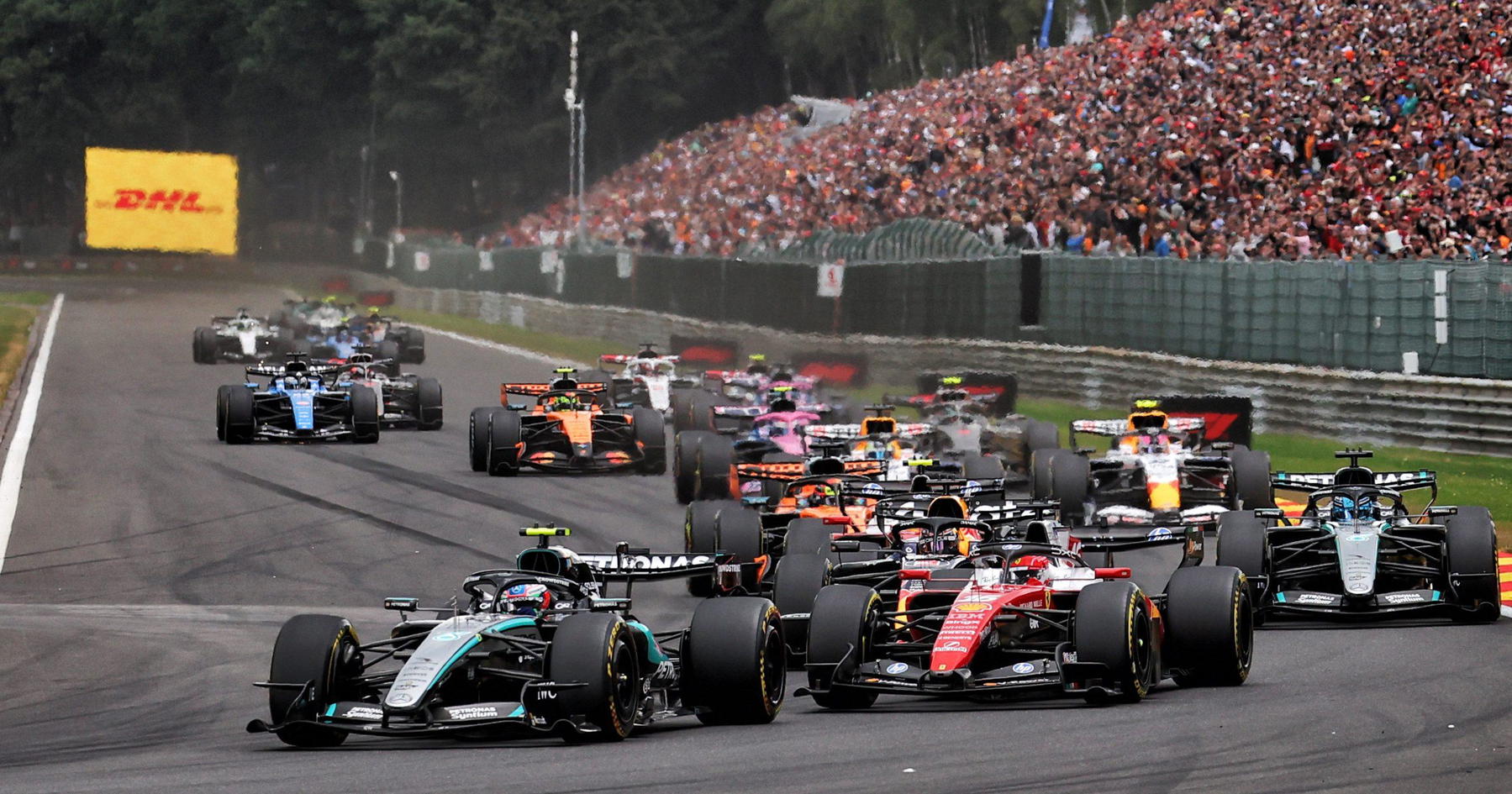
Antonelli, by contrast, had the simplest brief. Lead into Les Combes, control the tyre delta and convert track position into clean air. Max Verstappen's run to Eau Rouge briefly threatened that script, with the Red Bull using a stronger tow to grab the lead on the exit of La Source, but the Mercedes re-passed on the Kemmel straight run to Turn 5 and never looked seriously troubled in the early going. Or so it seemed for about 1,100 metres of the opening lap.
The collision that ended a championship push
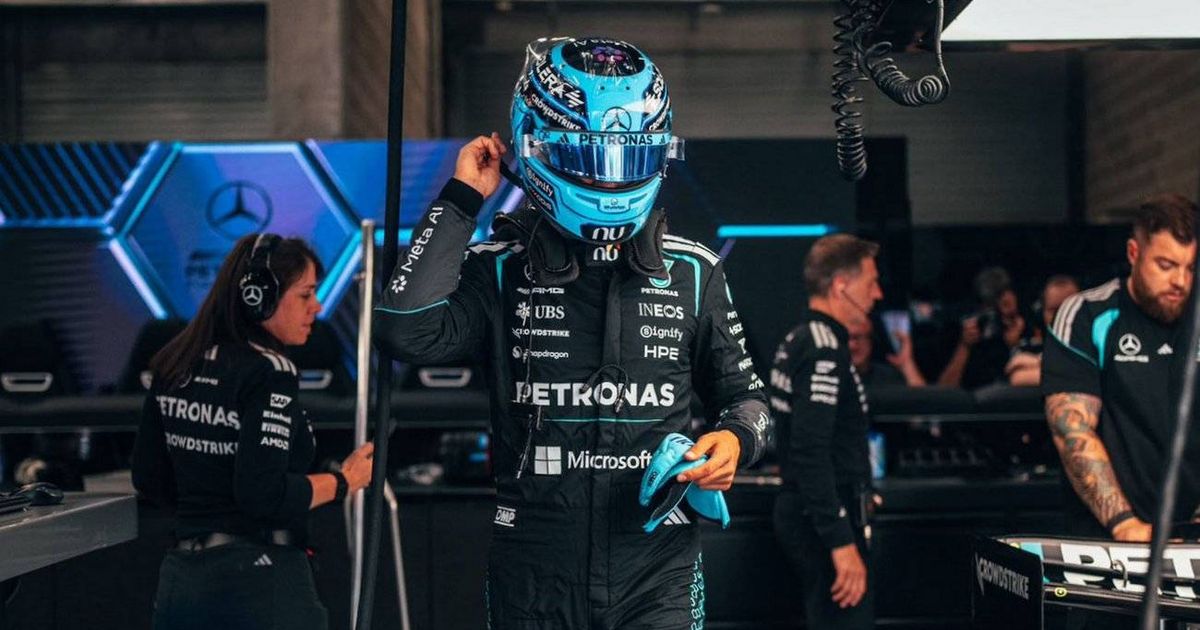
Russell started third, promoted from fourth after Norris's penalty, and arrived at Turn 5 with a sniff of the lead fight. He left the corner in the gravel. The sequence, captured from multiple angles and replayed by the Sky Sports F1 cameras, was ugly and brief: Russell, passed by several cars on the straight, attempted to go around the outside of Hamilton. Hamilton clipped the Mercedes, the car snapped sideways and beached itself on the inside. The stewards handed Hamilton a five-second time penalty for his part in the contact. Russell, understandably, framed it differently.
“I just got totally swallowed up down the straight and lost three positions but a racing incident. Just very disappointed.”
George Russell, Sky Sports F1
The result was two-fold and it landed hardest in the constructors' room. Antonelli's lead in the championship, already 25 points, doubled in race-winning space. The 25 points Russell would have taken from the lead group stayed in the car. The incident also carried a quieter subtext: Russell had arrived at Spa publicly baffled by a half-second gap to his team-mate in qualifying, and the silver car he lost in the gravel was already a compromised one. Whatever the engineering cause of that deficit, the championship math just stopped needing it to be solved this weekend.
The VSC and the trade-off it forced
After the safety-car restart, the race settled into a five-car breakaway: Antonelli, Leclerc, Verstappen, Oscar Piastri and Hamilton. Verstappen made a brave move stick on Leclerc through Eau Rouge, briefly lifting himself to second, but the strategic levers were already in motion. Verstappen was first into the pits, on Lap 17, for the hard Pirelli that Red Bull hoped could carry him home. Antonelli covered on the following lap, which left Ferrari holding the longest first stint and needing a break to convert it. The break came on Lap 20.
A virtual safety car for debris at Blanchimont compressed the pit-loss window, and both Ferrari and Hamilton dived in. Leclerc emerged in the lead of the race. Antonelli was caught behind Norris, who had not yet stopped, and Antonelli spent six laps clearing the McLaren before he had Leclerc in his mirrors. By the time the order was Antonelli, Leclerc, Verstappen with Hamilton nursing a 5-second penalty and a damaged Ferrari, the race had become a different problem. It was no longer a tyre-saving contest. It was a hunt.
“We had a little bit of luck, obviously with the VSC at the right time for us. But the pace was relatively strong. There have been some 5, 6 laps on the hard where I’ve been struggling with the front axle. And then it came back a little bit. I felt better with the car.”
Charles Leclerc
Leclerc held a three-second margin once Norris had been cleared, but the front-axle struggle he described was a window, not a wall. Antonelli closed it methodically, was baulked briefly by Valtteri Bottas's Cadillac through Turn 15, and then broke past into Turn 5 on Lap 34. From there, the Italian managed the gap above the one-second threshold where a fightback becomes possible, and the podium order settled: Antonelli, Leclerc, Verstappen. Hamilton took fourth on the road, but the Ferrari left the pits under a post-race investigation for an unsafe release that struck a mechanic. The classification was provisional.
The reliability ledger that finally closed
It is easy to forget, watching a car cruise to a controlled win, how close Mercedes came to a different afternoon. Antonelli had not won since Monaco on June 7, a three-race run that included reliability retirements in Barcelona and Silverstone while chasing Ferraris. The British Grand Prix, in particular, had been cruel: Antonelli was the fastest car on track until the car stopped. Toto Wolff had arrived at Spa urging his team to convert pace into points. On Sunday, the W17 did the only job that mattered.
“It was a hard-fought race. You know, we lost obviously the first place with the Virtual Safety Car. But then we managed to make our way back and yeah, it was a tough win because Charles was quick and we had to hold on to that.”
Kimi Antonelli
For Verstappen, the podium was a quieter kind of progress. Red Bull's race was shaped by the same VSC that cost them track position to Ferrari, and Verstappen's post-race assessment was the one a podium finish in a difficult weekend usually produces.
“I tried everything I could in the race. I mean, the first stint wasn’t too bad, second stint probably a little bit more difficult. But at the same time also I think Kimi and I, we got a little bit unlucky with the VSC as well. So I think for us to be on the podium is very good.”
Max Verstappen
The Russell mystery and the title it has paused
The strategic story of the Belgian Grand Prix was ultimately a question of how each team converted tyre choice and track position into the late-race window. But the strategic story of the season, and the reason Russell was 25 points back going in despite sitting in identical machinery, remained unsolved. In qualifying, Russell had been half a second adrift, with Mercedes first blaming driving style through the energy-harvesting sections and then changing the approach at Spa. The conclusion Russell offered on Saturday was unsparing.
“We have changed everything. There were four tenths on the straights in Q3. It’s frustrating. Every single lap I’ve come in this weekend and seen anywhere from two tenths to four tenths to five. In FP2, it was seven tenths. The team are working so hard to understand what it is.”
George Russell
Russell added that he was “battling with one hand behind your back.” Toto Wolff confirmed Mercedes had identified losses both in the corners and on Spa's long straights, but had not yet produced a definitive explanation. With Russell beached on Lap 1, the issue went untested in the race. Hungary will be the next chance to confirm whether the deficit is a car, a calibration or a calibration that has simply not been applied to one side of the garage.
The numbers behind the title swing
The provisional championship order at the halfway mark reflects both the race result and the timing of the post-race investigations. Antonelli sits on 204 points, a 45-point buffer to Hamilton, who provisionally moves to second with 159. Russell, classified a non-finisher, drops to third on 154. Three retirees, including Lance Stroll (potential gearbox issue) and Sergio Perez (suspension), meant the points were compressed upward in places it rarely is. Gabriel Bortoleto took eighth for Audi, equalling the manufacturer's best Formula 1 result, with Arvid Lindblad and Franco Colapinto rounding out the top ten.
What the Belgian Grand Prix actually changed, beyond the trophy, was the shape of the next nine races. Antonelli's lead is no longer a buffer that a single bad afternoon can erase. Hamilton's second place, pending the unsafe-release verdict, is the first time this season the seven-time champion has sat ahead of Russell in the standings. And Russell's deficit, whatever its mechanical cause, will follow him to Budapest in a car that has, on raw pace, no business being a second per lap off its sister. The strategic story of Spa is closed. The strategic story of the second half of 2026 has just been written, and it starts with a question only Mercedes can answer.
Sources
These sources formed the evidence pack for this article. Links open the original publisher; inclusion does not imply endorsement.
- Fraser Masefield original
- racingnews365.com original
- au.motorsport.com original
- grandprix247.com original
- Daniel Moxon original
- Sam Hall original
- PA original