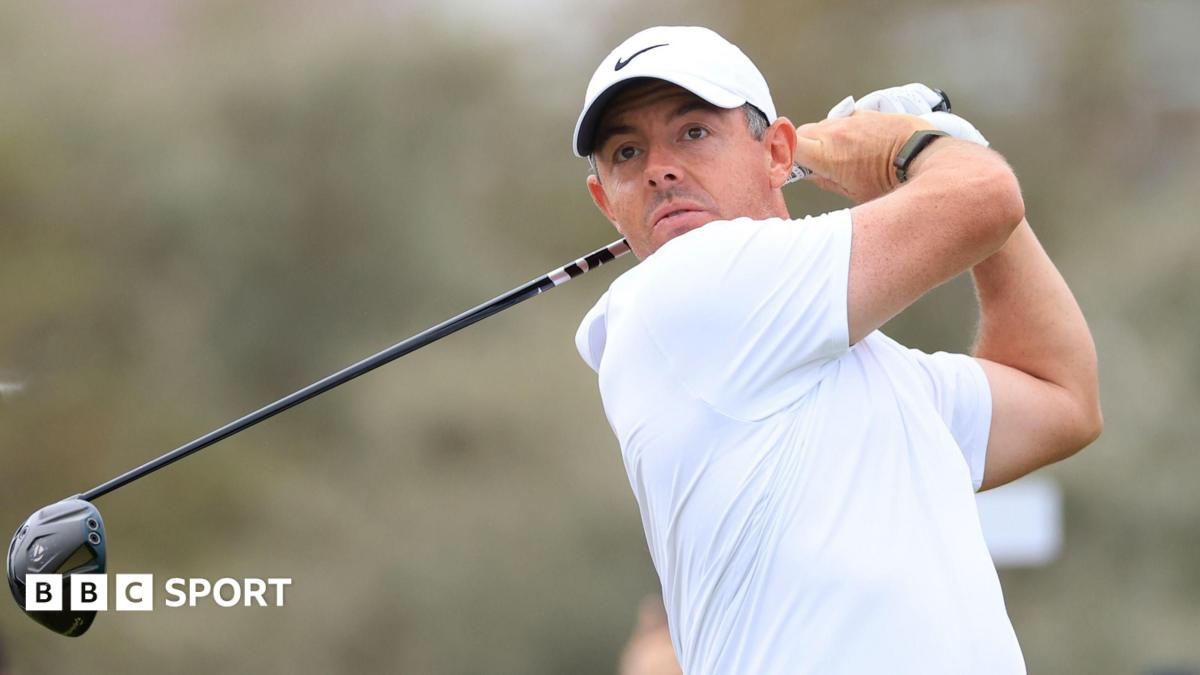
Professional golf rarely operates in a vacuum of clean scorecards and silent galleries. When friction arises, it frequently exposes the fault lines between individual showmanship and the collective rhythm of a major championship. At Royal Birkdale, those underlying tensions boiled over into the late-evening shadows, pitting world number two Rory McIlroy directly against the polarizing presence of Bryson DeChambeau.
The catalyst arrived on Friday evening during the second round, when DeChambeau found himself embroiled in heated, protracted discussions with R&A rules officials. The two-time US Open champion was assessed a two-stroke penalty for inadvertently improving his lie after appearing to trample down long grass close to his ball near the fifth hole. The penalty transformed what initially looked like a promising seven-under finish into a five-under reality, dropping him from one stroke off the lead to three back.
More disruptive than the stroke adjustment itself, however, was the logistical gridlock that followed. The lengthy deliberations and a subsequent return trip to the scene of the infraction forced a ripple effect across the tournament schedule, delaying the release of Saturday morning's tee times.
“All the uncertainty last night delayed the tee times,” McIlroy reflected, capturing the frustration shared across the locker room. “The whole process was delayed by what Bryson DeChambeau did and the way he behaved and I know a lot of pros that wanted to get to bed but couldn't until they knew.”

For McIlroy, whose own career trajectory reflects an organic ascent—from a young prodigy guided by Michael Bannon to a six-time major champion who recently secured back-to-back Masters titles and a spot in the UK financial rich lists with a £325m fortune—the incident crossed a line from competitive focus into performative distraction.
“I won't pretend to defend Bryson,” McIlroy stated bluntly. “I'm not particularly fond of him. I think a lot of it's performative. I think a lot of it's for attention. To hold the tournament hostage like that, and to have all of us, players, volunteers, everyone waiting on him to depart, I didn't feel like it was a great look.”
While DeChambeau took to social media—posting a defiant message on X declaring the ordeal "fired" him up and sharing a doctored Instagram image of himself levitating above the rough—the officiating body stood firm. R&A chief executive Mark Darbon defended the sanction as an "unfortunate decision but really clear-cut from a rules perspective," while acknowledging the heavy emotion surrounding the late-night showdown.

Meanwhile, other contenders navigated the fallout with calculated diplomacy. World number one Scottie Scheffler admitted he held strong opinions on the spectacle, noting, “Actually, I do have a ton to say. I haven't decided exactly what I want to say publicly yet,” before choosing to redirect his energy toward his third-round play.
Sam Burns, who carded a brilliant 65 during Saturday's third round to seize a two-stroke lead at nine under par, maintained a sympathetic view of his erstwhile playing partner despite admitting they did not discuss the penalty. “I feel bad for Bryson,” Burns remarked. “From my perspective, I didn't feel like maybe there was enough evidence for him to deserve a penalty.”
Yet McIlroy's core critique circled back to the inherent nature of golf as a self-policing enterprise. In a sport where millions of untelevised shots pass without external adjudication, the ubiquity of broadcast cameras creates an uneven landscape of accountability. But when high-definition evidence forces an official intervention, the resulting theatricality places the burden directly back on the field.
As the championship progresses toward its conclusion with Burns leading the charge and players like Fleetwood, MacIntyre, Scheffler, and a defiant DeChambeau packed tightly into the mix, the lasting memory of Royal Birkdale's midpoint may well be less about the strokes gained on the card and more about the hours lost to the clock.
Sources
These sources formed the evidence pack for this article. Links open the original publisher; inclusion does not imply endorsement.
- bbc.co.uk original
- rorymcilroy.com original
- bbc.com original
- linkedin.com original