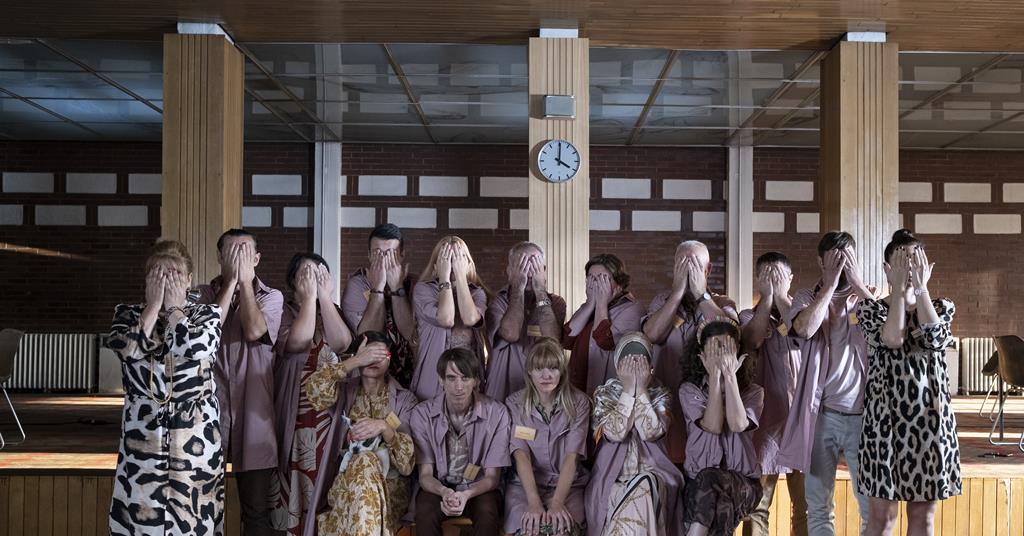
The architecture of a cinematic confrontation rarely relies on open battlefields. Instead, as Macedonian director Teona Strugar Mitevska demonstrates in The Happiest Man in the World—which served as Macedonia’s Oscar entry and screened in the Dealing With the Past programme of the Sarajevo Film Festival—trauma often festers in sterile, enclosed spaces. The film unfolds inside a labyrinthine Sarajevo hotel hosting a dating event titled Touch of Happiness. Promoted through a corporate philosophy urging participants to remember love and their need to share, the gathering quickly strips away its innocuous speed-dating veneer. Underneath the polite icebreakers about seasonal preferences and favorite colors bubbles a sharp, suffocating undercurrent of suspicion.
Sarajevo carries the heavy architectural and psychological weight of a city besieged for 1,425 days by Serb forces during the 1990s Bosnian War. Mitevska’s narrative seizes upon these unhealed collective wounds, asking a punishing question: What would a laboratory for reconciliation actually require when invisible lines still divide the capital's inhabitants? The rules of engagement shift unpredictably, leaving participants to voice discomfort at feeling like test subjects in an uncomfortable social experiment.
The claustrophobia intensifies as attendees don mandatory uniforms featuring sickly pink and green color schemes designed to manufacture artificial cohesion. While the clothes match, the personal histories of the attendees clash violently. The emotional core zeroes in on a single pairing:
- Asja: A 45-year-old legal adviser portrayed with tough, compassionate resilience by Jelena Kordić Kuret, who navigates a fractured identity as the child of a Serb Orthodox mother and a Muslim father.
- Zoran: A 43-year-old bank worker played with palpable, on-edge intensity by Adnan Omerović.
Initially finding common ground in their preliminary answers, the pairing shatters when Zoran confesses his past. During the war, he served for three years in the Army of the Republika Srpska, shooting at the very city he now inhabits. Worse still, he suspects he may have hit and injured Asja while she lived near the frontline under constant sniper fire. Mitevska deploys effective visual and aural approximations to recreate the visceral shock of trauma and flashbacks. The psychological divergence between the two leads is stark: Asja's desired superpower is to read thoughts and understand, while Zoran's is amnesia. Mitevska resists turning Zoran into a simple, sympathetic villain molded by herd mentality, holding him to account while examining his heavy immobilization by shame and self-loathing.
Director of photography Virginie Saint Martin’s camera traps the characters indoors, anchoring scenes in hotel rooms named after Swiss cities like Zurich and Basel that offer zero illusion of neutrality or affluent security. The resulting dislocation manifests in hallucinatory breaks from reality, managed through choreographed group performances. Yet, physical movement offers a path toward liberation; as scars tear open, Asja dances for release before the film concludes with a lingering, oil-painting-esque shot over the darkening Sarajevo skyline.
Sources
These sources formed the evidence pack for this article. Links open the original publisher; inclusion does not imply endorsement.
- knihydobrovsky.cz original
- thefilmverdict.com original
- dictionary.com original