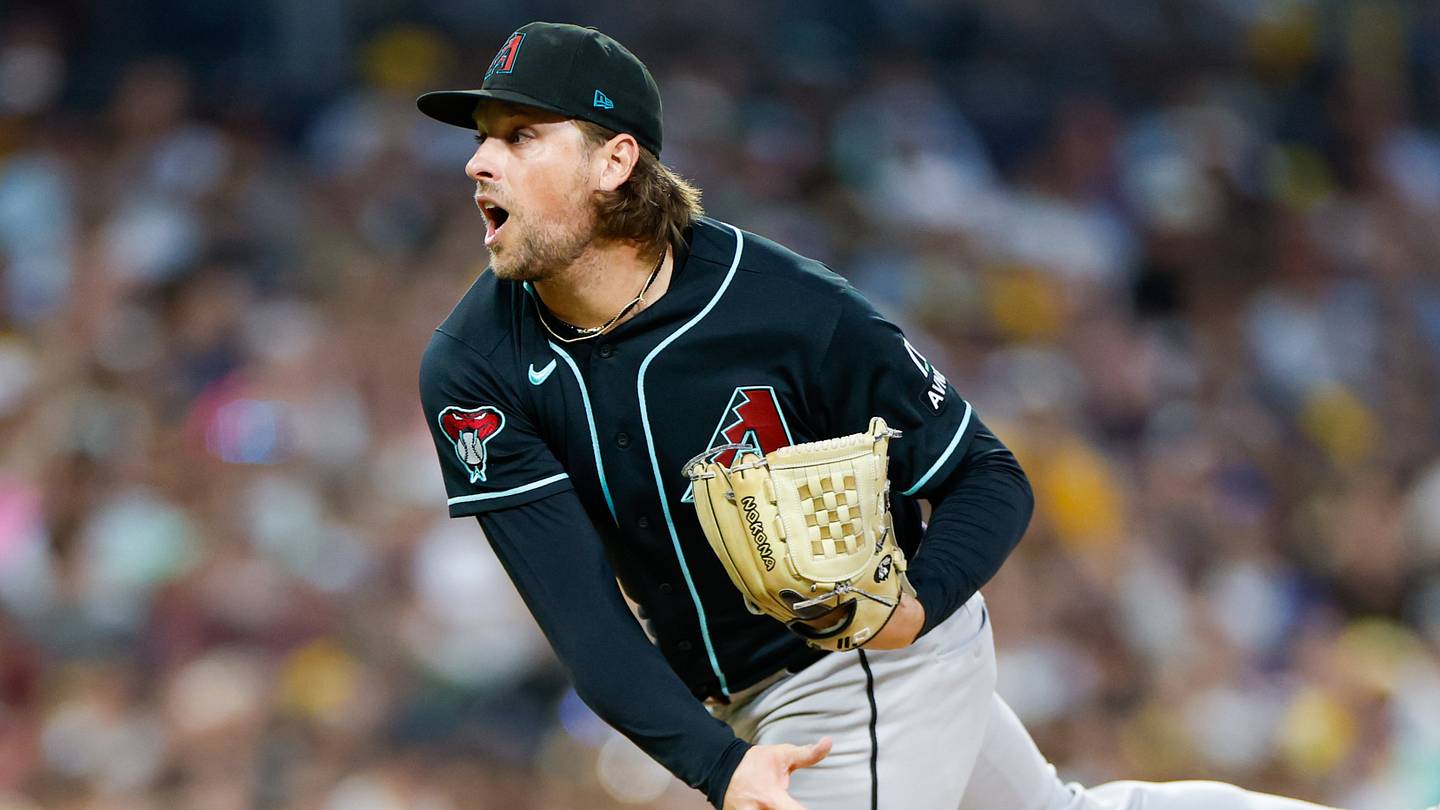
The Minnesota Twins didn't wait for the winter meetings to make their first bullpen move of the offseason. On Wednesday, they agreed to a two-year, $18 million contract with right-hander Kevin Ginkel, prying one of Arizona's most durable late-inning arms away from the only organization he'd known in eight major-league seasons.
The deal, first reported by MLB.com's Mark Feinsand and confirmed by the Associated Press, represents a clear statement from a front office that has spent the last week reversing three years of payroll contraction. In the span of seven days, Minnesota has re-signed catcher Ryan Jeffers on a $23.15 million qualifying offer, inked starter Sonny Gray to a $55 million pact, traded Royce Lewis for right-hander Bobby Miller — who profiles as a multi-inning relief option — and now added Ginkel to a bullpen that was gutted at the 2025 trade deadline.
What Ginkel Brings: The Slider-First Profile
Ginkel's calling card has never been velocity — his four-seamer sits in the mid-90s — but a slider he throws roughly half the time and that generates whiff rates well above average. Since his breakout during Arizona's 2023 World Series run, when he posted a 2.48 ERA across 68 appearances, he has been deployed almost exclusively in high-leverage spots, often bridging to the closer or finishing games himself.
The surface numbers from 2026 — a 4.12 ERA in 67 ⅔ innings with 72 strikeouts and just 17 walks — don't tell the full story. His career 3.47 FIP and 3.59 expected ERA have consistently outperformed his raw run prevention, a pattern that held true last season despite the elevated ERA. The 26.2% strikeout rate and .234 opponent batting average were his best marks since that 2023 peak, suggesting the underlying stuff remained sharp even as results fluctuated.
A Bullpen Rebuilt From Scratch
Context matters here. The Twins' 2025 deadline teardown shipped out five relievers — Jhoan Duran, Griffin Jax, Louis Varland, Brock Stewart, and Danny Coulombe — in a move that prioritized prospect capital and payroll relief over present-day competitiveness. Duran and Varland both made All-Star teams in 2026 for Philadelphia and Toronto, respectively, a reminder of the talent that walked out the door.
What remained was a patchwork group. Yoendrys Gómez, acquired from Tampa Bay, took over the closer role and had a respectable debut season. Rookie Andrew Morris flashed promise. Trade-deadline pickups Jeff Hoffman and Tommy Nance added veteran depth. Bobby Miller, the return for Lewis, gives the Twins a power arm who has started and relieved at the major-league level. But the unit lacked a proven, slider-dominant righty who could be trusted in the eighth inning of a tight game. Ginkel fits that role immediately.
The Left-Handed Hole Remains
One addition doesn't complete the project. A.J. Minter and Trevor Rogers, the Twins' primary left-handed relief options in 2026, are both free agents. The Athletic's Dan Hayes reported Wednesday that Minnesota remains active in the market for a southpaw. With Jeff Hoffman, Gómez, Tommy Nance, Cole Sands, Miller, and now Ginkel, the right-handed side of the ledger is suddenly deep — perhaps even crowded. The next move, if the front office follows through on its stated intent, will come from the left side.
Why Arizona Let Him Walk
The Diamondbacks' calculus was different. Their bullpen, a liability for years, emerged as a strength in 2026 behind a wave of young arms: Justin Martinez, Juan Morillo, and Brandyn Garcia have formed a new leverage core. Taylor Clarke, another righty, could return. In that context, a two-year, $18-19 million commitment to a 32-year-old with an 8-year track record of volatility — career 3.91 ERA, but peripheral metrics that consistently suggested better — made less sense for a team building around cost-controlled youth. Ginkel's farewell Instagram post after the 2026 season signaled the relationship had run its course.
The Bigger Picture
Three straight losing seasons. Three straight years of reduced payroll. A fan base that watched the front office dismantle a playoff roster at the 2025 deadline. The Twins' offseason activity to date — Jeffers, Gray, Miller, Ginkel — reads like an organization trying to reclaim relevance in a winnable AL Central. Ginkel alone doesn't guarantee contention. But he's exactly the type of proven, high-leverage reliever a team needs when it's ready to stop rebuilding and start winning again. The contract is modest by modern reliever standards. The signal it sends is not.
Sources
These sources formed the evidence pack for this article. Links open the original publisher; inclusion does not imply endorsement.
- si.com original
- sports.yahoo.com original
- newsday.com original
- twincities.com original