The champagne has barely dried, and the adrenaline from a Grand Slam victory is still coursing through the veins of Karolína Muchová, but for the Czech star, there is no room for a victory lap. In the high-velocity environment of Flushing Meadows, the transition from mixed doubles champion to singles contender isn't just a change of partners—it is a total psychological recalibration.
The Grand Slam Paradox
Muchová arrived at her singles opening match on the cusp of a dual identity. Just days prior, she and Jakub Menšík secured their first Grand Slam title in mixed doubles, navigating a grueling four-match run to defeat the Italian-Swiss duo of Flavio Cobolli and Belinda Bencicová with a 6-3, 1-6, 10-6 scoreline. The victory was a career milestone, yet the proximity of the celebrations to her singles duties created a unique tension.
Muchová admitted that the sheer speed of the professional circuit leaves little room for the traditional processing of such a monumental achievement. After the final point in the mixed doubles, the team was immediately occupied with mandatory doping tests and quick refreshments before retreating to hotels to prepare for the singles draw.
"Given the format of that competition, which lasted only two days, it is a bit strange and different to realize that one has won a Grand Slam. I think that’s how Kuba and I took it," Muchová told Czech journalists, reflecting on the surreal nature of the win.
Source: ceskenoviny.cz
The celebration was tempered by a singular, driving objective: Muchová’s desire to translate this momentum into the singles draw, where she carries the heavy expectations of a 7th seed.
The 58-Minute Statement
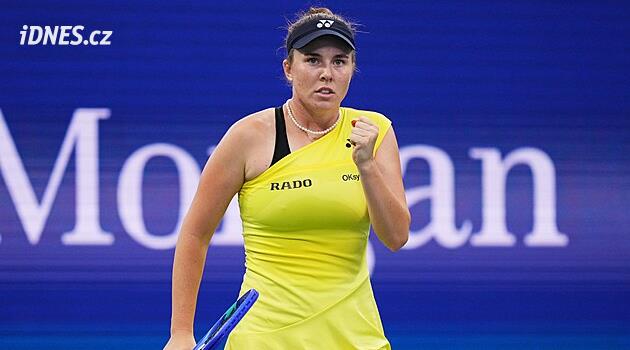
If there were concerns that the mixed doubles triumph would leave Muchová physically or mentally depleted, she silenced them in just under an hour. Facing Austria's Sinja Kraus, Muchová delivered a clinical 6-3, 6-0 performance that lasted a mere 58 minutes. It was a masterclass in efficiency, characterized by Muchová’s ability to ramp up her intensity immediately upon returning to the singles baseline.
This victory marks a significant milestone for the Olomouc native, representing her first singles win since the Wimbledon final, where she fell to Linda Noskova. The intervening period was marked by a minor surgical procedure, making this dominant return to the court in New York even more telling of her current physical state.
Despite the intensity of the match, Muchová maintained a sense of perspective, noting that while she felt a "healthy nervousness" typical of opening matches, she was primarily just eager to be back in the singles arena. She also leaned into the lighter side of her recent festivities, jokingly noting that after multiple celebrations for her 30th birthday with friends in New York, she now feels "about 33."
The Mental Gear Shift
The crux of Muchová’s success in New York may lie in her ability to compartmentalize. For many players, a Grand Slam title in one discipline can become a distraction for the other; for Muchová, it appears to be a catalyst for focus. She emphasized that the pace of the game necessitates an almost instant mental switch.
As she moves into the second round, the stakes escalate. The 7th seed will next face Britain's Katie Boulter, a matchup that will test whether the efficiency seen against Kraus can be sustained against higher-caliber singles opposition. The question remains whether the confidence gained from her mixed doubles success will act as a springboard or if the physical toll of the dual campaign will begin to surface as the tournament progresses toward the final on September 13.
Sources
These sources formed the evidence pack for this article. Links open the original publisher; inclusion does not imply endorsement.
- ceskenoviny.cz original
- idnes.cz original
- oneplay.cz original
- usopentennisinfo.com original