Scores, fixtures and picks
These fixtures are connected to teams or competitions named in the article. Live status and scores come from the normalized SportyPulses data feed; predictions are reader picks, not betting advice.
When modern offense is discussed across today's NBA, conversation frequently centers on high-usage playmakers who manipulate defense through deliberate deceleration and heavy pick-and-roll volume, much like Luka Doncic. Yet as younger talents emulate those heavy-possession styles, Kevin Durant continues to offer a masterclass in a different form of lethal isolation: hyper-efficient, space-neutral scoring that bypasses defensive schemes entirely.
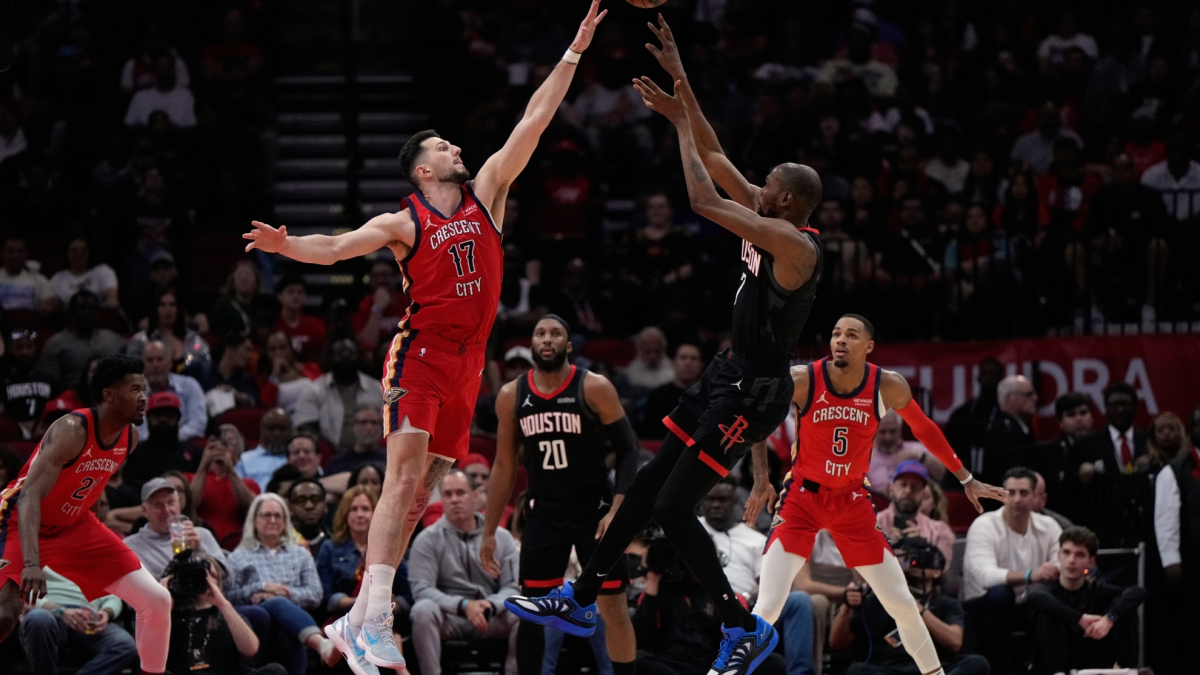
Now operating as the offensive focal point for the Houston Rockets following a historic offseason transaction, the 37-year-old forward has turned Houston's half-court execution into one of the league's most unguardable propositions. Durant's late-game performance against the New Orleans Pelicans—where he posted 32 points, six rebounds, five assists, and a game-winning jumper—propelled Houston into a tie with the Los Angeles Lakers for third place in the Western Conference standings. That clutch shot marked his 12th game-winning basket since entering the league in 2007-08, tying Carmelo Anthony for the most across that span and reinforcing how little age has diminished his late-clock reliability.
Mechanics of the Mid-Range: Isolation Pacing and the 50.6% Fadeaway
While heavy-usage ball-handlers often rely on high pick-and-rolls to collapse defensive shells, Durant’s efficiency is rooted in unassisted shot creation from the mid-post and elbows. The underlying shot profile metrics reveal a veteran operating at the absolute peak of craftiness. Durant leads the NBA in fadeaway effectiveness, knocking down 50.6% of those attempts, while converting 54.4% of his mid-range pull-up jumpers off the dribble.
This surgical touch reshapes how opponents must scheme against Houston. Paired alongside Clint Capela in the frontcourt, Durant provides the Rockets with an ideal inside-outside framework. Capela’s rim-running and offensive rebounding threat pull drop-coverage centers away from the paint, giving Durant the isolated pocket of space he needs to operate. When defenders play up on his shoulder to deny the pull-up, Durant uses precise footwork to elevate into his fadeaway, making contest height essentially irrelevant.
| Metric / Milestone | Stat / Percentage | League Rank / Historical Significance |
|---|---|---|
| Fadeaway Field Goal Percentage | 50.6% | 1st in NBA |
| Off-Dribble Mid-Range Efficiency | 54.4% | League-Leading Elite Tier |
| Career Game-Winning Shots (Since 2007-08) | 12 Baskets | Tied 1st (Carmelo Anthony) |
| 30+ Point Games Past Age 36 | 25 Games | Tied 1st All-Time (Michael Jordan) |
| Career Scoring Total (as of March 2026) | 32,206 Points | Closing in on Jordan (32,292) |
The Anatomy of a Seven-Team Blockbuster and Lineup Consequences
Houston’s current success is the direct byproduct of the most complex transaction in league history. Agreed upon in June 2025 and officially processed on July 6 to navigate second-apron cap penalties, the historic seven-team deal involved six players, fifteen draft picks, and extensive cash considerations, eclipsing the prior year's six-team trade that relocated Klay Thompson.
To secure Durant and Capela alongside a 2031 second-round pick swap, Houston parted ways with young core pieces Jalen Green and Dillon Brooks, alongside significant draft capital including the 10th overall pick in 2025 (Khaman Maluach) sent to the Phoenix Suns. The strategic trade-off was clear: sacrifice long-term youth development to instantly insert a two-time Finals MVP into a roster primed for playoff contention.
The roster shift fundamentally altered Houston's offensive geometry. Replacing Green's high-variance perimeter possessions with Durant’s steady 50-plus percent mid-range diet stabilized Houston’s late-game decision-making, converting a volatile young team into a structured half-court execution unit.
Cap Flex, Financial Sacrifices, and the Jordan Pursuit
Durant's impact in Houston extends beyond his on-court shot chart into roster construction strategy. Prior to the 2025-26 tip-off, Durant signed a two-year, $90 million contract extension with the Rockets. By accepting a deal well below his theoretical max salary—following a template popularized by New York's Jalen Brunson—Durant provided Houston crucial flexibility beneath restrictive second-apron hard caps.
Off the court, Durant's financial footprint remains immense. Forbes listed him among the world's highest-paid athletes in 2026 with $103.8 million in total earnings, backed by $49 million in off-court income from sponsors like Nike, FanDuel, and Fanatics, along with investments in over 80 companies via Thirty Five Ventures (35V), Boardroom, MLS's Philadelphia Union, NWSL's Gotham FC, and Rec's $11 million Series A round.

That off-court stability allows Durant to focus entirely on historical legacy. His 32-point night against New Orleans marked his 25th career game with 30 or more points after turning 36, tying Michael Jordan for the most in NBA history. Standing at 32,206 career points, Durant is rapidly closing the gap on Jordan's legendary career mark of 32,292 points.
Evidence-Led Forecast: Houston’s Western Conference Seeding Push
Likely Tactical Pattern: Expect Houston to increasingly run late-clock possessions through low-elbow isolations for Durant, using double-staggered screens to force high-switching defenses into mismatches against smaller guards.
Decisive Matchup: The synergy between Capela's rolling rhythm and Durant's mid-range patience. If opposing centers stay attached to Capela, Durant will maintain clear sightlines for his 54.4% off-dribble mid-range pull-up.
Strongest Counter-Case: Physical defensive teams that send immediate top-lock double teams before Durant catches the ball in his preferred elbow spots, forcing Houston's secondary spot-up shooters to prove they can consistently win four-on-three possessions.
What Would Change the Read: Any disruption to Houston's frontcourt rotation that allows defenses to trap Durant without paying a rim-protection penalty at the other end.
Sources
These sources formed the evidence pack for this article. Links open the original publisher; inclusion does not imply endorsement.
- forbes.com original
- basketball-evolution.com original
- marca.com original