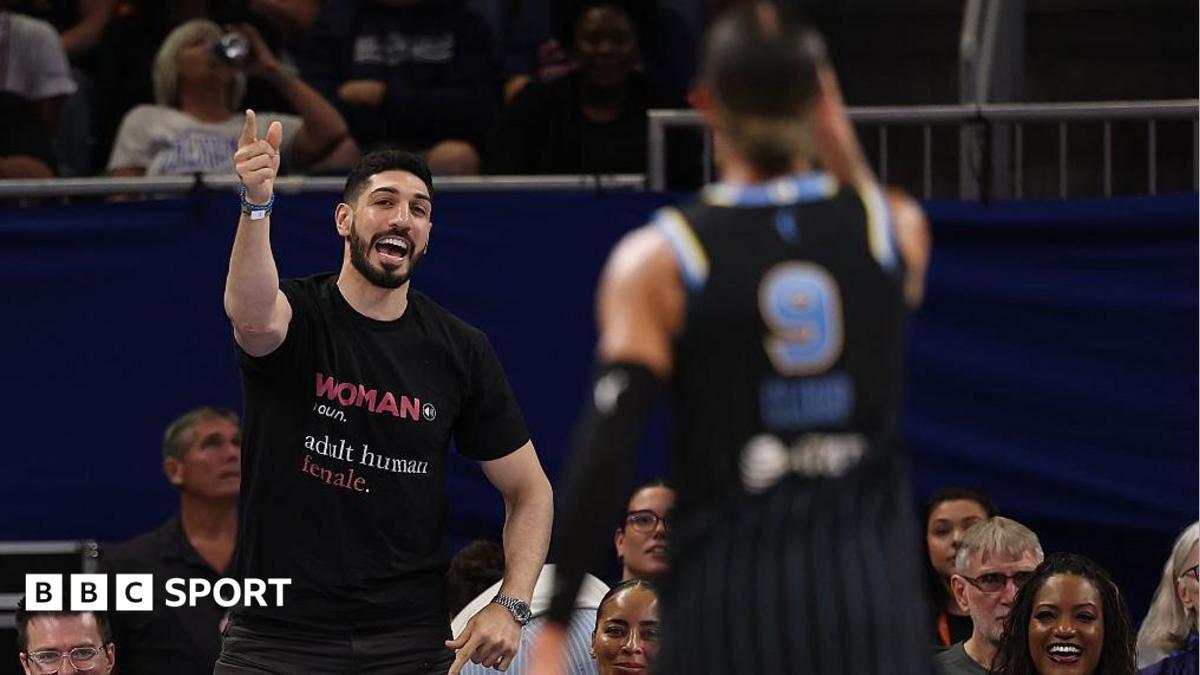
The tension at Wintrust Arena did not stem from a missed free throw or a blown defensive rotation. Instead, the eruption occurred during a timeout in the Chicago Sky’s matchup against the Indiana Fever, where the boundaries between spectator, protest, and professional sport blurred into a volatile confrontation.
Enes Kanter Freedom, the 34-year-old former NBA center, found himself at the center of a lightning rod incident when he stood at courtside, arms outstretched, wearing a T-shirt that read: "WOMAN noun. Adult human female." The visual provocation acted as a catalyst for a verbal altercation with Sky guard Natasha Cloud, who was seen pointing and shouting at Freedom before security and teammates intervened to escort the former Utah Jazz player from the arena.
The Paperwork Protest: A Tactical Challenge to the CBA
Freedom’s presence at the game was no mere act of heckling; it was a calculated demonstration of a brewing legal and regulatory challenge. Earlier this month, Freedom officially submitted paperwork to enter the 2027 WNBA Draft, specifically citing the current ambiguity in the league's eligibility guidelines.

The move is part of a broader, highly visible maneuver by former NBA players to test the WNBA’s structural framework. Alongside Freedom, Royce White—a former NBA player and Republican Senate candidate—has declared his intention to enter the 2027 Draft, stating, I’m transgender. I’m a woman… I identify as sometimes identifying as a woman for purposes of… professional basketball,
according to reports from Fox News.
While White has used social media to lean into the controversy, including a post celebrating his "feminine era" in a wig, Freedom has maintained a more litigious tone. In a formal document submitted to the WNBA, Freedom argued that his application is consistent with the existing collective bargaining agreement (CBA), asserting his rights as a player who meets the age and eligibility requirements outlined in Article XIII, Section 1(b).
The Regulatory Vacuum: Defining 'Woman'
At the heart of this storm lies a significant linguistic and legal loophole within the WNBA's governing documents. The current CBA is explicit on one front: "Only players who are women are eligible to play in the WNBA." However, the league has yet to provide a specific definition of what constitutes a "woman" regarding gender identity or sex assigned at birth.
This lack of specificity has created a vacuum that is being filled by intense debate, political maneuvering, and on-court volatility. Commissioner Cathy Engelbert has acknowledged the complexity, noting in a leaked memo that the league will "always approach this topic thoughtfully, respectfully, and in alignment with the longstanding values of our league."
Despite the escalating pressure, the WNBA leadership—including an anti-hate task force comprising team presidents and general managers—recently determined that there are "no immediate eligibility matters affecting" the league at this time. This decision, however, does little to quell the growing divide between different factions of the sport.

- The Defenders: Players and coaches like Seattle Storm’s Stefanie Dolson and Minnesota Lynx’s Cheryl Reeve have voiced support for transgender athletes, with Reeve framing the issue as a fundamental human rights matter.
- The Critics: Indiana Fever star Sophie Cunningham has sparked significant uproar by stating her desire to "protect young girls" from "biological men," a stance that has drawn support from figures such as Vice President JD Vance.
- The Union: The WNBA Players Association (WNBPA) has taken a firm stance against being utilized in the fray, stating they "will not be used as political pawns" while emphasizing their commitment to diversity and inclusion.
A League on Edge
The volatility isn't confined to the sidelines. The recent clash between Indiana's Sophie Cunningham and Chicago's DiJonai Carrington—which resulted in a flagrant 2 ejection for Carrington and a bloodied Cunningham—demonstrated how quickly tempers can boil over in this high-stakes environment. The subsequent social media exchange, involving Carrington’s post regarding "white privilege," underscores a broader climate of social and political friction that follows the players both on and off the hardwood.
As the WNBA moves into a period of intense scrutiny, the league faces a defining mandate: clarify the CBA to provide a definitive standard of eligibility, or continue to navigate a landscape where the very definition of the game's participants remains an open question. For now, the "integrity of the game" that Engelbert promises to preserve remains caught in the crossfire of a much larger cultural debate.
Sources
These sources formed the evidence pack for this article. Links open the original publisher; inclusion does not imply endorsement.
- dailymail.com original
- themirror.com original
- si.com original
- bbc.co.uk original

