The 2026 regulatory landscape has already birthed its first great technical disruptor, and for McLaren, the pursuit of that advantage has been a journey defined by both frustration and hard-won breakthroughs. While the paddock has spent much of the season dissecting Ferrari’s radical 'Macarena' rear wing, the Woking-based squad has been quietly working through the teething pains of its own response: the highly anticipated H-Wing.
The technical objective is singular and high-stakes: mastering the art of the 180-degree rotation. By switching between high-downforce cornering modes and low-drag straight-line modes, teams can theoretically bypass the traditional compromise between grip and top speed. Ferrari set the pace with this concept during pre-season testing in Bahrain, and Red Bull was quick to follow suit, leaving McLaren to navigate a more turbulent developmental path.
The 'Macarena' Catalyst
The nickname 'Macarena' was bestowed upon Ferrari’s solution, a design that earned its moniker through the striking visual of a rear wing that pivots 180 degrees. The benefit is purely mathematical; on the straights, the wing's position minimizes drag, allowing for superior top-end velocity, before rotating back to a high-angle configuration to provide the downforce necessary for high-speed cornering.
For McLaren, the realization of this potential was not immediate. Technical director Neil Houldey admitted that the team's initial focus was diverted toward more conventional aerodynamic upgrades that promised more immediate, albeit perhaps less revolutionary, performance gains.
“We were disappointed not to pick that up as quickly as Ferrari did and then Red Bull. As soon as we saw it, we realised there was an opportunity there and we looked into it for a while,” Houldey remarked, acknowledging the team's delayed reaction to the Ferrari-led trend.
This delay was not merely a matter of strategic choice, but one of engineering reality. The path to a reliable rotating wing is fraught with aerodynamic risks that can easily destabilize a car if the transition between modes is not seamless.
From Austrian Setbacks to Hungarian Clarity
McLaren's attempts to bridge the gap were met with a significant hurdle during the summer stretch. The team had integrated lab testing and preliminary free practice work into their schedule, but the transition from the wind tunnel to the asphalt proved difficult. During the Austrian Grand Prix weekend, the team encountered a specific technical issue with the prototype while in the garage, forcing them to pull the component from competition and return it to the factory for intensive troubleshooting.
However, the setback appears to have been a productive one. Following a period of continuous refinement, McLaren utilized the Hungarian Grand Prix weekend to test an updated iteration of the system. The results from the Hungarian trials were described as encouraging, providing the technical team with the confidence that the fundamental concept is sound.
“We think we've now found a concept that works and we've created a reliable solution,” Houldey confirmed. “We understand some of the aerodynamic risks with doing it... We're now trying to find a way of introducing that concept into our new rear wing generation, which should be happening in the next few races.”
Branding the Breakthrough: The Etihad Integration
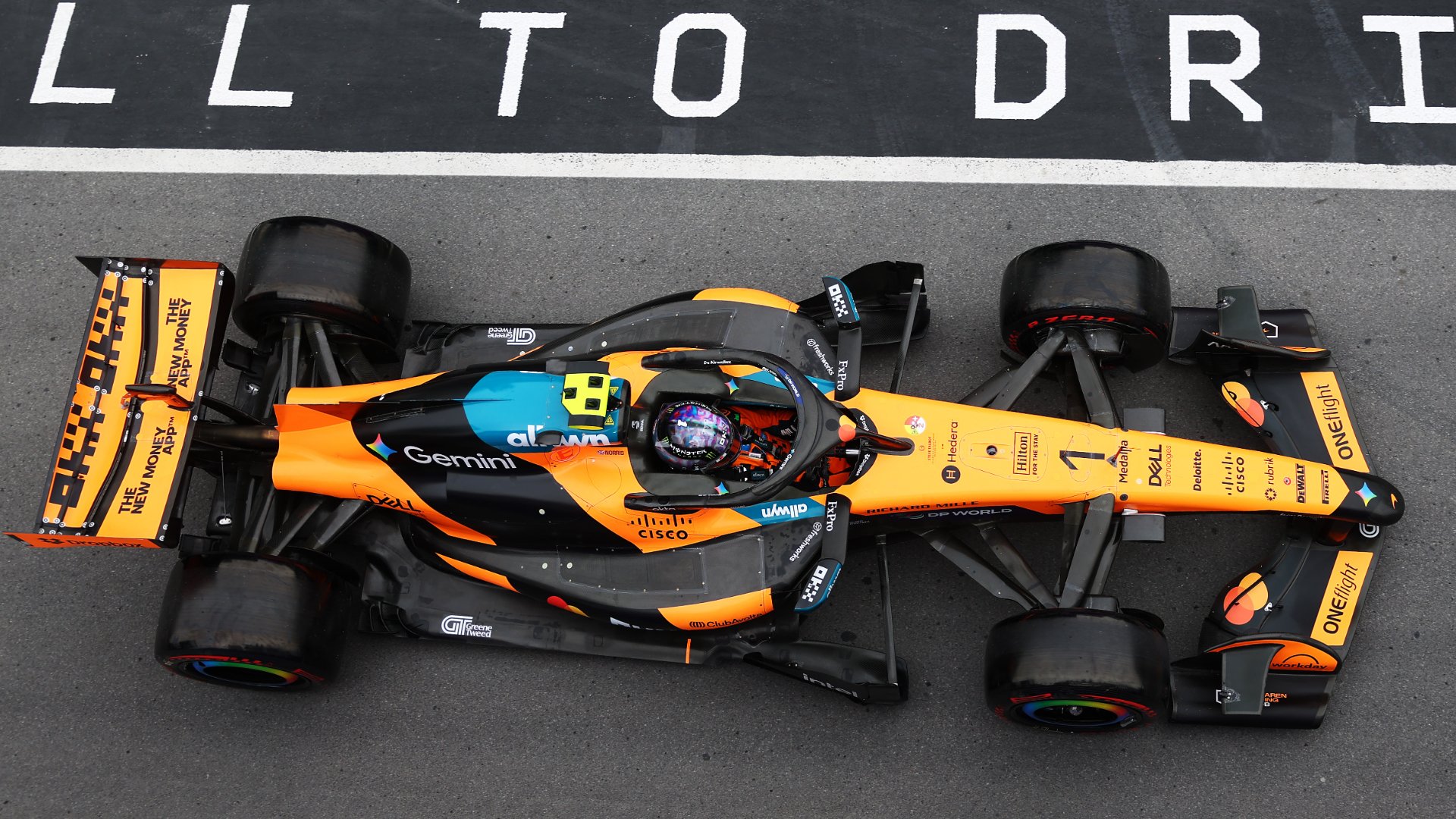
As the technical evolution of the MCL40 accelerates, the aesthetic identity of the car is undergoing a parallel transformation. The introduction of the H-Wing coincides with a significant commercial milestone: McLaren's new official partnership with Etihad, the national airline of the UAE.
This partnership is not merely a sponsorship; it is a visual integration designed to highlight the synergy between high-performance racing and global travel. The Etihad branding will be prominently featured on several key aerodynamic components of the MCL40, specifically targeting the rear wing—the very component currently undergoing its technical revolution—and the halo.
The partnership is expected to extend beyond the track, with Etihad also unveiling a bespoke aircraft livery featuring McLaren branding on one of its flagship Boeing 787 Dreamliner aircraft. For the fans, this means the high-speed, high-visibility components of the McLaren car will serve as the primary canvas for this new era of branding.

Technical Evolution Summary
| Feature | Current Status | Technical Objective |
|---|---|---|
| Rear Wing Concept | Reliable solution found | 180-degree rotation for drag reduction |
| Development Phase | Post-Hungarian testing | Integration into next wing generation |
| Primary Branding | Etihad Airways integration | Prominent placement on wing and halo |
| Strategic Goal | Catching Ferrari/Red Bull | Optimizing top speed on straights |
As McLaren prepares to deploy the H-Wing in the coming races, the focus shifts from whether the technology works to how effectively it can be integrated into the car's overall aero-balance. If successful, the Woking squad will have finally closed the gap on the 'Macarena' revolution, turning a developmental deficit into a tactical advantage.
Evidence-Led Forecast
Likely Tactical Pattern: Expect McLaren to deploy the rotating wing in a high-sensitivity mode, focusing on maximizing straight-line speed in circuits where overtaking opportunities are limited by low drag. The integration of the Etihad-branded wing will likely serve as a high-visibility marker of the team's technical resurgence.
Decisive Matchup: The effectiveness of the H-Wing against Ferrari's established rotating system will be most evident in high-speed, low-drag sectors (e.g., Monza or Spa), where the ability to shed drag without losing stability is the difference between a podium and a midfield struggle.
Strongest Counter-Case: The primary risk remains the aerodynamic stability during the rotation phase. If the transition between the 180-degree positions causes a momentary loss of rear-end stability, the driver may struggle with unpredictable handling in high-speed transition zones.
The Variable: A failure to achieve parity with Red Bull’s implementation of the technology could see McLaren remain a step behind in pure straight-line efficiency, even if their solution proves reliable.
Sources
These sources formed the evidence pack for this article. Links open the original publisher; inclusion does not imply endorsement.
- netcarshow.com original
- news.gp original
- mclaren.com original
- models118.com original