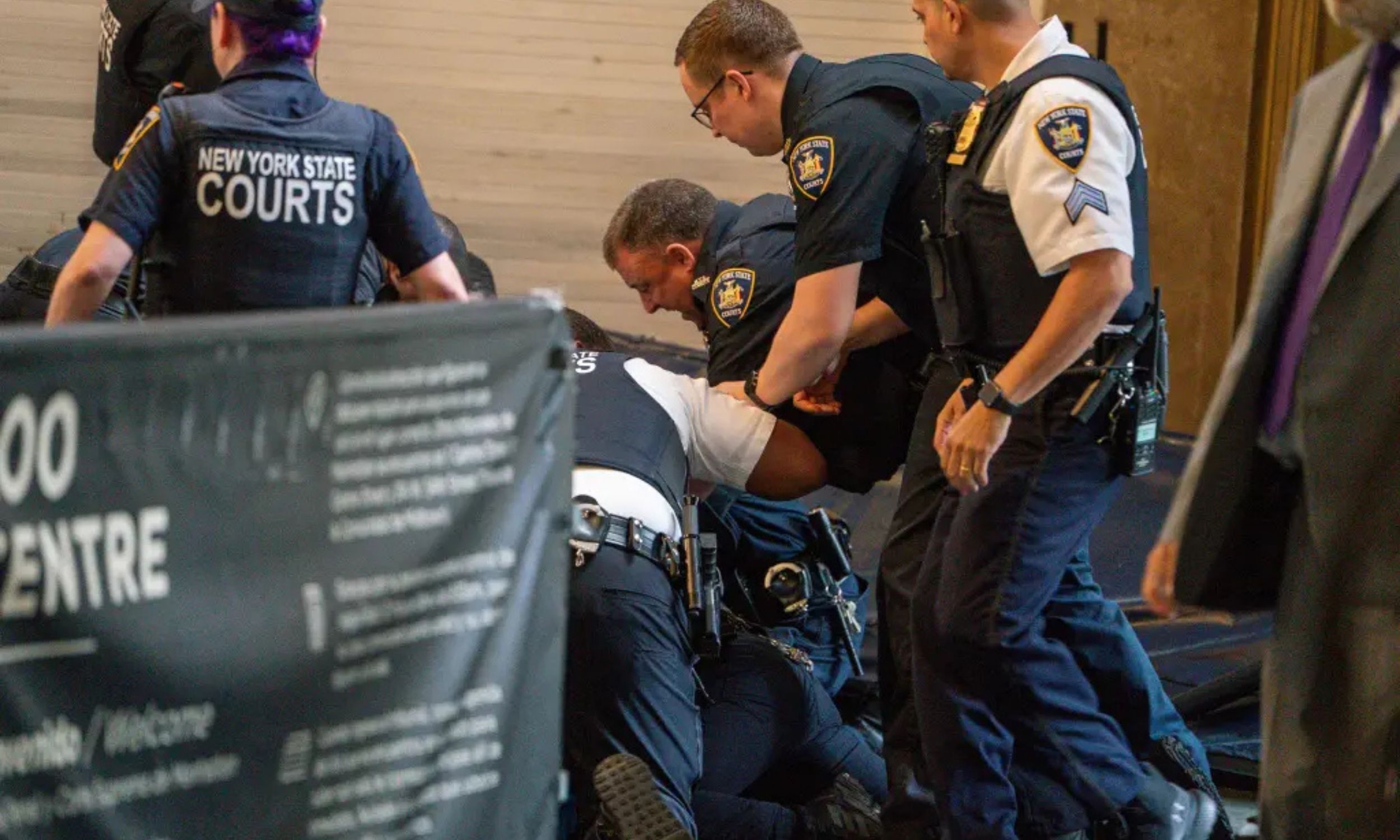
When high-exposure altercations move from public venues into the criminal justice system, the distinction between a minor infraction and a severe felony conviction hinges entirely on statutory definitions, documented injuries, and prosecutors' ability to establish criminal intent beyond a reasonable doubt. Under state penal codes, a violent encounter can rapidly escalate into a multi-decade legal struggle. The practical reality of these statutes was starkly illustrated on June 16, 2025, inside the security screening entrance of the Manhattan Criminal Courthouse at 100 Centre Street, near Foley Square in Lower Manhattan. What began as a standard checkpoint procedure turned violent when an individual allegedly produced a concealed knife and attacked personnel, slashing and stabbing at least three law enforcement officers before being subdued and arrested.
The attack forced an immediate partial lockdown of the courthouse, drawing emergency personnel and prompt action from law enforcement. The Manhattan District Attorney's Office moved quickly toward top-tier felony charges, demonstrating how local prosecutors treat violent acts inside civic buildings. For legal analysts monitoring violent offense litigation, the incident illustrates how statutory intent, forensic medical evidence, and state sentencing mandates converge.
Courthouse Security Breach and NY Penal Law § 120 Mechanics
In New York State, violent offenses are governed by Article 120 of the New York Penal Law. Statutory categories range from misdemeanor third-degree assault to Class B violent felonies. Following the June 2025 incident at 100 Centre Street, Mayor Eric Adams called for expanded security funding and targeted mental health interventions, while the New York City Office of Court Administration initiated a swift security protocol review. From a prosecutorial standpoint, securing top-count felony indictments remains the primary focus when bladed weapons and official personnel are involved.
Under New York Penal Law § 120.10, assault in the first degree—a Class B violent felony—occurs when an individual intentionally causes serious physical injury using a deadly weapon or dangerous instrument. A conviction under § 120.10 carries a mandatory prison sentence ranging from 5 to 25 years in state prison, alongside a mandatory 5-year period of post-release supervision monitored by the New York Department of Corrections and Community Supervision. Second-degree assault under Penal Law § 120.05 applies as a Class D violent felony, carrying 2 to 7 years in prison when physical injury is inflicted with a weapon or directed at law enforcement officers. Furthermore, under Penal Law § 120.08, causing physical harm to police officers, prosecutors, or court officers acting in their official capacity constitutes aggravated assault, severely restricting plea bargains or alternative sentencing under New York's Article 70 guidelines.
Medical Proof and Statutory Severity: Physical Injury vs. Serious Disfigurement
Establishing whether an offense rises to first-degree assault requires rigorous medical documentation. New York Penal Law § 10.00(10) defines serious physical injury
as impairment creating a substantial risk of death, protracted disfigurement, or the long-term loss or impairment of any bodily organ or function. By contrast, basic physical injury requires substantial pain or physical impairment.
In Manhattan criminal courtrooms, prosecutors rely on trauma records from facilities like NYC Health + Hospitals and Bellevue Hospital, backed by direct testimony from treating emergency physicians, trauma surgeons, and forensic nurses. Expert witnesses from the New York Office of the Chief Medical Examiner are frequently called to explain recovery prognoses to juries. Regarding weapons, bladed instruments and edged tools are categorized as dangerous instruments or deadly weapons under Penal Law § 10.00(13), mirroring standards recognized by the Bureau of Alcohol, Tobacco, Firearms and Explosives (ATF).
Jurisdictional Contrasts: Statutory Tiers in Texas, Tennessee, and South Carolina
Outside of New York's rigid sentencing framework, other state codes employ distinct procedural mechanisms and statutory classifications. In Texas, district court felony prosecutions require a grand jury indictment unless waived by the defendant, while Class A and B misdemeanors begin with an information document and Class C offenses originate via a filed complaint. Texas statute explicitly exempts certified juveniles and defendants under 18 at the time of the crime from life imprisonment without parole. Texas code also governs specialized economic and organized crime offenses, ranging from Directing Activities of a Gang under Penal Code § 71.023 (carrying a 25-year minimum prison term) to Illegal Recruitment of an Athlete under § 32.441 when financial benefits reach or exceed $300,000.
In Tennessee, aggravated assault is classified according to state of mind and victim classification under state law. Reckless behavior causing severe injury is charged as a Class D felony, carrying 2 to 12 years in prison and fines up to $5,000. Intentional or knowing aggravated assault—which encompasses attacks on emergency responders, child abuse, or failure to protect a protected adult—escalates to a Class C felony, punishable by 3 to 15 years in prison, fines up to $10,000, and mandatory victim restitution for medical care and damaged property. In South Carolina, aggravated assault is prosecuted as a felony carrying up to 20 years in prison, where trial judges exercise statutory sentencing discretion prior to entering final judgment.
| State Jurisdiction | Offense Category | Statutory Prison Range | Key Statutory Elements & Mandates |
|---|---|---|---|
| New York | Class B Violent Felony (Assault 1st) | 5 to 25 years prison | Intentional serious physical injury with a deadly weapon; mandatory 5-year post-release supervision. |
| New York | Class D Violent Felony (Assault 2nd) | 2 to 7 years prison | Physical injury using a weapon or targeting police and court personnel in official duty. |
| Tennessee | Class C Felony (Intentional Aggravated) | 3 to 15 years prison | Max $10,000 fine; encompasses emergency responder attacks; mandates restitution for medical care. |
| Tennessee | Class D Felony (Reckless Aggravated) | 2 to 12 years prison | Max $5,000 fine; reckless conduct causing severe bodily harm. |
| South Carolina | Felony Aggravated Assault | Up to 20 years prison | Severe non-transient harm; sentence length subject to judicial discretion under state guidelines. |
Defensive Strategies and Evidentiary Challenges in Violent Offense Litigation
Defending against high-exposure violent offense charges requires directly challenging the prosecution's evidence regarding mental state, weapon characterization, and injury severity. Because felony assault requires proving criminal intent beyond a reasonable doubt, defense attorneys regularly assess specific legal strategies:
- Self-Defense and Defense of Others: Presenting evidence that the alleged victim brandished a weapon first, initiated physical contact, or issued immediate threats that established a reasonable fear of imminent harm.
- Accidental Conduct and Absence of Intent: Establishing that physical injuries resulted from an accident rather than intentional or reckless conduct, which can defeat top-count felony charges or reduce offenses to lesser non-violent tiers.
- Insanity or Lack of Mental Capacity: Demonstrating through medical evidence that the defendant lacked the mental capacity to understand the wrongfulness of their conduct or control their actions during the event.
- Procedural Suppression and Case Dismissal: In jurisdictions like Texas, cases may be dismissed prior to trial if key evidence is suppressed due to an illegal arrest or search, if necessary witnesses are unavailable, or if the evidence fails to satisfy statutory proof standards.
Ultimately, when judges evaluate final sentences in discretionary jurisdictions, they review mitigating and aggravating factors presented at trial. Whether evaluating mandatory state prison terms in New York or statutory felony tiers across Tennessee, Texas, and South Carolina, the outcome of any high-stakes violent offense prosecution depends on how thoroughly forensic facts and statutory requirements are analyzed in court.
Sources
These sources formed the evidence pack for this article. Links open the original publisher; inclusion does not imply endorsement.
- petruslaw.com original
- atonyamcclainlaw.com original
- williamhodgelaw.com original
- jamesrowenlaw.com original