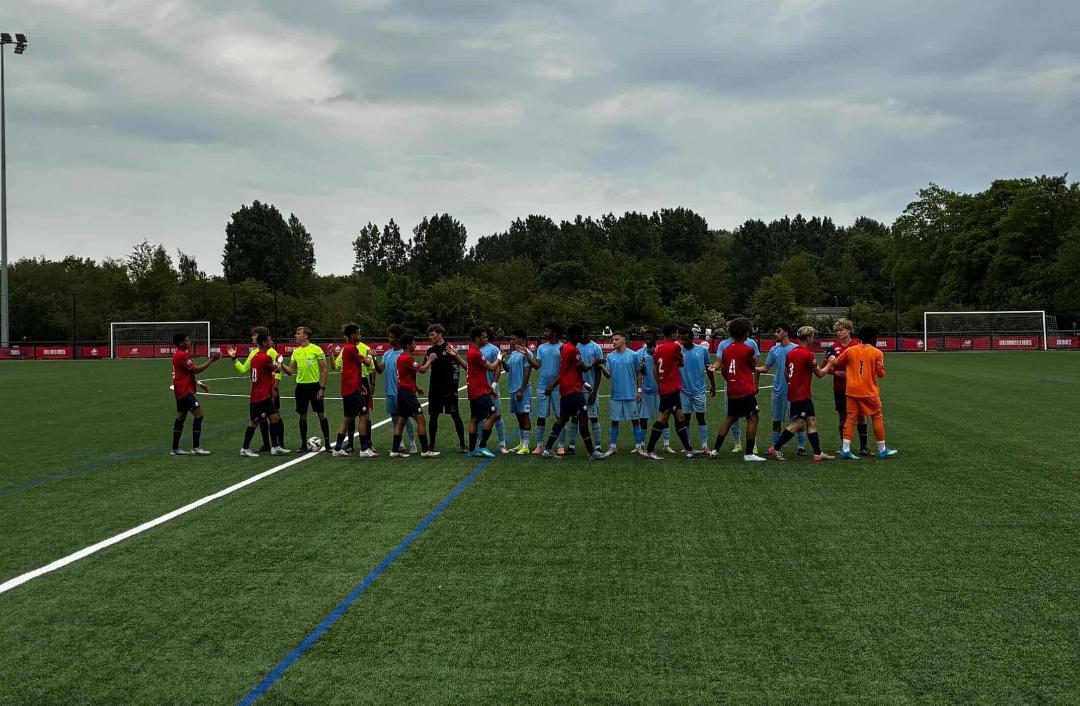
Youth football development lives in the margins between defensive solidity and executive ruthlessness in the final third. For clubs operating in the hyper-competitive ecosystem of the Championnat National U19, league and preparatory fixtures provide the ultimate laboratory to test these structural thresholds. When C'Chartres U19 lines up against disciplined opponents across a demanding 26-match calendar, the scoreline matters far less than the structural stress-tests applied across ninety minutes.
Looking back at the broader competitive landscape of the 2025–2026 campaign, C'Chartres found themselves perpetually fighting for survival in Groupe A. Finishing the regular league slate in 11th position with 31 points from 26 matches—nestled alongside Saint-Lô and Schiltigheim with a negative 19 goal difference—underlines the razor-thin margins the club must navigate. Against heavyweights, the cracks widened; the 7-1 dismantling by Paris SG at the Campus PSG in April 2026 exposed the gulf in elite athletic depth, while tighter affairs, such as the 1-0 victory over Quevilly at the Stade James Delarue, proved that Anthonin Baz’s side could grind out results when defensive lines held firm.
The Rigors of the National U19 Tier
Early tests and mid-season battles function as developmental crucibles. Whether hosting fixtures on the artificial turf of the Stade James Delarue—historically utilized for matches against regional opponents like Maintenon-Pierres—or traveling away, technical staff use these outings to evaluate squad depth without the paralyzing pressure of senior relegation points. Sides such as Montfermeil, who finished their National U19 campaign ninth in Groupe A with 36 points, 29 goals scored, and 32 conceded, present a distinct tactical profile within the FFF pyramid that demands absolute positional discipline.
/t:r(unknown)/filters:format(jpeg)/medias/CuRqpISqIC/image/soccer_6679088_19201726640080712.jpg)
When Chartres finds itself slightly short against such opposition, the diagnostic usually points to transitional phases. In league losses, such as the 5-2 capitulation to LOSC at Domaine de Luchin where defensive lapses on set-pieces and chaotic goalmouth scrambles undid early promise, the recurring issue is a lack of sustained concentration under pressure. Against well-organized defensive blocks, an under-prepared academy side quickly learns that a momentary loss of focus in midfield directly translates into defensive retreat.
Tactical Realities and Seasonal Continuity
Analyzing how these developmental squads construct attacks reveals vital clues about their ceiling. While top-tier contenders like Angers approached the 70-goal threshold with 69 goals, and Nantes cleared it with 71, Chartres struggled to convert possession into high-percentage efforts, netting just 33 times across 26 league matches. In competitive settings against stubborn rearguards, attacking patterns often look disjointed if key playmakers are rested or trialled in unfamiliar hybrid roles.
- Defensive Block Integrity: Maintaining horizontal compactness when facing rapid vertical transitions from opposition wingers.
- Set-Piece Vulnerability: Addressing recurring defensive lapses during second balls following opposition corners—a flaw exposed brutally during the closing weeks of the 2026 calendar.
- Transition Speed: Shortening the conversion window from defensive recovery to progressive forward passing.
As the club cycles through its annual roster turnover, integrating younger prospects from regional brackets into the National U19 setup remains an ongoing balancing act. The technical staff must weigh immediate physical competitiveness against long-term technical ceiling.
Forward Outlook and Fixture Context
When examining how C'Chartres U19 approaches upcoming fixtures in the Championnat National U19—such as their home encounters at the Stade James Delarue—squad management requires balancing physical recovery with tactical precision. Expect the technical staff to prioritize defensive organization on their synthetic home turf, attempting to stymie central progression from visiting attacks. The decisive battle invariably occurs in the second-ball retrieval zone outside the penalty area. If Chartres' central midfielders can secure first contact on clearances, they can starve opponents of sustained pressure; however, if defensive communication falters during transitional re-marks, the familiar vulnerabilities that plagued their 11th-place finish will resurface. The swing factor remains set-piece execution, an area where minor defensive lapses have historically altered match outcomes.
Sources
These sources formed the evidence pack for this article. Links open the original publisher; inclusion does not imply endorsement.
- ouest-france.fr original
- lesolympistes.fr original
- footmercato.net original
- intensite.net original
- Centre France original
- epreuves.fff.fr original