
Scores, fixtures and picks
These fixtures are connected to teams or competitions named in the article. Live status and scores come from the normalized SportyPulses data feed; predictions are reader picks, not betting advice.
When Josh Kerr first outlined 'Project 222' back in March, members of his own team advised him against painting such a massive target on his back. Announcing months in advance that you intend to hunt down one of the most stubborn milestones in athletics history is a gamble. But as a capacity 60,000-strong crowd at the London Stadium roared him home on Saturday, the 28-year-old Scot proved that his preparation matched his bravado.
Kerr clocked a remarkable 3:42.66 at the Wanda Diamond League meeting, slicing 0.47 seconds off Hicham El Guerrouj's iconic mark of 3:43.13, which had stood since 1999. In doing so, the former world 1500m champion collected a $50,000 prize and became the first athlete in history to dip under 3:43 for the distance.
The Anatomy of Project 222
The pacing strategy orchestrated for the Emsley Carr Mile was executed with chilling precision. Pacemakers Brannon Kidder and Žan Rudolf hit the opening 400m at precisely world-record tempo in 54.75 seconds. Kidder then maintained the strain through 800m in 1:50.63 before stepping aside, leaving Kerr to navigate the back half of the race against the clock and an elite international field.
Kerr reached the 1200m mark in 2:46.39. While the milestone was technically slower than the hand-timed 2:42.45 split he logged at 5,335 feet of elevation in Albuquerque during a recent training camp, it was more than fast enough to establish a decisive buffer over his pursuers.
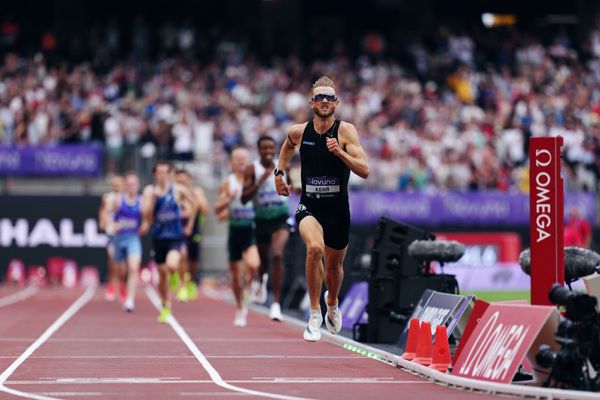
American Yared Nuguse, the fourth-fastest man in history over the mile, attempted to stick with the blistering pace but faded down the home straight, crossing second in 3:45.69. Great Britain's Jake Heyward rounded out the podium with a personal best of 3:46.73, while Germany's Robert Farken set a national record of 3:46.82 in fourth.
Preparations and Mindset
Kerr's journey to the start line was built on absolute adherence to routine. His meticulous buildup included ice baths lasting precisely three minutes and 42 seconds, alongside altitude training at his Albuquerque residence. Crucially, the Edinburgh athlete did not miss a single training session since capturing the world indoor title over 3000m in March.
Speaking before the race, Kerr noted how focusing primarily on the clock rather than direct tactical positioning reduced traditional racing variables. My body is capable of the mark, and so my job tomorrow is to have my mind to be available to let my body do its job,
Kerr said, as quoted by AP News.

Reflecting on the overwhelming emotional release after crossing the finish line, Kerr told the BBC: It's very overwhelming. I nearly lost it at the end, but I got over the line.
Historical Context and British Resonance
The mile occupies a revered space in British athletics lore, stretching from Roger Bannister's historic sub-four-minute barrier in 1954 through the legendary duels of Seb Coe and Steve Ovett. By reclaiming the ultimate global standard on home soil, Kerr firmly cemented his legacy in the event.
Yet, the afternoon carried contrasting fortunes for British athletics. While Kerr's audacious prediction materialized into reality, Olympic 800m champion Keely Hodgkinson saw her own world-record bid hampered by a freak training mishap. Hodgkinson won the women's 800m in 1:56.21—short of Jarmila Kratochvílová's 1983 mark of 1:53.28—after tripping over a protruding corner on a metal mesh drainage grate while cooling down in Wigan, sustaining painful cuts to both knees.
For Kerr, the risk of public failure carried significant weight, yet his tactical and mental conviction yielded a historic reward. With the world record now sitting in his favor, the 28-year-old has permanently altered the landscape of middle-distance running.
Sources
These sources formed the evidence pack for this article. Links open the original publisher; inclusion does not imply endorsement.
- skysports.com original
- Rachel Steinberg original
- worldathletics.org original
- Paul Eddison original
- the-independent.com original
- Nick Zaccardi Fri, July 17, 2026 at 5:04 PM UTC · 2 min read original
- apnews.com original