Related coverage
There is a particular kind of one-day international where the team batting first loses a wicket in the second over, rebuilds through one towering innings, and then watches the chase unravel in the space of 34 overs. The third ODI between India and England at the Narendra Modi Stadium on 12 February 2025 was that kind of game in its purest form. India finished on 356, lost all ten wickets inside 50 overs, and still won by 142 runs. The margin was less interesting than the way it was constructed: a single batter of authority, a middle order that refused to let the tempo dip, and a bowling attack that treated the reply like a problem to be solved over by over.
Six for one, then a century of intent
England won the toss and chose to bowl. Mark Wood rewarded the call almost immediately, finding Rohit Sharma's edge in the first over; Rohit departed for 1 off 2 balls, caught by Phil Salt, and India were 6 for 1 inside two overs. The stadium briefly considered a different afternoon. Then Shubman Gill decided it would not be different.
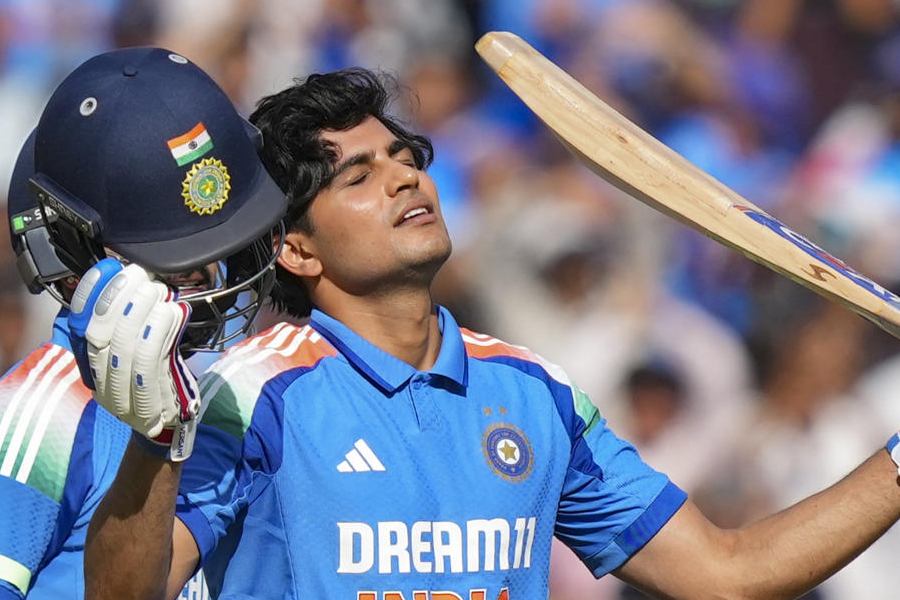
Gill's 112 off 102 balls did not glitter the way some centuries do. It did not need to. Fourteen fours and three sixes, yes, but the larger story was the architecture of the innings. He arrived with the wobble on, stayed through the middle overs when the ball was gripping, and accelerated only once the platform was solid. He was the third wicket to fall, bowled by Adil Rashid with the total on 226 in the 35th over, and by then the shape of the match had already been set.
Around him, three other innings did quiet but essential work. Virat Kohli's 52 off 55 balls steadied the innings through the middle phase before he fell in the 19th over, also to Rashid. Shreyas Iyer, who came in at three and batted through to the 38th, made 78 off 64 with eight fours and two sixes at a strike rate above 120 — the aggressor's role that turned a good total into a difficult one. KL Rahul's 40 off 29 at number five added the late acceleration that took India past 350, and Hardik Pandya's 17 off 9 gave the innings a final kick before the lower order fell.
Rashid held one end; the rest of the card thinned
Adil Rashid's 4 for 64 in ten overs was the kind of spell that, on most days, would be the headline. He took Gill, Kohli, Iyer, and Pandya — four of India's top six — and bowled his full allocation without a maiden but with a wicket every two-and-a-half overs. On a flat Ahmedabad surface with short straight boundaries, that was containment as much as it was attack.
The trouble for England was what happened at the other end. Mark Wood's 2 for 45 in nine overs was the only other performance of note from the seamers, and the rest of the card thinned quickly. Saqib Mahmood went for 68 in ten, Gus Atkinson for 74 in eight, Joe Root for 47 in five overs of part-time off-spin, and Liam Livingstone for 57 in eight without taking a wicket. India were allowed to score at 7.12 an over, and the asking rate for England's reply was always going to punish anything less than a flawless chase.
A chase that never found a gear
England's reply was less a chase than a slow study in how a target can feel insurmountable long before the mathematics say it is. Ben Duckett hit 34 off 22 with eight fours but fell in the 7th over with the score on 60; Phil Salt made 23 before following at 80 in the 9th. The Powerplay produced 80 for two, which on a different surface might have been a foundation. On this one, it was already a recovery.
Tom Banton's 38 off 41 was the only innings in the top seven that suggested the chase still had any real belief. Joe Root made 24, Harry Brook 19, Jos Buttler 6. Liam Livingstone scratched for 9 off 23 balls, the strike rate of a man who had already given up on the asking rate. Gus Atkinson's late 38 off 19, with six fours and a six, briefly suggested the margin might be smaller than it should have been, but by then the rest of the order was in the dressing room. England were bowled out for 214 in 34.2 overs; Rashid was the first batter dismissed in the chase, caught at the wicket, but the collapse had begun well before he walked off.
The Indian attack was less about individual brilliance than about collective suffocation. Axar Patel was the standout — 6.2 overs, one maiden, 2 for 22, finishing the innings when he castled Atkinson. Harshit Rana and Arshdeep Singh took two apiece with the new ball, the former conceding only 31 in his five overs and removing Buttler and Brook. Hardik Pandya's two came at the back end. Kuldeep Yadav and Washington Sundar shared three more. Six bowlers used, wickets spread across the innings, and the chase broken into manageable pieces.
A record at Lord's, five months later
There is a footnote to this match that does not appear on the Ahmedabad scorecard. India and England met again in the summer of 2026, with the series level at one apiece after India's six-wicket win in the opener at Edgbaston and a Joe Root-inspired four-wicket win for England at Cardiff. The third ODI at Lord's on 19 July 2026 was, this time, an actual series decider. According to the England and Wales Cricket Board, England posted what it described as a record-breaking 387 for three in that fixture — a reminder that the balance of power between these two white-ball sides has never stayed still for long.
But on a February afternoon in Ahmedabad, the balance belonged entirely to India. Gill's century, Rashid's resistance, and a bowling unit that asked the same patient question of every English batter and waited for the answer. Shubman Gill was named Player of the Match, and the only argument was whether he could have shared the award with the entire attack.
Sources
These sources formed the evidence pack for this article. Links open the original publisher; inclusion does not imply endorsement.
- skysports.com original
- timesofindia.indiatimes.com original
- Business Standard original
- ecb.co.uk original