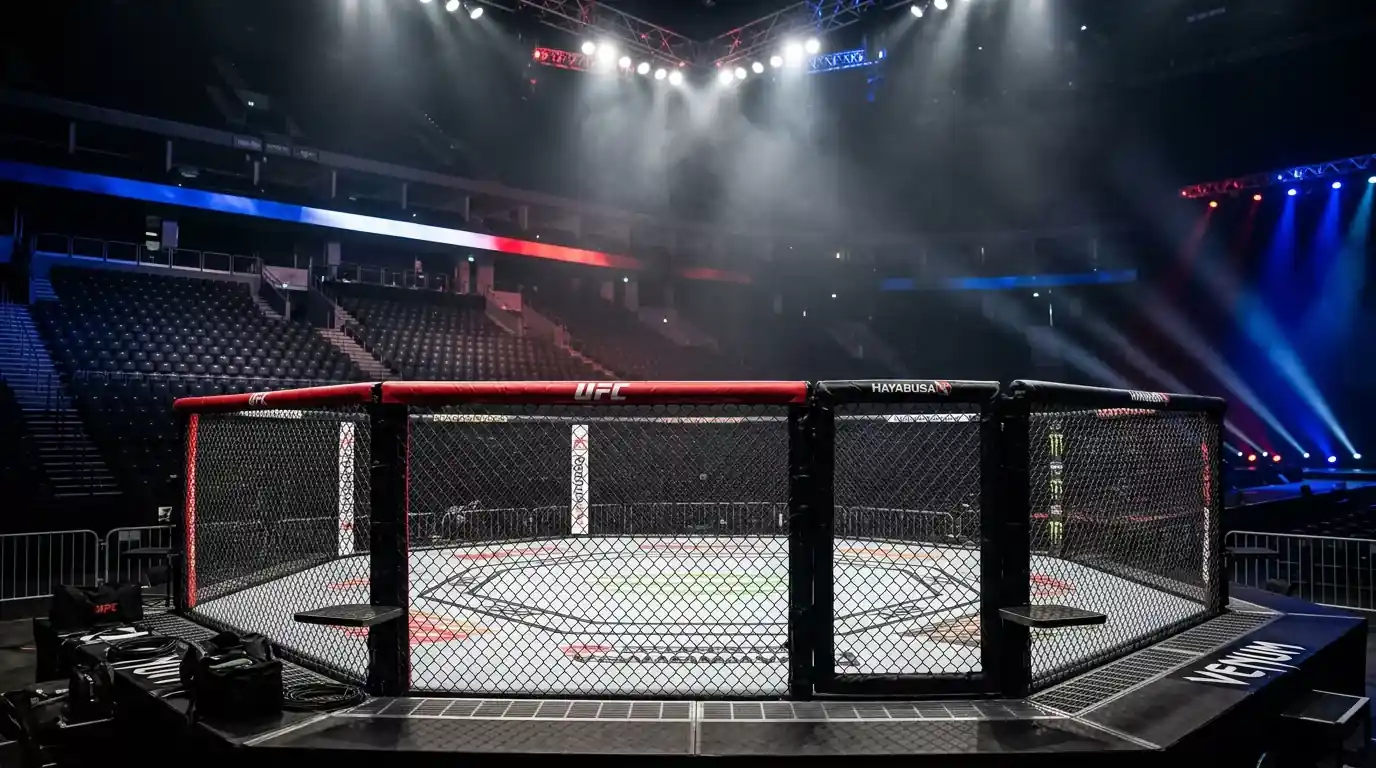
When mixed martial arts gained legal authorization in France in early 2020, critics treated the discipline as a niche experiment fighting for domestic legitimacy. Six years later, as the UFC prepares several European events across its 2026 calendar, those early doubts have been answered by economic reality. While official fight slates for 2026 remain subject to promoter announcements, industry projections point to Paris as a prime anchor for the UFC's European footprint. French MMA has completed a swift transition from an underground subculture to a major economic pillar, transforming domestic gaming regulation, operator marketing, and broadcast distribution.
Capitalizing on European Expansion: Projections for Paris in the 2026 Calendar
The UFC's sustained interest in Western Europe reflects a deliberate commercial calculation. Following successful local cards at venues like Paris's Accor Arena since authorization, Dana White and UFC leadership have repeatedly highlighted France as a priority growth hub. With the UFC scheduling multiple European stops for 2026, analysts view another return to Paris not as a novelty exhibition, but as a predictable component of the promotion's international strategy.
That trajectory is reinforced by domestic engagement metrics. Between 2023 and 2026, the number of active MMA bettors in France tripled. Wagering handle on fight cards expanded by an average of 65 percent annually over that three-year span—a velocity unmatched by traditional sports in the French market. This surge has elevated MMA into the Top 10 most wagered sports among licensed French bookmakers, proving that domestic audience interest extends far beyond casual event-night viewing.
The $23-Billion Machine Backing Western Europe’s Growth
Underpinning this regional footprint is the corporate machinery of TKO Group and the UFC. In 2025, the UFC generated $1.502 billion in revenue while delivering an Adjusted EBITDA of $851 million—a remarkable 57 percent operating margin that highlights the promotion's low overhead relative to team sports leagues. Powered by a $62.9 million year-over-year increase in corporate partnerships and marketing revenue, the UFC's overall top line expanded by $96 million in 2025, pushing its enterprise valuation to approximately $23 billion by late December 2025.

A transformative seven-year, $7.7 billion domestic broadcast rights agreement with Paramount further secures the promotion's international flexibility. Averaging over $1 billion annually—more than double its previous arrangement with ESPN—the deal ensures steady liquidity for a dense schedule of 42 to 43 annual events. Worldwide MMA volume has expanded from 100–110 major events in 2020 to 180–200 in 2025, driving overall industry revenues from $1.2 billion to over $2.2 billion. Major long-term sponsorships, such as the UFC's 10-year, $175 million deal with Crypto.com, provide additional financial stability as competitors like ONE Championship also scale their schedules (growing from 8 events in 2020 to 23 in 2024).
ANJ Oversight and the French Wagering Boom
The domestic framework supporting this commercial growth is managed by the Autorité Nationale des Jeux (ANJ). Formed in 2020 to replace ARJEL, the ANJ oversees roughly 78 percent of the French gambling market, compared to just 11 percent under the previous authority. The French online sports betting handle reached €6 billion in the first half of 2025 alone (+15 percent compared to H1 2024), generating €961 million in Gross Gaming Revenue (PBJ).
For full-year 2024, France's broader gaming market recorded €14 billion in PBJ (+4.7 percent year-over-year). Online sports betting contributed €1.8 billion (+19 percent) across 5.7 million active player accounts (+11 percent). Though established sports like football (€5.63 billion handle in 2024), tennis (€2.27 billion), basketball (€914 million), and rugby (€186 million) combined for 87.5 percent of total sports wagers, MMA firmly occupies the remaining 12.5 percent long-tail, generating reliable volume for licensed platforms.
Operator Partnerships and Changing Octagon Odds
Commercial operators have responded aggressively to the sport's legalization. Betclic executed a multi-region alliance with the UFC covering France, Portugal, and Poland—a deal praised by Betclic CEO Nicolas Beraud and UFC Vice President of Global Partnerships Nicholas Smith as an essential engine for localized fan engagement. Elsewhere in the market, Winamax partnered with Hexagone MMA in February 2025, while Parions Sport rebranded its platform to Unibet in late March 2026.
These commercial moves occurred alongside fiscal adjustments. On July 1, 2025, a 15 percent tax on operator advertising and promotional spend took effect to benefit the National Health Insurance Fund (CNAM). Despite this new tax, operator marketing budgets grew by nearly 11 percent in 2025. Led by President Isabelle Falque-Pierrotin, the ANJ continues to encourage lower-intensity play, focusing heavily on demographics where 30 percent of online sports bettors are aged 18 to 24, 15 percent are women, and average annual gambling spend per adult reached €258 in 2024 (up from €249 in 2023).
For analysts monitoring fight cards, performance trends reveal tightening competition across the roster. UFC favorites won at a 72 percent rate in 2024, but that figure dropped to 67.6 percent in 2025, as favorites logged 342 wins against 164 underdog upsets. As French combatants continue to sharpen defensive wrestling and striking efficiency, the projected 2026 European calendar arrives at a moment when French MMA is fully integrated into the global sports economy.
Sources
These sources formed the evidence pack for this article. Links open the original publisher; inclusion does not imply endorsement.
- pariersurcombatmma.com original
- pariermmaufc.com original
- operadeparis.fr original