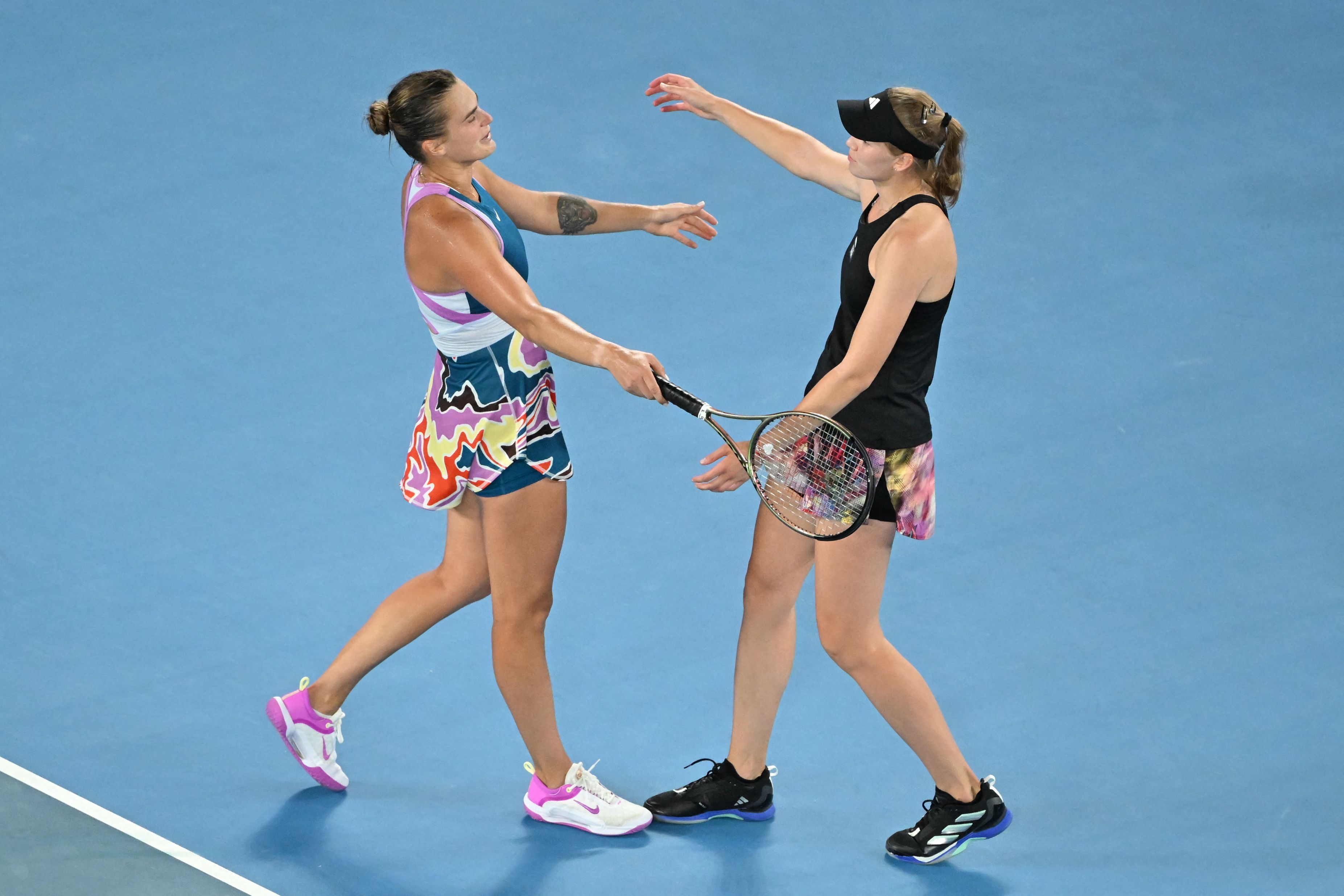
The professional tennis calendar offers little room for sentiment, marching relentlessly from hard courts to clay and back again, yet certain rivalries carve permanent grooves into the sport's landscape. When Elena Rybakina stands across the net from Aryna Sabalenka, the contest represents an elemental clash between two of the heaviest hitters on the women's tour. But what began as a series of tight, fluctuating battles has crystallized into a definitive tactical trend: on hard courts, Rybakina has emerged as the Belarusian's kryptonite, securing seven wins across their past nine encounters on the surface.
To understand how this dynamic shifted, one must look beyond basic scorelines and examine the physical chess match played out under heavy pressure. In their high-stakes encounters—ranging from the 2023 Australian Open final to subsequent hard-court showdowns—Sabalenka has frequently attempted to dictate terms with her trademark power and aggressive baseline pacing. Yet Rybakina's superpower lies in her ability to absorb pace, neutralize velocity with clean, flat ball-striking, and deploy clutch serving when the margins narrow to a razor's edge.

The Anatomy of a Hard-Court Turnaround
The tactical friction point in their matches invariably arrives when the scoreboard tightens. As demonstrated during dramatic championship moments where deficits vanish in a flurry of baseline exchanges, the capacity to remain unshakeable under duress separates top contenders from Grand Slam champions. Sabalenka, despite spending weeks at the summit of the rankings and maintaining dominant runs on hard surfaces, has occasionally battled late-match tightening. Conversely, Rybakina's statistical profile highlights a player capable of stringing together high-pressure holds:
- First-Strike Neutralization: Dampening opponent service momentum by blocking deep returns that deny early court control.
- Tiebreak Resilience: Converting long, grueling set-deciding sequences through high first-serve percentages.
- Top-10 Competence: Maintaining extended winning streaks against elite opposition from the quarterfinal stages onward.
This structural composure was famously underscored when Rybakina carved through a brutal draw to claim major hardware, mirroring historical milestones by defeating multiple top-10 players in the late rounds—a feat previously achieved by Naomi Osaka during her 2019 ascent. Winning matches against elite opposition requires more than raw power; it demands the tactical patience to weather five-game skids and immediately reset on serve.
Surface and Tournament Stakes
The broader WTA narrative shows that hard-court tennis rewards absolute precision over mere aggression. While Sabalenka remains a formidable force with deep runs across major hard-court finals, Rybakina's post-Wimbledon win tallies and consistency in tight matches signal a player operating at peak tactical efficiency. When opponents begin to overhit under the weight of a closing championship window, Rybakina's ability to maintain a neutral ball flight changes the geometry of the court, forcing opponents to manufacture angles they would rather avoid.
As the tour continues its hard-court swing, the psychological ledger between these two champions has fundamentally altered. Sabalenka knows that any dip in service percentage will be met with immediate, clinical exploitation. For Rybakina, the challenge shifts from chasing a breakthrough to protecting a hard-earned psychological edge—proving that on the tour's fastest surfaces, quiet composure remains the most devastating weapon of all.
Sources
These sources formed the evidence pack for this article. Links open the original publisher; inclusion does not imply endorsement.
- wtatennis.com original
- bbc.com original
- tbtennis.cz original