Related coverage
When the Prudential Center in Newark prepares for a high-stakes championship card, the baseline expectation usually involves a standard rotation of athletic commission officials, cutmen, and promotional staff. But fight week for UFC 328 operated under an entirely different meteorological forecast. The threat level was elevated not merely by the presence of two elite athletes colliding at the apex of the 185-pound division, but by a toxic brew of gym folklore, cultural vitriol, and open threats of real-world violence that prompted the deployment of additional uniformed police officers.
At the center of the tempest sat middleweight champion Khamzat Chimaev, defending the belt he claimed from Dricus Du Plessis, and challenger Sean Strickland. Their friction originated long before the UFC matchmaking office sketched out a main event. Back when both men shared the mats at Xtreme Couture in Las Vegas, what began as sparring sessions metastasized into a bitter narrative war. Chimaev maintained that he routinely dominated and submitted the American during those workouts, while Strickland countered by blasting Chimaev's training etiquette, claiming the undefeated star burned through his gas tank by treating casual rounds like undisputed title fights.
Security Logistics and the Theater of Threats
The animosity spilled far beyond standard promotional trash talk during the build-up. Chimaev openly teased the possibility of confronting Strickland in a hotel lobby with his associates, remarks that provoked a volatile response from Strickland, who stated he would rely on stand-your-ground principles to meet any multi-person confrontation with lethal force. The rhetoric forced the promotion and local authorities to take unprecedented precautions, separating the fighters into different hotels and embedding police officers around the clock.
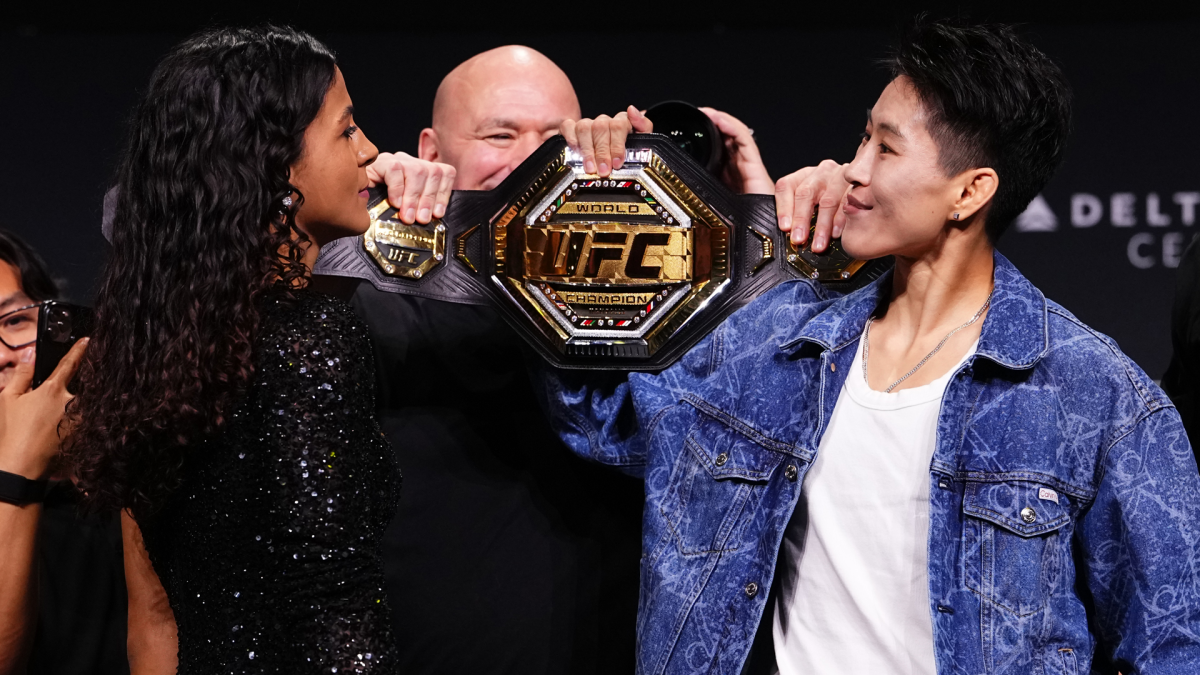
Flyweight contender Tatsuro Taira, co-headlining the event against champion Joshua Van, captured the surreal atmosphere best during media day, noting that the heavy police presence made the arena feel less like a standard fight card and more like a film set.

Yet, despite trading verbal barbs that crossed deeply personal boundaries—with Strickland leaning into inflammatory insults and Chimaev expressing amusement while camping out in hotel lobbies—Strickland maintained a pragmatic view of the corporate stakes. As he acknowledged during media availability, the promotion had invested millions into the fixture, ensuring that corporate financial self-preservation would ultimately keep the combat confined to the canvas.
Stylistic Divergence Inside the Octagon
Beyond the backstage logistics and security cordons, the matchup presented a fascinating study in stylistic opposites. Strickland's path to the championship was forged through an upright, defensive boxing shell, unrelenting forward pressure, and an engine designed to drown opponents in volume. He relies on disciplined parrying and steady pacing rather than reckless power.
Chimaev, conversely, represents the sport's most terrifying early-round storm. Operating with explosive wrestling entries, ferocious body-lock control, and suffocating ground-and-pound, his objective is immediate devastation. The fundamental tactical question of their pairing was whether Chimaev could secure an early finish before his tank emptied, or if Strickland could weather the initial wrestling onslaught, stuff the takedowns, and take over the later rounds as fatigue set in.
Ultimately, the collision in Newark proved that modern mixed martial arts occasionally struggles to contain the genuine animosity generated when conflicting personalities, gym reputations, and clashing cultures occupy the exact same weight class. While the heavy police presence and separated quarters successfully protected the promotion's investment ahead of fight night, the rivalry underscored the fine line combat sports walk between manufactured hype and raw, unpredictable human friction.
Sources
These sources formed the evidence pack for this article. Links open the original publisher; inclusion does not imply endorsement.
- wrestlinginc.com original
- ufcfight.net original
- sherdog.com original
- nypost.com original