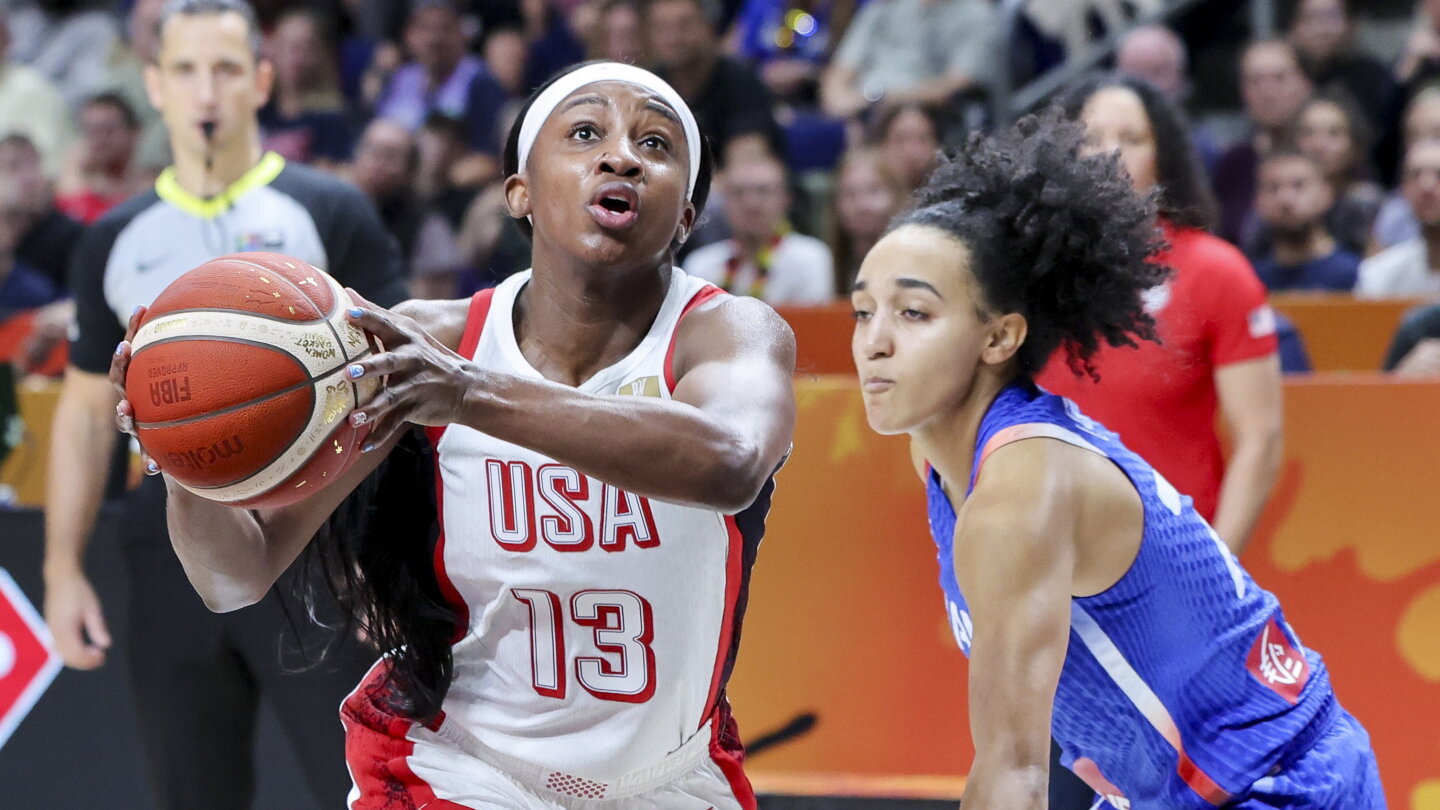
The margin between international basketball dominance and a monumental upset has never been thinner. At the FIBA Women’s Basketball World Cup in Berlin, the United States captured its fifth consecutive World Cup gold with a 97-79 victory over France, but the path to victory underscored a rapidly shifting international hierarchy. Facing a 14-point second-quarter deficit against a French squad featuring eight WNBA players, the Americans relied on veteran composure and a decisive second-half adjustment to extend their historic winning streak.
The triumph marked the U.S. program's 36th consecutive World Cup victory dating back to 2006 and its 72nd straight win across World Cup and Olympic competition. Yet the tournament in Berlin proved that top-tier international rivals are closing the gap, requiring precise execution and split-second tactical adaptability under high-pressure conditions.
Surviving Berlin: USA’s Hard-Fought World Cup Crown
Under head coach Kara Lawson, who succeeded Cheryl Reeve following the Paris Olympics, the U.S. roster featured seven players making their senior 5x5 global championship debut. The transition was tested early. France vaulted to a 31-17 lead early in the second quarter behind Golden State Valkyries All-Star Gabby Williams, who torched the perimeter for 16 first-half points.
Lawson’s team responded with a relentless 30-12 third-quarter run, stifling Williams to 1-of-7 shooting after halftime. Tournament MVP Breanna Stewart powered the comeback with 22 points and 10 rebounds, becoming the first American player to record a 20-10 stat line in a FIBA World Cup final since Lisa Leslie in 1998. Veteran starters Jackie Young (18 points, six rebounds, five assists), Kahleah Copper (15 points), and Chelsea Gray (12 points, five assists) provided critical stability.
blockquote>“These (other) teams are always continuing to be better, but we’re the standard,” Stewart said after the final. “We always have been.”
The Americans achieved gold despite playing without reigning Olympic and WNBA MVP A'ja Wilson, who withdrew shortly before the tournament for health reasons. The young bench core stepped up, led by Caitlin Clark's 12 points in the final and team-high 5.3 assists per game across the tournament, alongside impactful minutes from Aliyah Boston, Rhyne Howard, and Angel Reese.
blockquote>“There was a lot of noise out there,” Gray noted. “I’m pretty sure we quieted that a little bit.”
Global Parity and Tactical Friction in International Hoops
The Berlin campaign revealed that blowout margins are no longer guaranteed for USA Basketball. Prior to the final, the U.S. survived a narrow three-point victory over Italy in group play—its closest World Cup game since losing in the 2006 semifinals—and found itself tied with Spain after three quarters in the semifinals before pulling away for a 76-66 win.
This tightening balance reflects broader global growth across both men's and women's international competitions. In modern elite basketball, time management, execution in transition, and precise clock control determine tournament outcomes as domestic leagues and global events increasingly align.
Precision Stars: Lillard, Parker, and Germany's Wagner Brothers
The sport's global footprint relies heavily on elite athlete ambassadors who showcase composure under timing pressures. Swiss watchmaker Tissot—the Official Timekeeper of the NBA, WNBA, Tour de France, and MotoGP—has built its basketball connection through players accustomed to high-stakes moments:
- Damian Lillard: The multi-time NBA All-Star and 2013 Rookie of the Year, drafted sixth overall in 2012, earned the nickname
Dame Time
for his late-game heroics. Expressing his affinity for wristwear, Lillard noted:I like attractive, accessible watches that adapt to every style. That’s why I love Tissot.
- Tony Parker: Standing 1.88 m, the retired French guard won four NBA championships and earned six All-Star selections with the San Antonio Spurs and Charlotte Hornets before turning his focus to mentoring the next generation.
- Moritz and Franz Wagner: The German brothers developed through ALBA Berlin and the University of Michigan before entering the NBA. In 2023, they anchored the German national team during its historic run to its first-ever FIBA World Cup title.
Sources
These sources formed the evidence pack for this article. Links open the original publisher; inclusion does not imply endorsement.
- tissotwatches.com original
- nbcsports.com original
- cassinopix-au.com original