
In high-stakes combat sports, viral clips often obscure the nuanced mechanics of elite competition. Internet chatter surrounding Umar Nurmagomedov frequently inflates a moment of real danger into hyperbolic narratives. While his professional record remains unblemished, his recent bout against Bezkat Almakhan featured a jarring flash knockdown in the opening minute. Nurmagomedov was not knocked out, but the exchange exposed specific, repeatable habits in his striking system that future opponent Cory Sandhagen and newly crowned bantamweight champion Merab Dvalishvili—who recently dominated Sean O'Malley at UFC 306—are bound to dissect.
Having spent over a year preparing for Sandhagen following their cancelled August 2023 matchup, Nurmagomedov presents a fascinating study. Despite a past image posted by his manager showing a broken hand during his rise, the undefeated contender continues to climb the 135-pound ladder through a distinct blend of dynamic kicking and suffocating cage wrestling.
Dissecting the Knockdown: Flaws and Flash Mechanics in Umar's Stance
Operating primarily from a southpaw stance, Nurmagomedov employs a much flashier striking palette than traditional Dagestani grapplers. His long-range offense relies heavily on a whipping lead-leg high kick and a front teep. Against orthodox opponents, kicking to the closed side limits conventional target selection between hip and shoulder. To overcome this spatial restriction, Nurmagomedov utilizes an exaggerated turnover on his question mark kick, sneaking the strike over his opponent's lead shoulder as they step forward into range. While it noticeably stunned Sergey Morozov, the technique functions more as a distance-managing distraction than a power shot.
More functional is his teep, a weapon he shares with his teammate, Bellator lightweight champion Usman Nurmagomedov. While the teep tenderizes the midsection when opponents maintain a tight guard, even Khabib Nurmagomedov has publicly noted that Umar's pure boxing remains a work in progress. Rather than engaging in sustained pocket exchanges, Nurmagomedov prefers navigating between long kicking range and clinch depth. He demonstrated clean power when knocking out Raoni Barcelos with a short left hand off a knee, yet his rear left hand often remains an afterthought during standard boxing sequences.
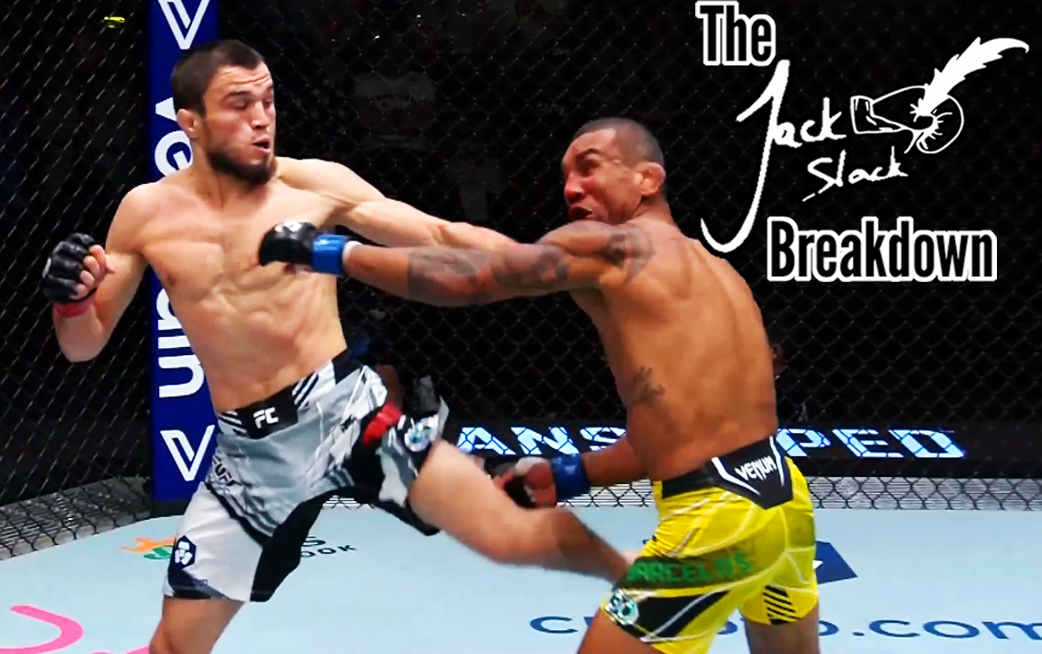
Inside Foot Mechanics and the Rockhold Blueprint
When operating from the inside foot position, Nurmagomedov frequently relies on single jabs and a specific counter reaction when pressed. When opponents return fire or disrupt his balance, his immediate defensive reflex is to retreat, blade his stance, and throw a wide southpaw right hook. Additionally, when his teeps are knocked offline, he frequently gets crossed up and attempts to run backward to reset his distance. It was precisely this crossed-up balance error that allowed Bezkat Almakhan to drop him early in their fight.
This reliance on a leaning lead-hook escape mirrors former UFC champion Luke Rockhold. Rockhold repeatedly relied on a lean-back right hook as his primary defensive escape. Opponents eventually timed this habit: Michael Bisping caught Rockhold crossed up after a jab on the inside foot angle, and Yoel Romero exploited Rockhold's bladed retreat by firing a straight left down the middle inside his wide hook counter. While Tenshin Nasukawa demonstrated fluid two-handed combinations from the inside foot angle and Miguel Cotto used inside steps to drop Sergio Martinez three times in one round, Nurmagomedov's single-shot habits present clear targets for high-level counter-strikers.
Level Changes, Crackdowns, and Cage Control
Where Nurmagomedov separates himself is his instantaneous transition from striking peril to wrestling control. Much like his teammate Ikram Aliskerov, the moment heavy strikes come back at him, Nurmagomedov initiates his level change. Immediately after being dropped by Bezkat Almakhan, Nurmagomedov attacked a takedown to smother follow-up damage before dominating the remainder of the contest on the mat.
A key element of his wrestling repertoire is finishing head-outside single legs using the crackdown. Popularized in MMA by grapplers such as Jake Shields and Rani Yahya, the crackdown grounds the opponent's hip to the mat, turning a scrambled single-leg defense into a controlled floor sequence. Once established on the mat, Nurmagomedov transitions smoothly to back control, boasting six rear-naked choke victories among his nine professional finishes. By pressing opponents against the cage while taking the backpack position, he forces defenders to post weight on their arms, allowing him to use both hands to strike and secure submissions without relinquishing control.
The core narrative of Umar Nurmagomedov's career is not a fictional knockout defeat, but whether elite 135-pounders can exploit his specific striking habits before his superior cage wrestling takes over. As long as his takedown transitions remain an unyielding escape valve, solving his striking tendencies remains one of the toughest puzzles in the bantamweight division.
Sources
These sources formed the evidence pack for this article. Links open the original publisher; inclusion does not imply endorsement.
- fightprimer.com original
- mmafighting.com original
- fights.cz original


