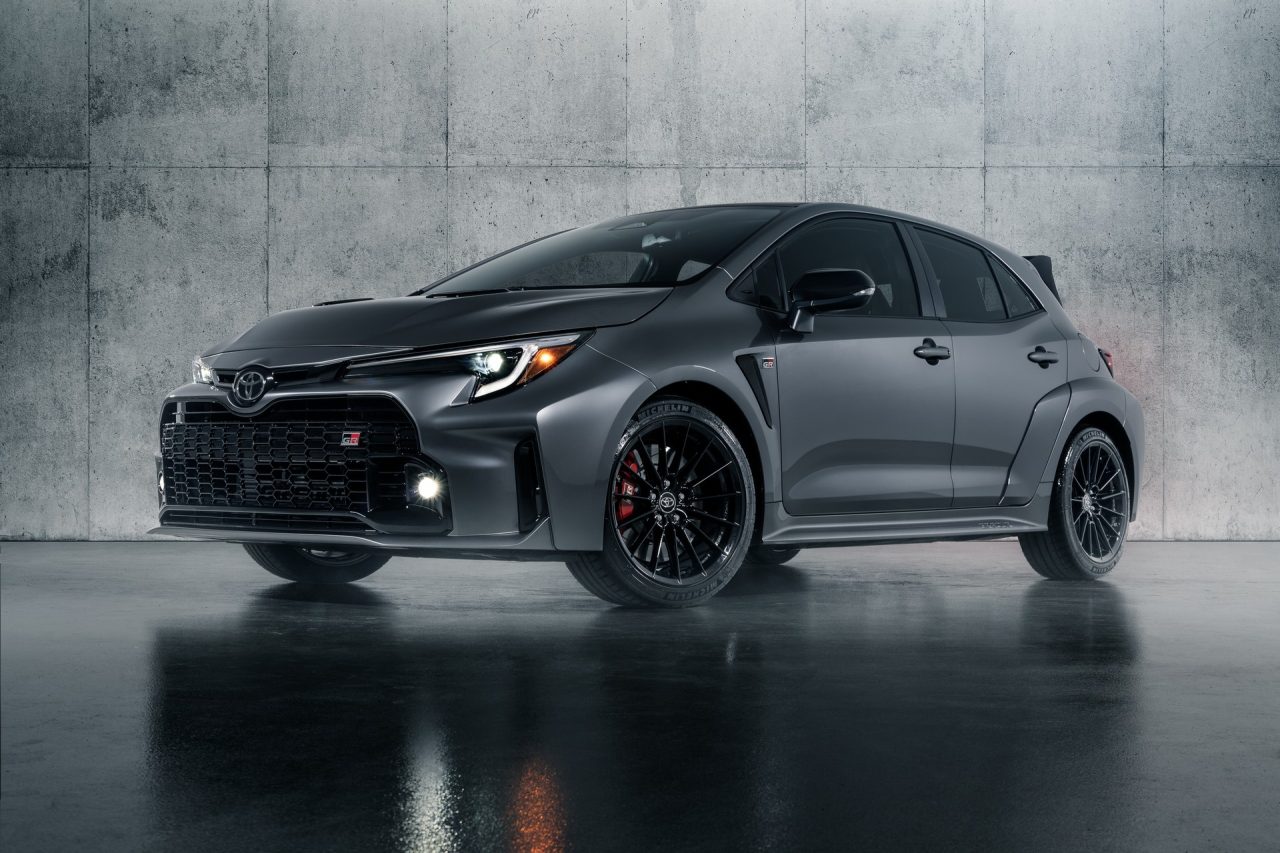
For decades, Toyota built the Corolla line around everyday reliability and efficient commuting. The Gazoo Racing model flips that legacy on its head. By fitting a high-boost 1.6-liter turbocharged three-cylinder engine into a stiffened TNGA-C platform, Toyota created a 300-horsepower hot hatch designed to take on established performance benchmarks like the Volkswagen Golf R.
Engineering the Turbocharged AWD Core
The standout feature of the GR Corolla is its rally-inspired powertrain. The 1.6-liter turbocharged three-cylinder motor generates 300 horsepower and 370 Nm of maximum torque. That nearly doubles the output of the standard four-cylinder version, which produces 168 horsepower and 251 Nm of torque. Power is delivered exclusively through a six-speed manual transmission and routed to all four wheels via an adaptable all-wheel-drive system.
To manage varied surfaces, drivers can select between three torque distribution ratios:
- 60:40 split
- 50:50 split
- 30:70 split
These adjustable settings ensure the drivetrain can handle any traction demands. Power transfer across both axles is optimized by front and rear self-locking limited-slip differentials.
Chassis Stiffening and Braking Hardware
Adapting the TNGA-C platform to handle 300 horsepower required targeted structural enhancements. Engineers incorporated additional welding points and applied structural adhesive to increase joint rigidity. Reinforced suspension components work alongside aluminum body construction to keep weight under control. At 1,474 kg, the GR Corolla weighs just 85.7 kg more than the standard hatchback baseline.
The car rolls on 18-inch alloy wheels wrapped in Michelin Pilot Sport 4 tires, backed by dedicated performance brakes:
Segment Comparisons and Cabin Technology
In the competitive hot hatch landscape, the GR Corolla positions itself right next to top-tier rivals. The Volkswagen Golf R holds a minor 15-horsepower edge in total output, but Toyota counters with a manual gearshift, mechanical limited-slip differentials, and versatile torque splits.

This aggressive orientation sits alongside the broader Corolla lineup, where standard hybrid models focus on high efficiency and practical daily driving. Hybrid variants in the line produce between 103 kW (140 hp) and 131 kW (178 hp) using e-CVT automatic transmissions. In consumer reporting, the model line earns strong marks, including a 9.0/10 rating from Dutch organization Consumentenbond, while Toyota holds a 22.0% average defect rate in TÜV Report evaluations (3rd out of 14 evaluated brands).
Inside the cabin, driver information is presented through a 12.3-inch digital instrument panel alongside an 8-inch central infotainment display. Track-inspired touches include fabric sport seats with gray stitching, metal pedals, a leather sport steering wheel, and an eight-speaker audio system. Safety equipment remains comprehensive with the Toyota Safety Sense 3.0 suite, incorporating adaptive cruise control, blind spot detection, and rear cross-traffic alert.
Sources
These sources formed the evidence pack for this article. Links open the original publisher; inclusion does not imply endorsement.
- kladno.toyota-louwman.cz original
- highmotor.com original
- letiste.toyota-louwman.cz original
- autohled.cz original