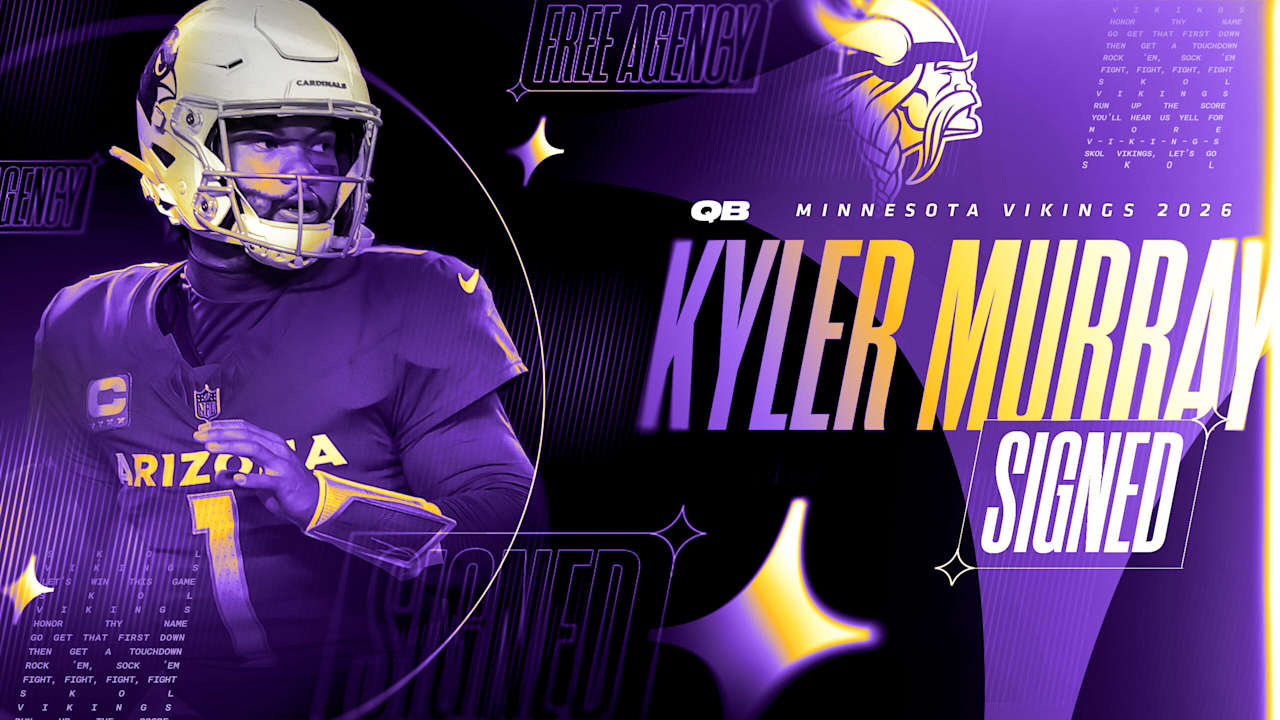
The Gjallarhorn may sound with its characteristic minor sixth interval to celebrate big plays and touchdowns, but for the Minnesota Vikings, the loudest sound this week was the silence of a decision finally made. After a two-week training camp battle that gripped the Skol Nation, the Vikings have officially named Kyler Murray as their QB1, opting for veteran stability in a franchise long searching for a consistent hand under center.
The decision to crown Murray over the 23-year-old J.J. McCarthy is not merely a personnel choice; it is a philosophical statement from a front office in transition. Following the departure of former General Manager Kwesi Adofo-Mensah, Executive Vice President of Football Operations Rob Brzezinski has been tasked with navigating the 2026 offseason. By selecting Murray, the Vikings are signaling a desire to maximize their current window, perhaps driven by the palpable frustration of stars like Justin Jefferson, who has been vocal about the difficulties of playing behind inconsistent quarterback play.

A Resume Built on Precision and Mobility
The logic behind the Murray selection is rooted in a statistical profile that is as rare as it is explosive. Murray enters the Vikings' room not as a developmental project, but as a proven high-volume producer. During his tenure with the Arizona Cardinals, Murray completed 1,974 of 2,941 passes for over 20,000 yards, posting a career completion percentage of 67.1%—a figure that ranks fifth all-time in NFL history among players with significant attempts.
Beyond the pocket, Murray offers a dual-threat capability that few in the league can match. He joins an elite tier of quarterbacks—including Josh Allen—who have achieved more than 20,000 passing yards and 3,000 rushing yards in 85 or fewer games. This mobility is a critical component of Kevin O'Connell's offensive scheme, providing a layer of unpredictability that can stress even the most disciplined defenses.
- Career Passer Rating: 92.2
- Touchdown Production: 121 career passing touchdowns
- Efficiency: 67.1% career completion percentage
- Dual-Threat Status: One of only two QBs to hit 20k passing/3k rushing in 85 games or fewer
However, the decision is not without its cautionary tales. Murray's rookie campaign, while earning him AP Offensive Rookie of the Year honors, saw him sacked an NFL-high 48 times. The Vikings' ability to protect him will be the barometer for his success in Minnesota.
The McCarthy Dilemma: Talent vs. Timing
If Murray represents the immediate answer, J.J. McCarthy represents the complicated future. The 2024 first-round pick showed flashes of brilliance, going 6-4 in his first 10 career starts, but his momentum was derailed by a 2025 season defined by physical setbacks. A high-ankle sprain, a concussion, and a hand injury effectively limited his ability to establish a rhythm.
The coaching staff's decision to move forward with Murray raises urgent questions about the role of a 23-year-old former first-round pick. As the Vikings aim to deepen their quarterback room—which also includes 2025 undrafted rookie Max Brosmer—the tension lies in whether McCarthy can remain a committed student of the game as a backup, or if the perceived ceiling of his opportunity will necessitate a move elsewhere. For now, the Vikings have chosen to prioritize the veteran who has already surpassed early training camp expectations over the young talent tasked with waiting his turn.
"The Vikings said in January that they wanted to make the quarterbacks room as deep and competitive as possible this offseason."
With the organizational shift under Brzezinski, the mandate is clear: build a room where competition drives excellence, even if that competition results in a difficult reality for one of the franchise's brightest young prospects.
Evidence-Led Forecast: The Murray Era Tactical Blueprint
Likely Tactical Pattern: Expect an offense that leans heavily on Murray’s ability to extend plays. While the Vikings have historically struggled to find success in the run game under O'Connell, Murray’s presence should force defenses to account for the quarterback as a primary rushing threat, potentially opening up lanes for the ground game and creating more space for Justin Jefferson in the intermediate passing game.
Decisive Matchup: The effectiveness of the Vikings' offensive line against opposing edge rushers. Given Murray’s history of absorbing high sack totals early in his career, his ability to navigate pressure without losing efficiency will be the determining factor in Minnesota's success.
Strongest Counter-Case: A regression in Murray's health or mobility. His 2025 season was limited to just five games; if the physical toll of his high-mobility style manifests in Minnesota, the Vikings may find themselves prematurely returning to the McCarthy era.
What Would Change the Read: A significant failure in the Vikings' improved run game. If the offense remains one-dimensional, the predictable nature of Murray's passing attacks may allow defenses to sit on routes, negating the very stability the front office sought to acquire.
Sources
These sources formed the evidence pack for this article. Links open the original publisher; inclusion does not imply endorsement.
- essentiallysports.com original
- vikings.com original
- nytimes.com original
- newsweek.com original