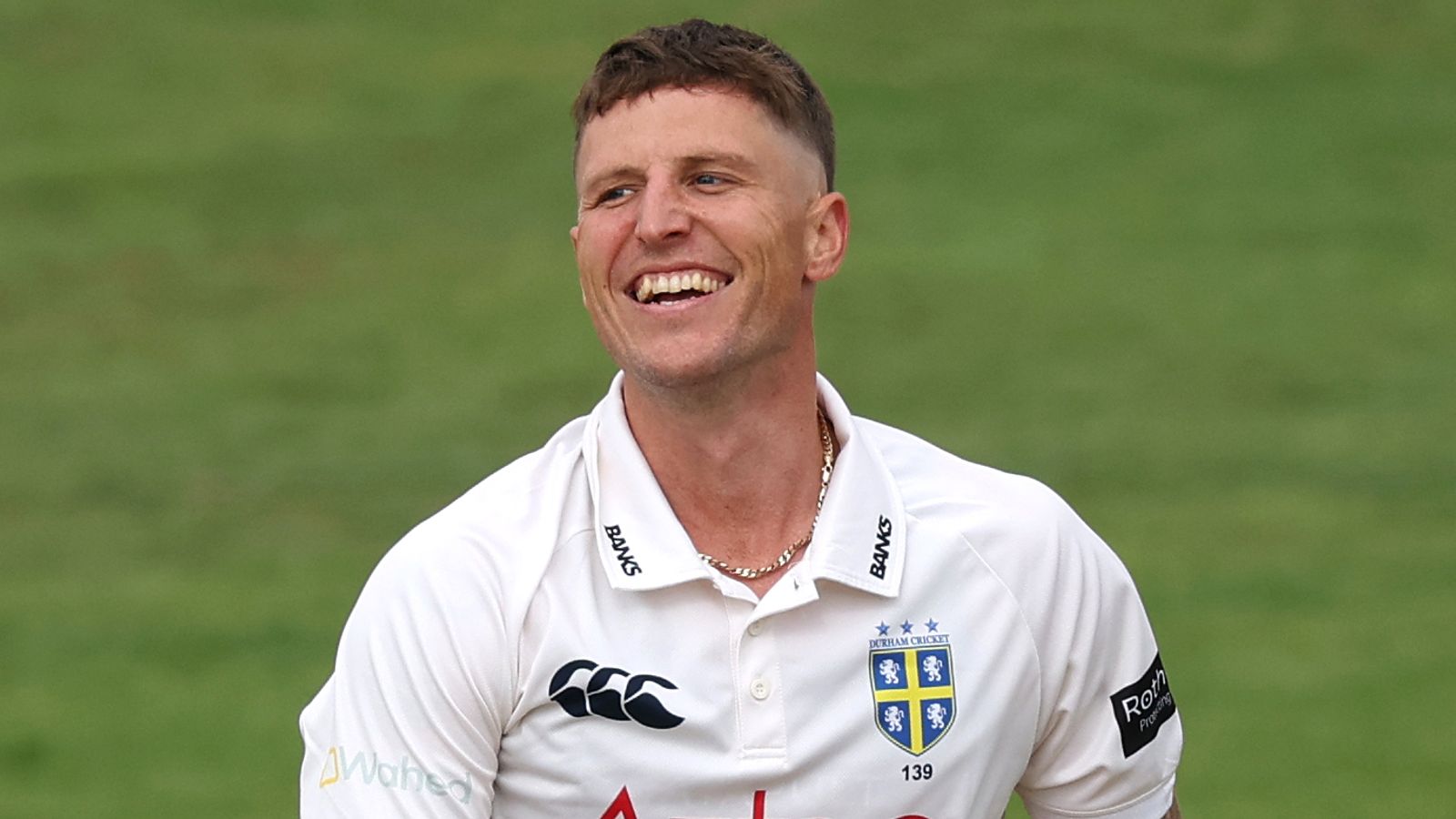
The selection for England’s upcoming ODI tri-series in Pakistan is less a standard squad announcement and more a high-stakes tactical pivot. By recalling Mason Crane—an eight-year absentee from the international arena—and opting to rest the indispensable Jofra Archer, Brendon McCullum is signaling a deliberate shift in how England will navigate the congested white-ball calendar leading into next year’s 50-over World Cup in southern Africa.
The Eight-Year Resurrection
The most striking movement in the squad is the return of Glamorgan’s Mason Crane. For the 29-year-old leg-spinner, the call-up marks a journey nearly a decade in the making, following a solitary Test cap against Australia in Sydney in 2018. Crane is not merely filling a gap; he is occupying a space created by the recent struggles of Rehan Ahmed, who was dropped following England's 2-1 victory over Sri Lanka.
Crane’s resurgence is underpinned by a summer of profound domestic evolution. He arrives in Pakistan having claimed 34 wickets in the County Championship and, crucially, having added a new dimension to his game by recording his first two first-class hundreds. National selector Marcus North defended the decision, describing Crane as an "experienced, high-class leg-spinner who thoroughly deserves another opportunity at international level."
This selection effectively places Crane in the middle of a broader battle for supremacy within England's Test spin department, providing McCullum with a seasoned option to navigate the subcontinent's demanding conditions.
Calculated Absences and the Winter Blueprint
While Crane’s inclusion provides a boost, the squad is defined as much by who is missing as who is present. The absence of Jofra Archer is a calculated move in a wider strategy of workload management. As a first-choice player across all three formats, Archer’s rest in Pakistan suggests a highly structured plan to preserve his availability for the heavy winter period, which includes a tour of Australia in November and three crucial Tests in South Africa in December.
The injury list remains a complicating factor for the leadership. Jos Buttler, a cornerstone of the white-ball setup, will miss the trip due to a recently sustained hamstring injury, while Jacob Bethell continues his recovery from knee surgery. Additionally, Brydon Carse remains absent amid an ongoing investigation by the Cricket Regulator regarding an incident in Derby this past August.
However, the squad gains significant depth with the returns of Sam Curran and Adil Rashid. The inclusion of uncapped players James Coles and Henry Crocombe further demonstrates England's intent to expand their talent pool ahead of the World Cup.
Chasing the Art of the Reverse
For the younger members of the squad, the Pakistan tour represents a specialized developmental laboratory. Sonny Baker, the 23-year-old Hampshire seamer and recent PCA Young Player of the Year, is widely expected to take the new ball in the absence of Archer and Carse. For Baker, the mission is specific: mastering the craft of reverse swing in what he describes as the art-form’s "spiritual home."
"In Pakistan it would be reverse-swing, trying to bang my yorkers, and learn about executing skills in those conditions," Baker noted, emphasizing a desire to segment his career development through targeted skill acquisition.
This focus on seam movement is timely. Recent regulation tweaks—which involve starting the innings with two new Kookaburra balls before reverting to one for the final 16 overs—have made death-over power-hitting more difficult. If Baker and the emerging Crocombe can weaponize the reverse ball, England may find a tactical advantage that offsets the loss of raw pace.
A Rotating Support Structure
The logistical complexity of the tour is mirrored in the coaching setup. As England continues to refine its backroom hierarchy following the appointment of Stephen Fleming as Test coach, the Pakistan trip will see a pared-back support staff. While McCullum remains at the helm, he will be assisted by Jeetan Patel, Mike Yardy, David Saker, and Carl Hopkinson.
In a move toward squad and staff rotation, Marcus Trescothick, Sarah Taylor, and Tim Southee will miss the Pakistan leg, though all three are expected to feature in other tours this winter. This rotation highlights the era of specialized, period-specific coaching that characterizes the current England setup.
Evidence-Led Forecast: Pakistan Tri-Series
Expected Tactical Pattern: England will likely adopt a spin-heavy approach, utilizing Crane and Rashid to choke the run rate in the middle overs, while relying on the technical discipline of Baker and the new ball to exploit early movement in Rawalpindi and Lahore.
Decisive Matchup: Mason Crane vs. the Pakistani middle order. If Crane can replicate his domestic form of taking wickets through turn rather than just containment, England can dictate the tempo of the round-robin stage.
Strongest Counter-Case: The lack of frontline, high-velocity pace. Without Archer and Carse, the seam attack may struggle if the pitch surfaces provide little assistance for traditional swing, leaving the burden entirely on the spinners.
What would change the read: Any late injury to Adil Rashid or Sam Curran would force England to rely even more heavily on the uncapped Coles or Crocombe, potentially destabilizing the balance of the bowling attack.
Sources
These sources formed the evidence pack for this article. Links open the original publisher; inclusion does not imply endorsement.
- visitengland.com original
- bbc.co.uk original
- theguardian.com original
- worldatlas.com original