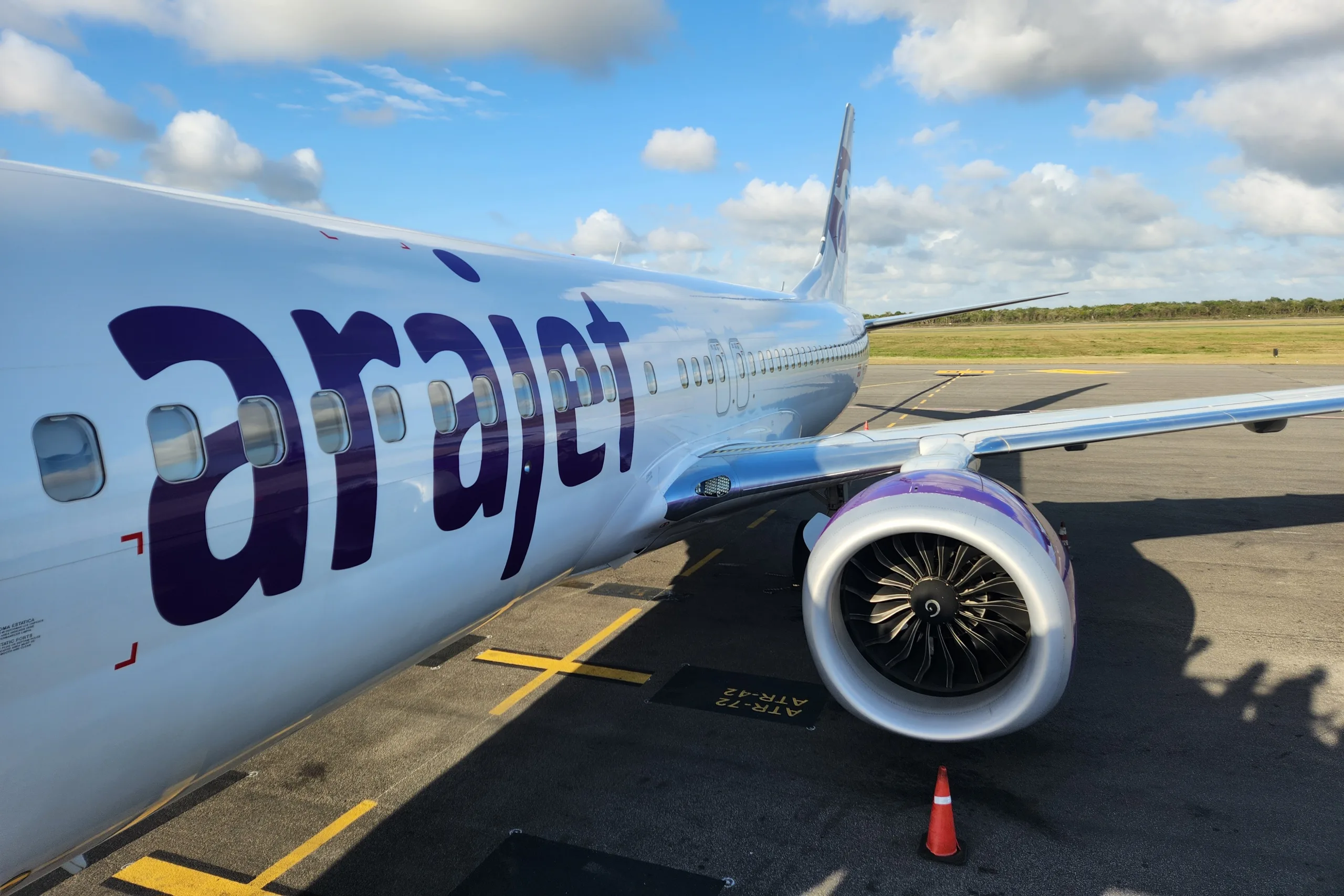
For a carrier that has maintained a relatively low profile in the global aviation consciousness, Arajet is making a series of aggressive, high-stakes moves that suggest a much larger ambition. Founded in 2022, the Dominican Republic’s flag carrier is no longer content with simply being a regional player; it is actively restructuring its entire operational DNA to bridge the massive gap between Northern markets like Canada and the deep reaches of South America.
The most significant tell of this ambition is a major strategic recalibration that took effect during the 2024/25 IATA winter schedule. While the airline originally intended to build its pan-American hub around the capital, Santo Domingo (SDQ), it has since pivoted, realigning its network to establish Punta Cana (PUJ) as its primary hub, while maintaining a smaller secondary base in the capital.
The Punta Cana Pivot: Prioritizing the Beach over the Bureaucracy
The logic behind the shift is a masterclass in market capture. Santo Domingo serves as the political and administrative heart of the country, but Punta Cana is the undisputed heavyweight of Dominican tourism. By moving its main hub to the coast, Arajet is positioning itself to capture two distinct revenue streams simultaneously: the high-volume leisure traveler seeking tropical vacations and the transit passenger looking for a gateway to the rest of the Americas.
This shift has come with direct consequences for Canadian travelers. The airline has transitioned its services from Toronto (YYZ) and Montreal (YUL) away from Santo Domingo and directly toward Punta Cana. The scale of these operations is expanding; flights between Punta Cana and Toronto are scheduled to move from five times weekly toward a daily frequency, while Montreal services are slated to increase from five to six weekly flights. For those still intent on visiting the capital, Arajet has integrated a bus service from Punta Cana into its air tickets, ensuring the connection remains seamless even as the flight paths change.
The Hub-and-Spoke Anomaly: A Different Kind of Low-Cost
In the world of low-cost carriers (LCCs), the standard operating procedure is point-to-point travel—direct, simple, and efficient. Arajet, however, is breaking the mold by operating a "hub-and-spoke" model, a tactic usually reserved for legacy giants. This allows them to facilitate complex connections throughout Latin America and the Caribbean, effectively acting as a regional bridge.
This model has profound implications for how the airline prices its seats. Unlike traditional legacy carriers that might penalize passengers for booking one-way segments, Arajet’s pricing is based on the origin and final destination rather than the sum of individual flight segments. "The airline’s flights are thus priced based on the origin and final destination, rather than the cumulative sum of each flight segment’s cost," which allows for significant savings on complex routings.
The Boeing 737 MAX 8: The Long-Haul Engine
The backbone of this expansion is a modern, uniform fleet of 10 Boeing 737 MAX 8 aircraft. The choice of the MAX 8 is tactical; with a maximum range of 3,500 nautical miles, the airline isn't just hopping between islands. They are capable of eight-hour journeys reaching as far as São Paulo (GRU), Santiago de Chile (SCL), and Buenos Aires (EZE).
While the fleet is optimized for long-range versatility, the onboard experience remains strictly within the "low-price" mandate. The interior configuration is a practical 3-3 layout with slimline seats, though a small segment of the cabin is carved out for a more premium experience:
- Premium Seats: Eight seats located in the first two rows, arranged in a 2-2 configuration to mimic narrowbody business class.
- Economy Seats: 177 standard seats providing a 30-inch pitch and up to 2 inches of recline.
- Connectivity: Passengers should note that the aircraft currently lacks onboard Wi-Fi and entertainment systems, a necessity for the longer South American hauls.
The Barebones Blueprint: Navigating the "Smart" Fare
To fly with Arajet is to accept the trade-offs of the low-cost model. The airline utilizes a tiered fare structure—Smart, Comfort, and Extra—and travelers must be vigilant to avoid unexpected costs at the gate. The "Smart" fare is the most restrictive, excluding carry-on bags, checked luggage, and seat selection.
Operational efficiency is also pushed onto the passenger. To avoid fees, travelers are expected to check in online; checking in with staff at the airport incurs a surcharge. Even the most basic amenities, such as bottled water (priced at $2 USD), are paid services. However, for those looking to upgrade, the "Premium" seats offer a relatively modest entry point—for instance, a Toronto-to-Punta Cana upgrade can be secured for as low as $75 USD.
As Arajet continues to scale, its success will depend on whether this hybrid model—combining the pricing of a budget carrier with the network complexity of a legacy airline—can withstand the competition from established pan-American giants like LATAM and Avianca. For now, the airline is successfully betting that the world wants a cheaper, faster way to reach the Caribbean and beyond.
Sources
These sources formed the evidence pack for this article. Links open the original publisher; inclusion does not imply endorsement.
- princeoftravel.com original
- liberty-int.com original
- cpj.org original