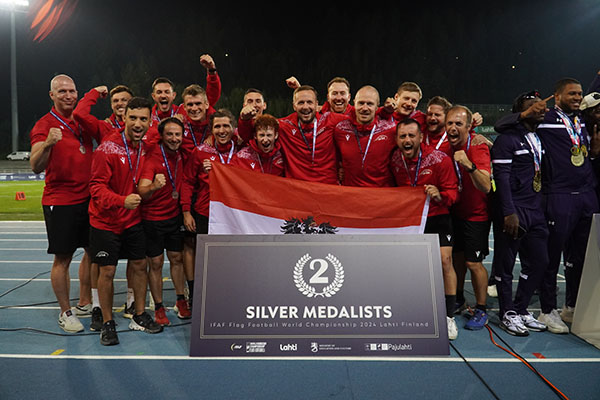
The trajectory of Austrian Flag Football has shifted from chasing global respect to eyeing Olympic gold. For years, the nation's men's and women's programs have functioned as consistent outliers in a sport traditionally dominated by other regions, but the landscape changed fundamentally when the International Olympic Committee (IOC) confirmed the sport's inclusion for the Los Angeles 2028 Summer Games.
In Mumbai, the IOC membership greenlit a revamped program for LA 2028, introducing Flag Football alongside Cricket, Baseball/Softball, Lacrosse, and Squash. This decision doesn't just expand the athlete count—projected to break the 10,500 threshold—it provides a definitive finish line for a program that has been building toward this moment since the "Olympic Games 2028" project was ignited at the Youth European Championships in Grosseto in 2021.
A Pedigree of Podiums
Austria does not enter the Olympic conversation as an underdog; they enter as a certified heavyweight. The men’s national team has been a fixture of international competition since 2002, crafting a legacy defined by high-stakes finishes. Having already secured multiple World and European titles, the men's squad sits comfortably in the upper echelon of the sport, bolstered by a recent run of exceptional form: a silver medal at the 2023 European Championships in Limerick and a sensationally high second-place finish at the 2024 World Championships in Lahti.
Under the leadership of Head Coach Michael Salamon, who took the reins from success-driven coach Dietmar Furthmayr in early 2020, the men's program has maintained a standard of excellence that makes them natural contenders for the 2028 podium. But the men are only half of the Austrian success story.
The women’s national team possesses a statistical dominance that is difficult to ignore. Since 2007, the squad has secured medals in ten out of twelve major competitions, a run that includes multiple European gold medals and both silver and bronze honors at the World Championships. Currently ranked fourth in the world, the women's team operates under the guidance of Head Coach Robert Riedl, who took over in January 2024. For this group, the Olympic stage represents the ultimate validation of a decade of consistent, elite-level performance.
The Infrastructure of Success
The presence of Austria on the world stage is not a product of recent luck, but rather the result of a deeply rooted developmental pipeline. The success seen in the adult national teams is a direct reflection of the work done in the youth ranks.
- Historical Foundation: The U15 national team claimed the European Championship title as far back as 2005, establishing a culture of winning early in the developmental cycle.
- Consistent Excellence: Beyond the U15 success, the U13 programs have remained perennial fixtures in the sport's top tier.
- Coaching and Education: The Austrian Flag Football Association (AFBÖ) relies on regular training and further education as the fundamental bedrock of their tactical evolution.
This systemic approach ensures that as the 2028 Games approach, the talent pool is not just deep, but battle-tested in international competition.
Evidence-Led Forecast: The Road to Los Angeles
As the international community looks toward LA 2028, Austria's path to the podium will likely be dictated by their ability to translate regional dominance into the specific high-pressure environment of the Olympic Games.
Likely Tactical Pattern: Expect the Austrian teams to rely on the disciplined, structured play that has characterized their recent silver-medal runs. Their history suggests a reliance on high-execution tactical frameworks that minimize errors in transition.
Decisive Matchup: The primary hurdle for both the men's and women's squads will be the gap between the current top three world-ranked nations and the chasing pack. For the women's team (ranked 4th), the ability to bridge that single-rank gap will be the difference between a podium finish and a fourth-place exit.
Strongest Counter-Case: The intense scrutiny and the sudden influx of mainstream attention accompanying an Olympic debut could disrupt the established club and national team rhythms that have sustained their current success.
The X-Factor: A shift in the global talent landscape. As more nations invest in Flag Football following the IOC announcement, the "standard" for elite play will rise sharply, potentially narrowing the margin of victory in much tighter, more physical contests.
Sources
These sources formed the evidence pack for this article. Links open the original publisher; inclusion does not imply endorsement.
- football.at original
- fck.de original
- sport1.de original
- vietentours.com original