Related coverage
View the Instagram post
On July 31, in the shadow of Siem Reap’s cultural landmarks, a high-stakes meeting took place that signaled a fundamental shift in Cambodia's approach to its most storied combat tradition. Tourism Minister Huot Hak sat down with Daisuke Teraguchi, Chief of International Operations at K-1, alongside Kun Khmer Boxing Federation President Khov Chhay and Kombat Global President Rick Shin. This wasn't merely a diplomatic courtesy; it was a strategic summit aimed at turning Kun Khmer from a national symbol into a global tourism magnet.
Cambodia is no longer content to let its martial arts heritage exist in a cultural vacuum. Instead, the Kingdom is executing a calculated pivot, using international combat sports partnerships to drive foreign arrivals and establish itself as a premier destination on the global fighting calendar.
The K-1 Roadmap: From Tradition to Global Broadcast
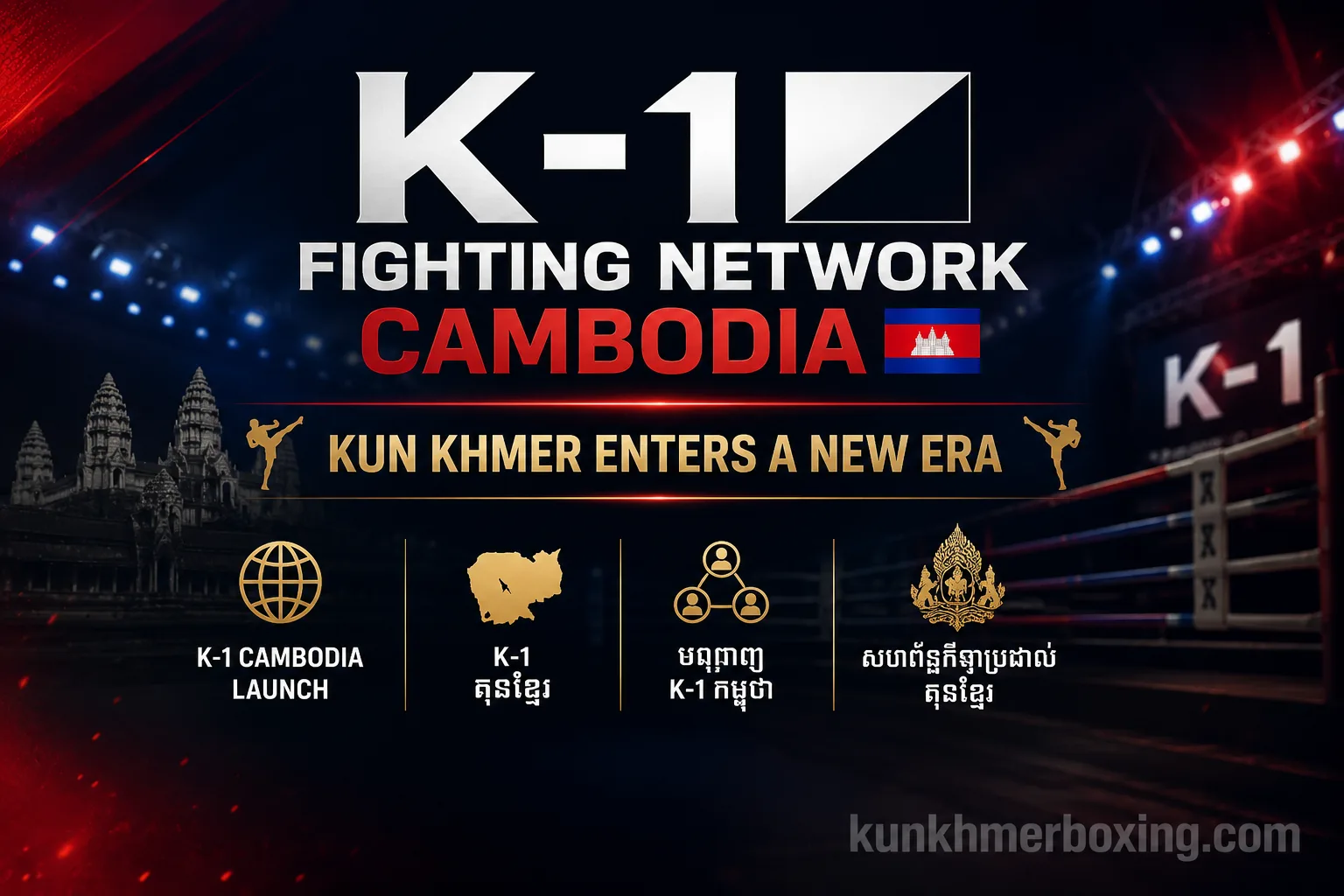
The centerpiece of this offensive is the recent launch of the K-1 Fighting Network Cambodia. Announced in early July 2026, the partnership with the Japanese striking powerhouse is an ambitious play for scale. K-1, a brand that has commanded the attention of combat sports fans in Tokyo, Amsterdam, and Paris for over three decades, is bringing its legendary rule set to Cambodian soil.
The scale of the commitment is evident in the projected calendar: ten international events are planned within the first twelve months. This is not a sporadic series of exhibition matches; it is a structured rollout designed to establish Cambodia as a fixed destination for elite stand-up fighters from Asia, Europe, the Middle East, and the Americas.

For the Cambodian combat sports ecosystem, this provides a tangible pathway for professional growth. The integration offers fighters access to:
- Higher-level international competition: Testing skills against world-class opponents.
- Global visibility: Leveraging K-1's existing television coverage and international networks.
- Commercial viability: Unlocking new sponsorship opportunities and professional contracts.
The Identity Paradox: Integration Without Erasure
A common tension in the globalization of traditional sports is the fear of dilution. If Kun Khmer fighters adopt the striking-heavy focus of K-1, do they lose the essence of their heritage? Khov Chhay, the president of the Cambodian Boxing Federation, is preemptively addressing this concern with a philosophy of "strategic openness."
Chhay argues that moving forward in isolation is a recipe for stagnation. Instead, he views international cooperation as a bridge rather than a takeover. Integrating with international combat sports does not mean abandoning or losing Kun Khmer’s identity. On the contrary, it is a strategy of cooperation, partnership and openness that allows Kun Khmer to enter the existing global sports network.
This is a sophisticated analytical stance. Rather than building a global infrastructure from scratch—which Chhay notes would be "starting from zero"—Cambodia is piggybacking on the massive, pre-existing institutional structures of organizations like K-1, Kombat Global, and the WKN. The goal is to export the practitioners and the culture through the framework of established international combat sports.
A Multi-Front Tourism Strategy
While the K-1 deal handles the high-octane striking market, Cambodia is simultaneously diversifying its combat-tourism portfolio through other regional partnerships. A recent collaboration between the Ministry of Tourism, the Kun Khmer Federation, and China’s Emei-Legend (a renowned martial arts club from Sichuan Province) illustrates this multi-pronged approach.
By linking Kun Khmer and Bokator with Chinese martial arts communities, the Ministry of Tourism aims to create a cultural exchange that brings spectators to the Kingdom. Tourism Minister Huot Hak has been clear: combat sports are a vehicle to showcase Cambodia’s broader destinations and unique heritage. The objective is to transform a fight night into a travel experience, driving long-term tourism growth through the shared language of martial excellence.
Evidence-Led Forecast: The Tactical Clash
As Cambodia implements this ambitious schedule, the primary tension will not be political, but technical. The success of this initiative rests on how effectively Cambodian athletes can bridge the gap between traditional Kun Khmer and international striking rulesets.
The Decisive Matchup: The upcoming season will likely see a clash between the traditional Kun Khmer emphasis on clinching and aggressive knee strikes versus the K-1 rule set, which is famously designed to favor continuous, high-volume striking and limit prolonged clinching. The athletes who can successfully adapt their high fight IQ to these constraints will become the vanguard of the new Cambodian combat brand.
The Counter-Case: If the ten-event rollout fails to secure consistent international broadcasting or if the local talent pool struggles to adapt to the technical demands of the K-1 ruleset, the initiative risks being viewed as a series of disconnected spectacles rather than a sustainable sports industry. Success depends on whether the "integration" Chhay promises results in genuine technical advancement or merely superficial participation.
Sources
These sources formed the evidence pack for this article. Links open the original publisher; inclusion does not imply endorsement.
- Chhorn Norn original
- kunkhmerboxing original
- Agence Kampuchea Presse - AKP original
- k-1.world original
- khmertimeskh.com original