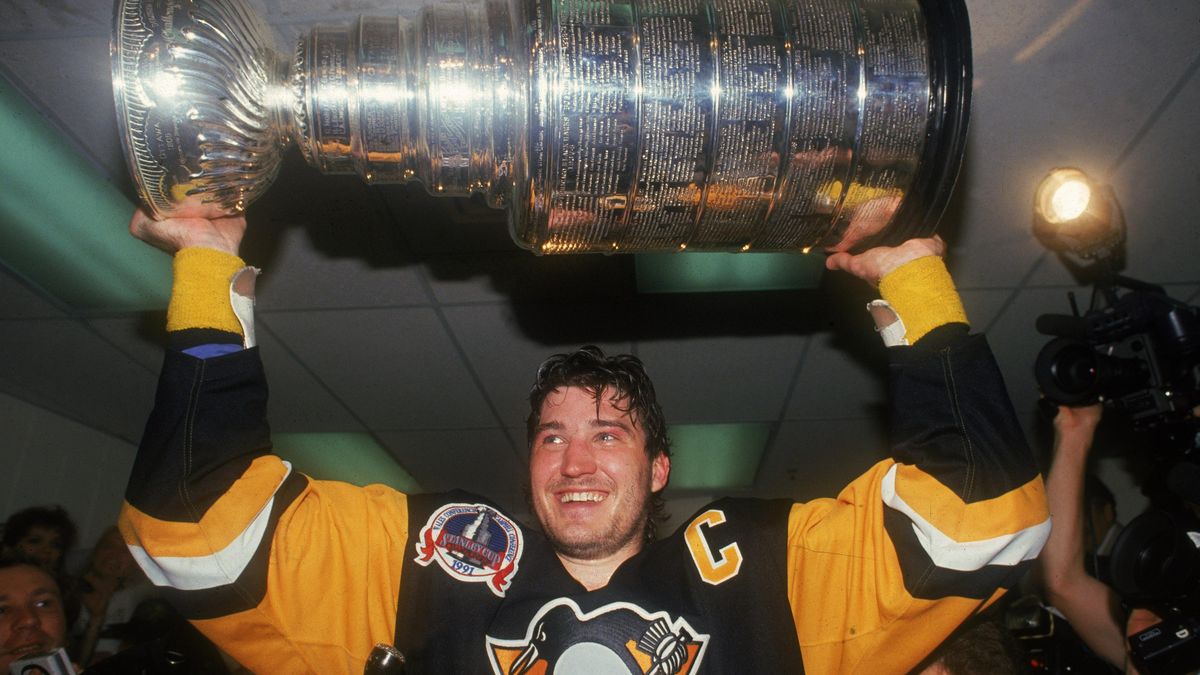
In the quiet months of the NHL calendar, when front offices recalibrate and the long march toward the Stanley Cup pauses, hockey minds invariably drift back to an unresolvable argument. Lemieux literally translates from French as the best, a moniker Mario Lemieux spent an entire career attempting to live up to. At his absolute zenith, he might well have been the finest player to ever lace up skates. At worst, he stood second only to Wayne Gretzky—a debate that reliably divides generations of players, coaches, and scribes.
Yet evaluating the gap between Gretzky and Lemieux is less about scouring stat sheets and more about understanding spatial manipulation on the ice. Hall of Fame defenseman Paul Coffey, who occupied a unique vantage point by playing alongside both legends during their respective peaks, offered a precise tactical distillation of their differing approaches.
S Waynem jsem mu hodil přihrávku, hnal se za ním, díval se, jak k sobě přitáhl celé kluziště a pak to dal někomu do prázdné brány. Mariovi jste dali dlouhý pas, zrychlili jste, abyste získali místo v první řadě, a koukali, jak všechny obehrál a skóroval.
Paul Coffey
Gretzky’s genius lay in gravity and geometry. As Coffey noted, Number 99 specialized in pulling the entire defensive structure toward himself before releasing a millimeter-perfect pass in the absolute final fraction of a second. Lemieux, by contrast, operated as a terrifying individual force. Standing over 190 centimeters, possessing preternatural reach and soft hands, Lemieux could gather a long outlet pass, accelerate through neutral ice, dismantle a defensive shell single-handedly, and finish the play himself.
That fundamental difference in deployment manifested clearly on international ice. During the 1987 Canada Cup, when a young Lemieux tried to return a pass to Gretzky, the Great One famously rebuffed him: Ty jsi lepší střelec. Už mi puk nikdy nevracej! Od teďka já nahrávám a ty zakončuješ.
It was a tactical acknowledgment from the game's ultimate orchestrator that Lemieux possessed a singular scoring architecture.

The Burden of Injury and the Anatomy of Miraculous Returns
Absolute numbers favor Gretzky, whose enduring scoring records remain untouched. But that statistical ledger comes with a vital contextual asterisk: Lemieux fought severe, chronic back ailments that forced him to miss months and, eventually, years of prime athletic output. Whenever he returned from the brink, however, the hockey world stood paralyzed.
Former forward Jiří Hrdina, who joined Pittsburgh in December 1990 while Lemieux was entirely paralyzed by back pain, recalls the astonishing speed of the center's recovery. After roughly three days of stationary cycling and two light practices, Lemieux boarded a flight to Quebec, stepped onto the ice with minimal preparation, and immediately registered three assists. He went on to score in all but four of his remaining 24 regular-season games, carrying the Penguins to their maiden Stanley Cup.
Milan Kraft, who sat alongside Lemieux in the Pittsburgh dressing room a decade later during the legend's second miraculous comeback in December 2000, captured the unique aura that accompanied the center onto the ice:
Když dostal Mario puk, všechno ztichlo. Dokonce i hráči Toronta odstoupili, protože legenda měla kotouč. Měl velký respekt i u soupeřů, protože nevěděli, co čekat.
Milan Kraft
That 2000 return saw Lemieux register a goal and two assists in a 5–0 victory over Toronto, skating unusually on the wing initially to let Jan Hrdina handle defensive zone faceoffs alongside Jaromír Jágr. It was an improvised masterclass born out of organizational necessity, as the franchise—which Lemieux had ultimately purchased out of bankruptcy in 1999 to save it from relocation—needed a center for Jágr, and the owner simply decided to insert himself back onto the top line.
The Franchise Savior and the Introvert Behind the Wall
The stakes of Lemieux’s arrival in Pittsburgh in 1984 extend far beyond individual accolades. Before he was drafted, the franchise was teetering on the edge of extinction, battling plummeting attendance down to 6,839 fans and persistent rumors of relocation. General Manager Eddie Johnston famously rebuffed exorbitant trade offers—including a package from Quebec featuring the three Šťastný brothers (Peter, Anton, and Marián) plus a first-round pick—insisting that management would have to fire him before trading the generational pick.
Lemieux arrived as a 19-year-old raised in a francophone Montreal household, grappling with a new language and a crushing burden of expectations. While media mythologized his early struggles with English, associates like Nancy Matthews noted that his quiet demeanor was driven largely by profound shyness and an intense desire to protect his privacy. While Gretzky embraced the ambassadorial spotlight, media obligations, and public appearances, Lemieux preferred building a literal and figurative fortress around his private life—complete with the legendary multi-room wine cellar beneath his home where he famously submerged the newly won Stanley Cup in 1991.
As Scotty Bowman remarked when consulted by The Athletic, evaluating the upper echelon of hockey history often brings observers back to a simple conclusion: Gretzky may own the historic milestones, but when measuring sheer, unadulterated dominance over a sheet of ice, Mario Lemieux remains unmatched.
Sources
These sources formed the evidence pack for this article. Links open the original publisher; inclusion does not imply endorsement.
- seznamzpravy.cz original
- telly.cz original
- nhl.cz original
- sport.ceskatelevize.cz original


