Scores, fixtures and picks
These fixtures are connected to teams or competitions named in the article. Live status and scores come from the normalized SportyPulses data feed; predictions are reader picks, not betting advice.
When the International Ice Hockey Federation, NHL, NHLPA, and International Olympic Committee formally cleared the path for the world's premier players to return to the Olympic stage, it ended a twelve-year drought stretching back to the Sochi Games in 2014. That long-awaited reunion of hockey’s ultimate tier takes physical shape from February 11 to 22, 2026, hosted across Milan’s primary 14,000-capacity Santa Giulia arena and the 5,700-seat Milano Rho Arena.
Rather than dropping entire 25-man depth charts at once, the tournament's competing federations adopted a staged rollout, beginning with the announcement of the first six foundational players per nation. For talent evaluators and tacticians, examining these initial blocks reveals how coaching staffs plan to construct their structural spines.
The Core Architecture: Defending Identities and Building Blocks
Every national selection tells an immediate story about roster construction, balance, and historical context. Team USA enters the tournament carrying the weight of history—and the lingering memory of 1980 in Lake Placid—with a preliminary wave anchored by Toronto Maple Leafs star Auston Matthews, Jack Eichel, and physical tone-setters Brady and Matthew Tkachuk, supplemented on the blue line by Quinn Hughes and Charlie McAvoy.
Up north, Canada’s inaugural six-man reveal outlines a terrifying exercise in offensive horsepower and transition dominance:
- Forwards: Sidney Crosby, Nathan MacKinnon, Connor McDavid, Brayden Point, and Sam Reinhart
- Defense: Cale Makar, holder of the Norris Trophy for the NHL's top defenseman
Meanwhile, Czech head coach Jiří Šlégr anchored his initial selections directly to the collective chemistry that captured gold at the 2024 World Championship in Prague. Výběr prvních šesti hráčů považuji za naprosto logický, jelikož právě tito hráči tvořili kostru týmu na světovém šampionátu v roce 2024, na kterém jsme získali zlaté medaile,
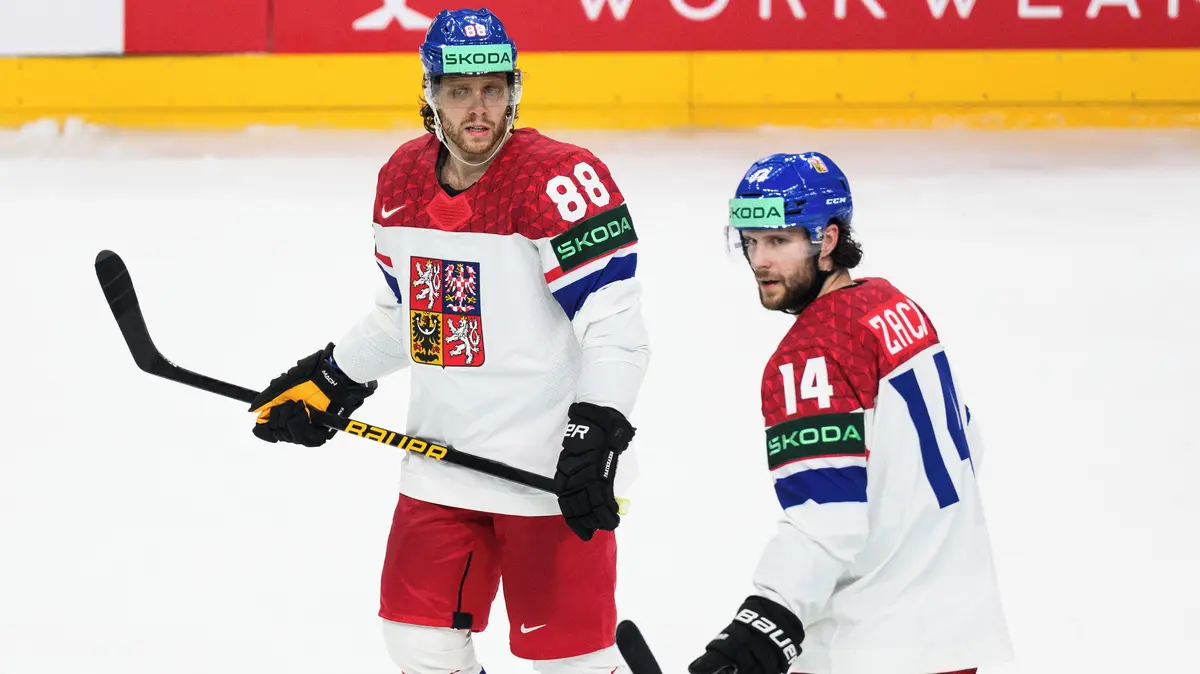
notes Šlégr, emphasizing continuity Šlégr. This foundational group pairs goaltender Lukáš Dostál (Anaheim) and defenseman Radko Gudas with elite forwards David Pastrňák, Martin Nečas, Pavel Zacha, and Ondřej Palát. For Pastrňák, Zacha, Nečas, and Dostál, this represents a maiden voyage under the five Olympic rings.
Global Group Dynamics and Venue Realities
The 12-team tournament is split into three preliminary groups. Group A features Canada alongside Czechia, Switzerland, and France (noting the inclusion of Czech Extraliga standouts Yohann Auvitu of Vítkovice and Jordann Perret of Hradec Králové on the French side). Group B pairs Finland, Sweden, Slovakia, and Italy, while Group C groups the United States with Germany, Latvia, and Denmark.
Finland's opening wave features Juuse Saros in net, Miro Heiskanen and Esa Lindell on defense, and Mikko Rantanen, Aleksander Barkov, and Sebastian Aho up front. Sweden counters with a blue line featuring Victor Hedman and Rasmus Dahlin, complemented by forwards William Nylander, Gabriel Landeskog, Adrian Kempe, and Lucas Raymond. Switzerland relies on Roman Josi, Jonas Siegenthaler, Nico Hischier, Nino Niederreiter, Kevin Fiala, and Timo Meier.
Evidence-Led Forecast: Group C and Early Tournament Chess Matches
Likely Tactical Pattern: Expect high-pace transitional pressure in Group C where Team USA faces structured European counter-attacking frameworks from Germany, Latvia, and Denmark. The inclusion of high-motor forwards like the Tkachuk brothers alongside playmakers like Auston Matthews signals an aggressive forechecking system designed to pin opponents deep and neutralize lateral puck movement.
Decisive Matchup: The battle for zone entry control orchestrated by elite blue-liners like Quinn Hughes and Charlie McAvoy against heavy, defensively disciplined neutral-zone structures.
Strongest Counter-Case: Cohesive European sides with established international chemistry could disrupt disjointed NHL combinations during the short preliminary window, particularly if special teams units fail to organize quickly without extended practice blocks.
What Would Change the Read: Additional roster unveilings rounding out the bottom six forward slots and special-teams specialists will clarify whether federations prioritize grit and shutdown profiles or pure offensive depth.
Sources
These sources formed the evidence pack for this article. Links open the original publisher; inclusion does not imply endorsement.
- kprofiles.com original
- sport.cz original
- ceskeadaptivnisporty.cz original
- linkedin.com original