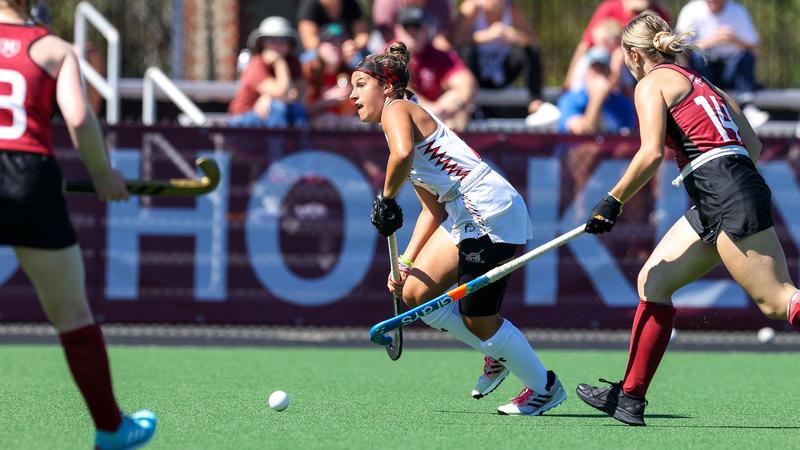
For most American field hockey players, the game has an expiration date that arrives in May of senior year. The diploma goes on the wall, the stick goes in the garage, and a sport that is a way of life in Buenos Aires, Kuala Lumpur, or Zeist becomes, almost overnight, a memory. Maria Armaganian looked at that calendar, decided she wanted no part of it, and signed with Schaerwijde Hockey Club in the Netherlands.
"This is my dream. I want to continue to play field hockey," Armaganian told WMUR's Ian Steele. "Unfortunately, it's a very common thing in the States that once you graduate college, that's where your career ends. If you go anywhere in Europe, anywhere in Asia, South America, people are playing field hockey until they're 70 years old and they can't run anymore. And I'm kind of trying to show the young youth of field hockey that if you love the sport, continue to play it as long as you can."
That is not a small thing in a country that has produced exactly zero of the players who will line up alongside her at the club's Zeist complex. Armaganian, a 2021 graduate of Concord High School and a 2025 graduate of Northeastern University, is the first American ever to pull on a Schaerwijde first-team jersey. The club, founded in 1932 and headquartered in the wooded outskirts of Utrecht, is a nonprofit outfit with a youth pipeline, a senior program, and — beginning in August — one very deliberate import.
A Field Hockey Childhood, By Way of Three Sports
To understand why Armaganian is willing to relocate to a town most Americans cannot find on a map, it helps to know that field hockey in her house is not a season. It is a lifestyle, inherited.
Her mother, Nicole Armaganian, is the head coach of the Concord High field hockey program. Her father plays goalie for an indoor team on the Seacoast. Her younger sister, Camille, is a defender at Northeastern — the same program Maria starred at, and the same campus she is now leaving behind. The Concord Monitor's Alexander Rapp, profiling Armaganian in 2024, noted that Nicole agreed not to coach Maria during her high school years but still taught her the game at home, every day, in living rooms and driveways.
Maria was a three-sport athlete at Concord — field hockey, ice hockey, and lacrosse — and left the Crimson Tide as the program's 2021 Player of the Year. The crossover skills mattered. Indoor hockey, with its enclosed boards, rapid transitions, and almost continuous pressure, is closer to ice hockey than it is to grass. "It (indoor) is a very different game, and that's where her (ice) hockey skills really come in," Nicole Armaganian told the Concord Monitor. "She has really quick stick skills, and then she has a sense of where to be, she doesn't just stay in one spot so it's helpful for her teammates."
The Northeastern Years and a Jersey With a Flag on It
At Northeastern, Armaganian did not ease into a college career so much as sprint into one. As a midfielder she started 15 of the Huskies' 18 games in her senior indoor season, finishing tied for sixth on the team with 10 points on two goals and six assists, the latter mark good for ninth in the conference. She picked up a CAA Player of the Week nod in September and logged a five-game point streak in the middle of the year.
But the real inflection point came in June 2024, when she showed up to the U.S. Women's National Indoor Team tryout in Colorado Springs. She had cycled through outdoor national team tryouts before without a call, and decided, almost on a lark, to try the indoor program after playing the format in high school. The result was a spot on the 2024-25 Senior U.S. Women's National Indoor Team — and, by extension, an assignment to a 2025 FIH Indoor Hockey World Cup roster that faced the Czech Republic, Belgium, and host Croatia in Poreč.
"This is my goal, my dream," she said at the time. "It's high-intensity field hockey, it's for the national team. You're wearing the flag on your jersey. It's a really huge accomplishment."
Jun Kentwell, the U.S. indoor head coach, was blunt about what she wanted from the program. "If you give it your all, 24/7, then only good things will come of it," Armaganian recalled, paraphrasing Kentwell's evaluation-day message. It was the right kind of pressure for a player who had built her career on relentless preparation: get her homework done on Monday, free up the rest of the week; lift twice, sprint twice, watch film in the cracks.
The Dutch Calculus
Even with a national team cap and a résumé, the next step in American field hockey is usually a slow fade into club leagues, beer leagues, and pickup on weekends. Armaganian was not interested. She plotted a different route, to the small Dutch city of Zeist, where Schaerwijde runs a first team that plays in the Dutch club system, a sprawling pyramid that feeds the Orange — winners of multiple Olympic gold medals and the team that sets the tactical template for everyone else.
The decision was not just athletic. Her LinkedIn profile, which lists her as a current member of Schaerweijde Dames 1 beginning in June 2026, makes clear that she is also bringing an industrial engineering degree and a graphic design background into a youth-coaching role at the club. "I am currently seeking professional opportunities in Utrecht or Amsterdam," she wrote, "where I can apply my background in industrial engineering, operations, communications, project coordination, and design."
That blend — a U.S. national team midfielder with engineering fluency who also helps run youth clinics — is part of what makes the move unusual. Schaerwijde is a community club in the Dutch tradition, not a salaried pro franchise. The exchange is reputational and developmental. Armaganian gets a level of competition and a culture of lifelong play that simply does not exist for an American in her position. The club gets an internationally capped midfielder with a coaching footprint and a story it can tell for years.
What the Move Actually Signals
Read narrowly, this is a personal career decision: a 23-year-old midfielder refused to let the college cliff take the only game she ever wanted to play. Read more broadly, it is a small piece of evidence in a slow-motion argument about where American field hockey is willing to let talent go.
The U.S. women's national team, in both indoor and outdoor forms, draws from a small, stubbornly persistent talent pool. Most of the players who make rosters do so because they keep playing somewhere — a regional club, a Masters team, an overseas stint in a country where the calendar does not end at commencement. The Dutch system, where Schaerwijde sits, is one of the most developed pipelines on earth. A Concord kid in a Zeist shirt is not just finding a team. She is inserting herself into a developmental ecosystem that has produced generations of internationals.
It is also a bet on a specific version of the sport. Indoor hockey, the format that finally got her a national team cap, has become a quietly important proving ground for American players. The six-a-side format punishes indecision, rewards the kind of small-space stick work that Armaganian sharpened on the Seacoast with her father, and forces decisions at a speed that translates directly into the outdoor game. Her move does not abandon that identity. It extends it.
Forward Implications and What to Watch
The most interesting question is not whether Armaganian can play at the Dutch club level. The résumé says she can. The more revealing question is whether a single American midfielder with a national team cap and a youth-clinics side hustle can shift the trajectory of even one hometown kid in Concord, or one northeastern college player weighing a fifth year, or one parent wondering whether the field hockey pipeline has to be a four-year pipe.
For now, the schedule is straightforward. She linked in with Schaerweijde in June 2026 for a month of pre-season integration before the 2026 Dutch club season opens in August. She is also listed on Northeastern's athletics site as a 2024-25 senior, with a schedule that already includes the RohrMax Cup in Vienna over the New Year and the 2025 FIH Indoor Hockey World Cup in Croatia. Whether she is named to the next U.S. indoor squad, and how the club season in Zeist layers on top of any national-team windows, will be the practical tempo question of her first year abroad.
None of that is guaranteed, and the move carries obvious risk. A player who had been the only New Englander on her U.S. indoor squad is now a foreigner in a country where she is one of very few. But the framing she keeps returning to is not the risk. It is the message.
"Continue to play it as long as you can," she said. The schedule in Zeist, the youth clinics on the side, the engineering job search in Utrecht — it is all, in her telling, the same sentence. For an American sport that has been telling its best players to stop, Maria Armaganian is the rare case study in what it looks like to say no.
Sources
These sources formed the evidence pack for this article. Links open the original publisher; inclusion does not imply endorsement.
- Ian Steele original
- Exa original
- Alexander Rapp original
- nuhuskies.com original


