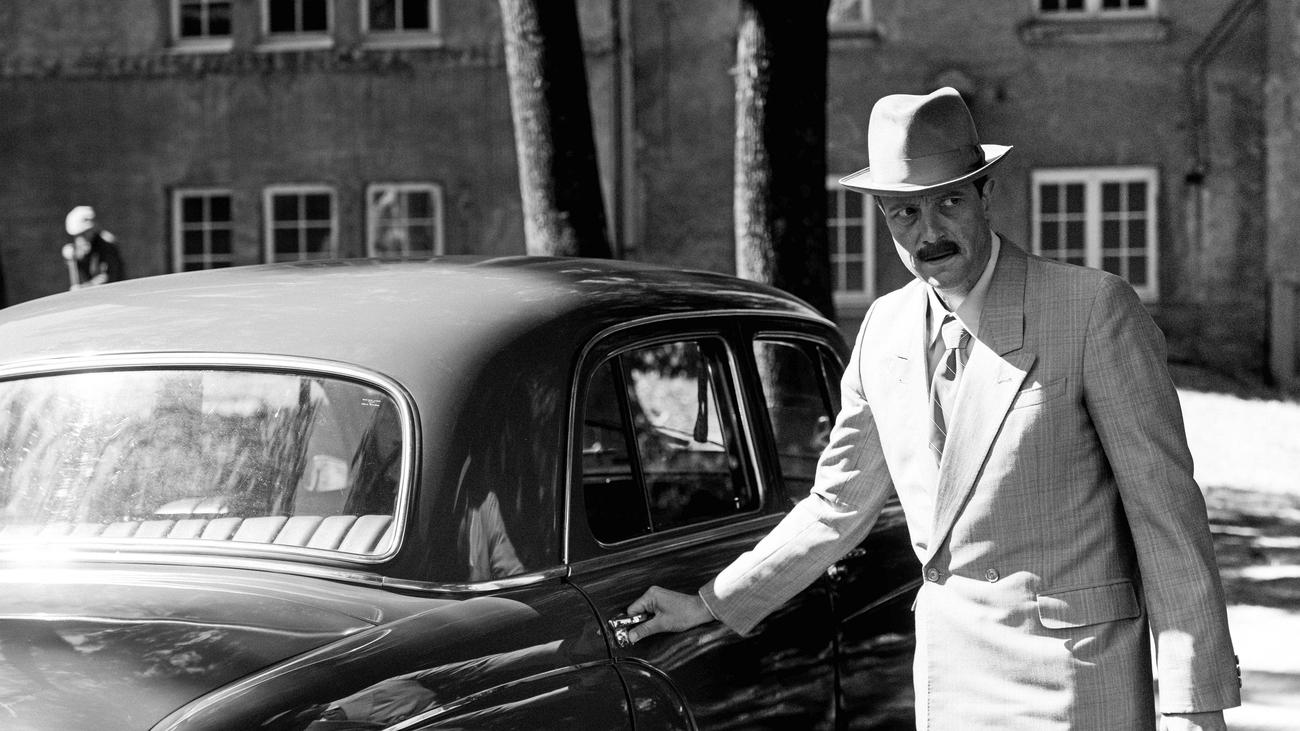
When a film stakes its opening act on an academic dissection of a skeleton in a São Paulo lecture hall before violently hurtling back to 1956 Buenos Aires, it signals an intent to treat history not as a monument, but as an unsettled autopsy. Kirill Serebrennikov’s Das Verschwinden des Josef Mengele—adapted from Olivier Guez’s award-winning 2017 novel—lands squarely in this provocative territory. Premiering internationally at the Festival de Cannes before its October 2025 theatrical release by DCM Film Distribution, the 135-minute German-language production deploys a barrage of formal techniques: high-contrast black-and-white cinematography, undercurrent jazz, trenchcoated evasion, and jittery hand-held framing that mimics the psychological erosion of its subject.
Serebrennikov’s structural choices immediately divide critical consensus. The narrative refuses a neat chronological sweep, opting instead to shuttle back and forth between a middle-aged Mengele navigating the safehouses of Argentina and Paraguay, and an aging, paranoid recluse in Brazil facing the twilight of his life in 1977. Yet this spatial and temporal fragmentation raises hard questions about cinematic empathy and moral alignment. By anchoring the camera so tightly to Mengele’s perspective—following August Diehl as he paces through shadows, clutches a barking German shepherd, or stares aggressively naked into a mirror—the film flirts with a dangerous proximity.
The Mechanics of Paranoia and Spatial Deployment
Serebrennikov transforms geography into a psychological trap. In Buenos Aires, Mengele moves with the hyper-vigilant cadence of a classic 1940s film noir protagonist, shedding identities and slipping into taxis. Later, on an isolated rural farm in Paraguay and Brazil, the frame closes in. The director uses stark lighting and barbed wire fences to visually code the landscape not as an asylum for a fugitive, but as an inverted concentration camp where the hunter has become the hunted. As reviewer Anke Leweke notes, the aesthetic purposefully bends to match Mengele’s escalating persecution mania, complete with night-vision sweeps of dark compounds and haunting reminders of his past—such as twin boys serving wine at a high-society wedding in Buenos Aires complete with a swastika-adorned cake.
This deployment of space is masterfully executed by Diehl, whose physical performance commands the screen. Diehl plays against a script that critics like Christian Neffe argue struggles to define its ultimate target, yet his portrayal of unrepentant malice, shaking hands, and sudden choleric outbursts creates a suffocating atmosphere. He denounces the world, rails against imaginary slander, and insists on viewing his murderous selections at the Auschwitz ramp as humanitarian acts. The camera records every tremor, forcing viewers to confront the raw, unvarnished corporality of a mass murderer growing old and frail.

The Generational Clash: Confronting the Archive
The structural pivot of the film arrives with the appearance of Mengele’s estranged son, Rolf, played by Max Bretschneider. Traveling to Brazil under false papers, Rolf confronts his father to demand the truth about Auschwitz. Mengele’s response is not confession, but defensive fury.
At this juncture, Serebrennikov alters his visual register entirely. As summarized in critical evaluations from the festival circuit:
The images become colored, take on the look of a 16mm home video. An orchestra of little people is seen, a smiling Josef Mengele selects the people at the ramp. Also laboratory investigations are shown. Outside the sun shines, the men in uniform look satisfied and rested. The agonizingly long sequence looks like a monstrous vacation video.
Anke Leweke, Die Zeit
This tonal shift shatters the noir-infused subjectivity that came before it. By inserting archival-style color footage of the atrocities into a faux-leisurely family archive, the film strips away the fugitive's self-pitying illusion of victimhood. It exposes the banal, sunlit horror of industrial slaughter, contrasting sharply with the weeping, isolated old man clutching his dog in the dirt.
An Analytical Verdict on an Uncomfortable Experiment
Ultimately, Das Verschwinden des Josef Mengele functions less as a conventional biopic and more as an aggressive cinematic provocation. Critics point out its thematic loose ends—how it touches upon international intelligence failures and elite South American Nazi networks only to drop them in favor of an intense character study. Yet its discomfort is precisely its method. Serebrennikov and Diehl construct an artistic experiment that refuses to grant the audience safe moral distance, even if the runtime occasionally drifts into a circular exploration of a mind that remained proudly, stubbornly rotten to the very end.
Sources
These sources formed the evidence pack for this article. Links open the original publisher; inclusion does not imply endorsement.
- Eine Filmkritik von Christian Neffe original
- Von Anke Leweke original
- cbssports.com original
- Sarah Knauth original
- festival-cannes.com original
- just-publicity.de original
- wnba.com original