As modern professional tennis continues to favor two-handed baseline power, Roger Federer's single-handed backhand remains a masterpiece of biomechanics and tactical versatility. Across a two-decade career yielding 20 Grand Slam singles titles, the Swiss icon demonstrated that a classical one-hander could absorb heavy pace, dictate court geometry, and hold up under championship pressure.
Biomechanical Precision Behind the Stroke
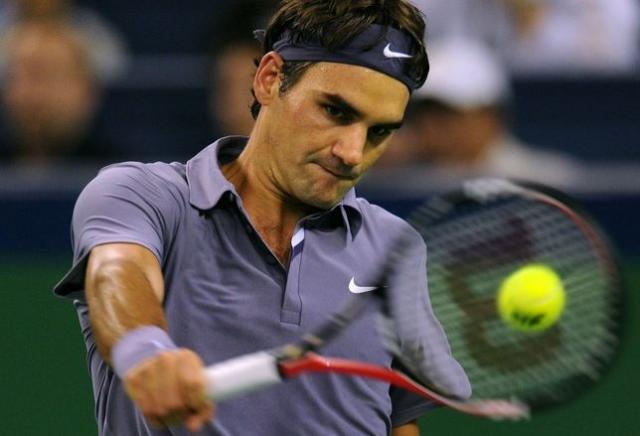
The efficiency of Federer's backhand relies on disciplined technical sequencing rather than raw arm strength. The mechanics begin prior to any swing through a synchronized movement known as the Unit Turn. By coiling the torso and shoulders roughly 45 degrees before initiating the backswing, Federer loads kinetic energy directly into his core muscles, keeping the movement compact and preventing an arm-dominated stroke.
Key technical components define the stroke's execution:
- Grip and Alignment: Utilizing a standard backhand grip, the stroke naturally positions the point of contact out in front of the body.
- Impact Realignment: While his arm remains slightly bent during preparation, it straightens out considerably at the precise moment of ball impact.
- Versatile Follow-Through: The stroke finishes high, employing an upward brushing movement to generate heavy topspin and high net clearance, or flattening out to drive ball depth across the baseline.
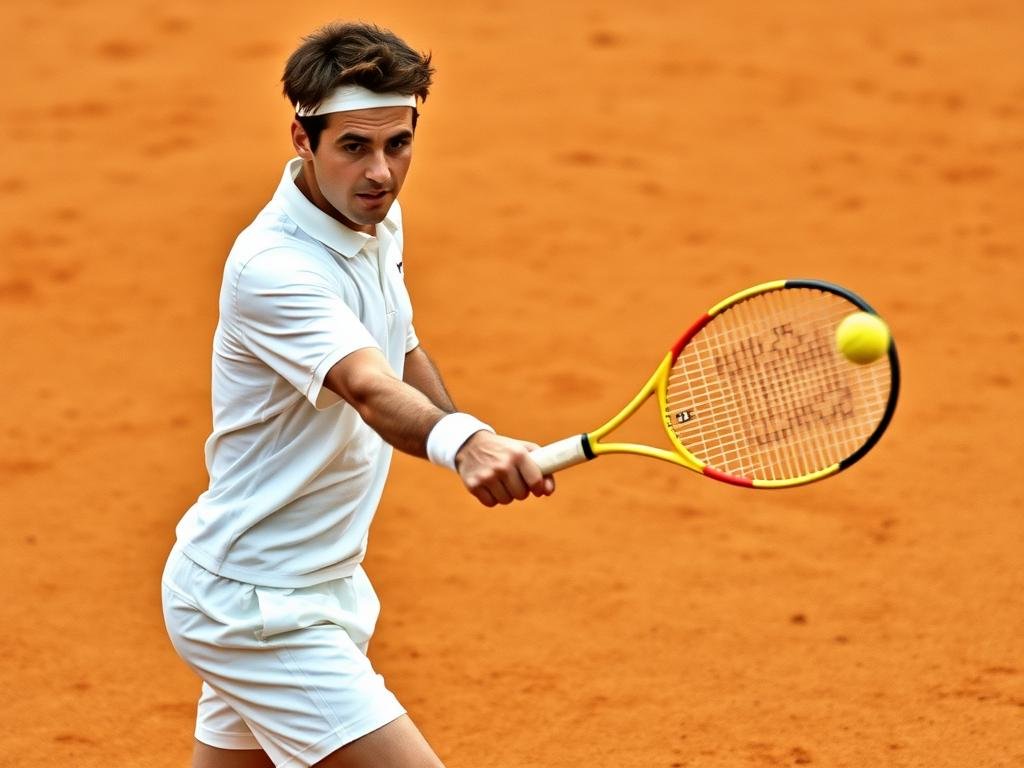
- Adaptive Stance: When handling fast service returns, Federer uses a quick shoulder pivot and an abbreviated backswing to block the ball on the rise. When given extra time, he sets up in a closed stance with a full, fluid backswing.
Neutralizing Target Tactics Across the Tour
As baseline grinding dominated the men's circuit, opponents—most notably Rafael Nadal—frequently attempted to target Federer's backhand as a potential vulnerability. However, the versatility of the stroke allowed Federer to neutralize heavy pace, maintain return depth, and strike back with inside-out backhands down the line or surprise tactics like his SABR (Sneak Attack By Roger) return.
Writer David Foster Wallace captured the distinct fluidity of Federer's overall game in his widely cited observation:
— David Foster Wallace
Federer’s forehand is a great liquid whip, his backhand a one-hander that he can drive flat, load with topspin, or slice… His serve has world-class pace and a degree of placement and variety no one else comes close to.
From On-Court Temper to Two Decades of Dominance
The calm composure that defined Federer's technique was hard-earned. Born on August 8, 1981, in Basel, Switzerland, to Robert and Lynette Federer, Roger began playing tennis at age three while developing spatial coordination across badminton, basketball, and football. By age 12, he concentrated exclusively on tennis, entering Switzerland's National Tennis Center at 14. As a junior player, Federer regularly battled frustration, throwing racquets when shots failed to meet his expectations.
The tragic death of his early coach Peter Carter in 2002 marked a profound turning point, instilling a deeper professional focus. Federer addressed his emotional evolution directly:
— Roger Federer
I don’t get the anxiety during a match so much anymore. You know, to throw racquets, to toss balls out of the court, scream and stuff. I almost laugh [on the inside] about it a little bit today when an opponent does it. But that’s something for me that’s not a problem anymore.
What followed was one of the most dominant eras in sports history:
- Inaugural Major: Defeated Mark Philippoussis at Wimbledon in 2003, two years after his breakthrough 2001 Wimbledon victory over seven-time champion Pete Sampras.
- Peak Consistency (2004–2007): Won 11 of 16 Grand Slam titles, capturing three majors in a single year three separate times (2004, 2006, 2007) while making 10 consecutive Grand Slam finals.
- Career Grand Slam: Lifted the trophy at Roland Garros in 2009 to join Rod Laver, Andre Agassi, and Rafael Nadal as a winner of all four majors.
- Wimbledon Dominance: Secured a record eight Wimbledon men's singles titles, including five consecutive titles from 2003 to 2007 to tie Björn Borg's Open Era mark.
- Resurgence and 20th Slam: Returned from a six-month injury layoff at 35 to win the 2017 Australian Open and 2017 Wimbledon (defeating Marin Cilic), culminating in an emotional 20th major title at the 2018 Australian Open while clutching the Norman Brookes Challenge Cup alongside his wife Mirka and coaching team.
Federer's legacy extended far beyond numerical records. Voted ATP Fans' Favorite for 19 consecutive years from 2003 to 2021, a 13-time ATP Sportsmanship Award recipient, and a five-time Laureus World Sportsman of the Year, his single-handed backhand remains an enduring textbook standard for generations of players.
Sources
These sources formed the evidence pack for this article. Links open the original publisher; inclusion does not imply endorsement.
- celebpath.com original
- algorithmicculture.com original
- tennisinstruction.com original
- behindthename.com original