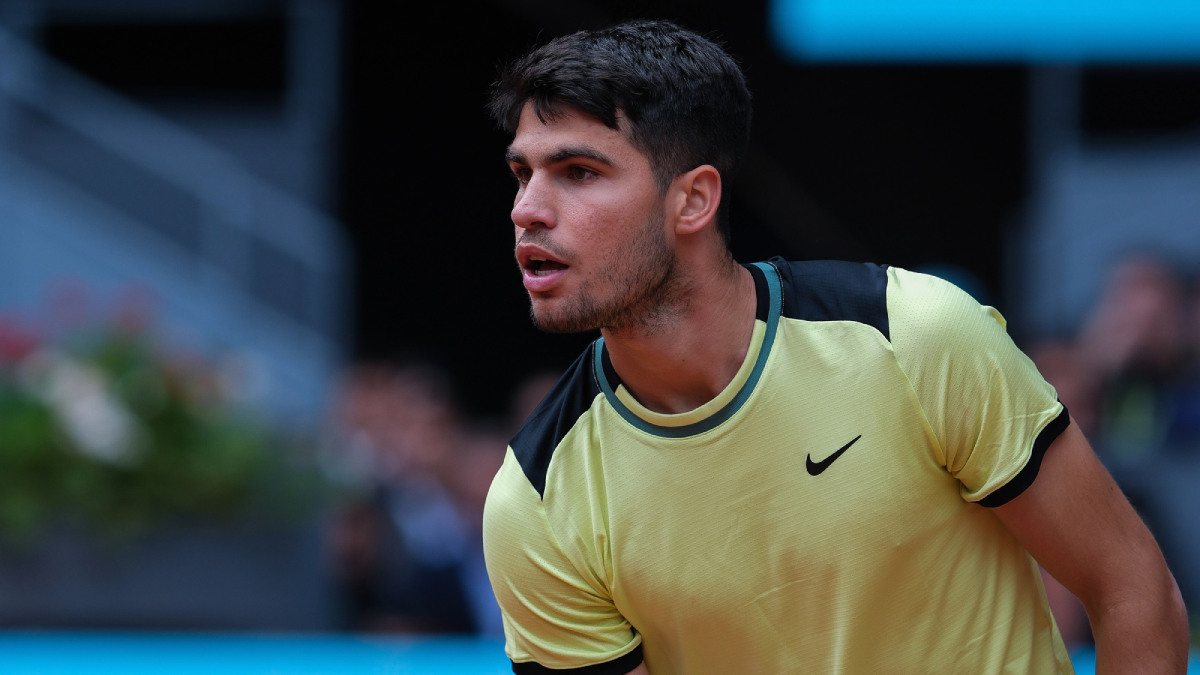
When 19-year-old Rafael Jodar steps onto a court, the visual composition of his player box immediately separates him from the rest of the ATP Tour elite. While contemporary professionals travel with sprawling entourages encompassing hitting partners, biomechanics specialists, nutritionists, and agents, Jodar's technical team features precisely one person: his father, Rafa Jódar sénior. That singular partnership has now propelled the Spanish teenager to a career-high No 15 in the live ATP Rankings following an arduous run at the Washington DC Open, marking a staggering climb for a player who sat at No 540 just over a year ago.
The ascent has been nothing short of meteoric. After defeating fourth seed Lorenzo Musetti in a grueling three-set quarter-final battle, Jodar navigated another testing encounter against Alejandro Tabilo. Dropping the opening set in a tight tie-break, the world No 30 equivalent bounced back by claiming the crucial break in the seventh game of the second set and striking immediately in the decider to seal a 6-7 (6-8), 6-4, 6-4 victory. Yet, amidst the flurry of historic milestones—which earlier in the year included a maiden ATP title at Marrakech, a run to the Barcelona Open semi-finals, and a Roland Garros debut against Alexander Zverev—the teenager's focus remains squarely anchored on the man who introduced him to the sport at age four.
It is great,
Jodar said Shahida Jacobs. I am doing good things with my team and especially my dad. He’s always there with me, so I really appreciate it that he is travelling with me every week.
Unlike traditional player development pathways where teenage prodigies are quickly handed over to sprawling academy structures or corporate management conglomerates, the Jódar household kept the blueprint remarkably insular. Rafa sénior is not merely a parent in the stands; he acts as coach, physical trainer, and manager. Formed academically in sports science at the INEF in Madrid, the elder Jódar brings professional credentials to a methodology forged during grueling hours at the Club de Tenis Chamartín.
The Anatomy of a Two-Person Team
The strict exclusivity of the Jódar player box has occasionally caused friction in high-profile arenas. During his Roland Garros third-round clash against Alex Michelsen, spectators attempting to occupy vacant seats in his private section were swiftly rebuked. Jodar actively appealed to the chair umpire, establishing a boundary that brook no compromise: At the end of the day, the people in my bench have to be the people from my team, and my team is my father and me. The only one who has the right to be there is my father,
Jodar explained Marca.
This fierce protection of their dynamic stems from a foundational philosophy where tennis was never meant to be a corporate grind. I started playing tennis with him at my tennis club when I was little, when I was four years old. It means a lot to me that he is in the box. You know, he kept pushing me every day when I was younger to play tennis just for fun and that’s the main goal. I am very grateful,
Jodar noted Shahida Jacobs. Having stepped away from his brief collegiate stint at the University of Virginia—where he worked with assistants Brian Rasmussen and Treat Huey—Jodar doubled down on the familial formula. Asked during his breakout Masters 1000 run in Madrid whether he planned to expand his staff, his response was unequivocal: The team has always been my father and me. For now, we are not going to change it because it is something that is working, so I see no reason to change it. Everything will stay the same,
he told Eurosport.
Comparing Tour Familial Dynasties
While the father-coach or parent-coach model is not entirely unprecedented on the professional circuit—echoing the paths of Stefanos Tsitsipas with his father Apostolos, or Ben Shelton guided by his father Bryan—the Jódar structure operates with an ascetic minimalism. Even Alexander Zverev, Jodar's formidable opponent on the Parisian clay, experienced a revolving door of tennis legends like Ivan Lendl, Juan Carlos Ferrero, and David Ferrer before continually returning to his father, Alexander Mikhailovich, and his mother, Irina. Yet none mirror the absolute isolation of the Jódar box.
The statistical leap is undeniable:
- Ranking trajectory: Climbed from No 540 to inside the top 15 of the ATP Rankings within roughly twelve months.
- Title breakthrough: Captured his maiden ATP title at the Marrakech 250 event.
- Deep tournament runs: Reached the semi-finals at the Barcelona Open (Conde de Godó), the quarter-finals at the Madrid Open Masters 1000, and the second week of Roland Garros.
- Staff count: Exactly one active coach, trainer, and manager on site.
Forward Implications
As Jodar prepares to face Taylor Fritz in the Washington DC final following Fritz's win over Brandon Nakashima, the physical and media demands on the Spanish No 2—sitting behind only Carlos Alcaraz—will inevitably test the limits of a two-person operation. Analysts point out that commercial obligations, brand partnerships, and media scaling usually force young players to inflate their support staff. Yet Jodar continues to resist outside intrusion, preferring the quiet counsel of a father who taught him how to handle a racquet before he understood the weight of a ranking.
When things are not going so well, he always has a solution,
Jodar observed Joan Solsona regarding his father's courtside presence. As long as that specialized connection holds firm, the tennis establishment will have to reckon with the most potent father-son tandem on Tour.
Sources
These sources formed the evidence pack for this article. Links open the original publisher; inclusion does not imply endorsement.
- Shahida Jacobs original
- Juan Claudio Matossian original
- Maria Leiva original
- Rafael La Casa original
- eurosport.es original
- Joan Solsona original
- José Morgado original