Related coverage
On 19 July 2026, hours before Spain and Argentina kicked off the first 48-team World Cup final, Gianni Infantino climbed the stage at a gathering of all 211 FIFA member federations and delivered his verdict. The tournament's expansion, he said, had delivered exactly what he had promised it would. L'expansion à 48 équipes a montré que donner à plus de pays la chance de rivaliser ne fait que renforcer la Coupe du monde de la FIFA
, the FIFA president declared, before landing the line that would travel: le football a prouvé une fois de plus qu'il est une langue universelle.
It was, by any measure, a victory lap. It was also a launchpad. Inside the same gathering, the conversation had already turned to whether 2030 — already a six-country sprawl across Morocco, Portugal, Spain, Argentina, Paraguay and Uruguay — should grow again, to 64 teams and 128 matches. The data Infantino leaned on to defend the 48-team format is real. So is the data that complicates it.
The scoreboard of the 16 expansion winners
L'Équipe's post-group-stage audit isolated the 16 nations that would not have travelled to a 32-team World Cup but booked a ticket under the new formula — and asked how they had actually played. The headline number is friendly to Infantino: nine of the 16 advanced to the round of 16. The sub-numbers, broken down by confederation, are anything but uniform.
| Confederation | Extra places | Expansion winners | Advanced? |
|---|---|---|---|
| UEFA | +3 | Bosnia-Herzegovina, Sweden, Czech Republic | 2 of 3 |
| CONMEBOL | +2 | Brazil, Paraguay | 2 of 2 |
| CONCACAF | +2 | Haiti, Curaçao | 0 of 2 |
| CAF | +5 | South Africa, Côte d'Ivoire, Cape Verde, Ghana, DR Congo | 5 of 5 |
| AFC | +3 | Saudi Arabia, Qatar, Iraq | 0 of 3 |
| OFC | +1 | New Zealand | 0 of 1 |
Read across that table and the 48-team experiment looks like two completely different tournaments stitched together.

Africa is the case Infantino keeps making
The strongest evidence in the FIFA president's corner is the African continent. CAF moved from five to ten direct slots, and L'Équipe's audit found that nine of the ten African entrants reached the round of 16 — a leap from the previous cycle. Infantino has hammered the point in interview after interview. At the last World Cup, there were only five teams from Africa. That just goes to show how important it is to include all teams, to give them this opportunity to participate,
he told Swiss outlet Blue Sport, as quoted by Reuters. Côte d'Ivoire (six points, second in Group E), Cape Verde (three points, second in Group H behind Spain) and a South African side that took four points all justified their presence. The DR Congo, the only African qualifier to come through a playoff, advanced as one of the best third-placed teams.
It is the part of the Infantino argument that holds up under pressure. The expansion's loudest defenders always point here, and with reason.
Where the universal language broke up
The 48-team format also produced the tournament's most lopsided scorelines, and the geography of those routs is unflattering for the FIFA line. Of the 16 expansion winners, all three from the Asian Football Confederation — Saudi Arabia, Qatar and Iraq — finished bottom of their groups. Iraq, drawn into a group with France, Norway and Senegal, recorded the worst goal difference of the entire tournament at minus 11. Qatar, the host of the previous World Cup, lost 6-0 to Canada and 3-1 to Bosnia-Herzegovina. Saudi Arabia took two points but never looked like troubling the bracket. Only two of Asia's nine representatives, Australia and Japan, made the round of 16,
L'Équipe noted.
The new CONCACAF slots told a similarly brutal story. Haiti, drawn into a group with Brazil, took zero points. Curaçao took a single point — a 0-0 against Ecuador that L'Équipe read as a draw that felt like a win, sandwiched between a 7-1 demolition by Germany and a 2-0 loss to Côte d'Ivoire. New Zealand, the OFC's first direct entrant, took a dramatic 2-2 draw with Iran but finished with the group's wooden spoon.
The UEFA picture was kinder, but only just. Bosnia-Herzegovina and Sweden both squeezed through as best third-placed teams, conceding heavy losses to Switzerland (4-1) and the Netherlands (5-1) along the way. Czech Republic, the third beneficiary, finished dead last in its group with a single point. L'Équipe's verdict on the European winners: just about passable.
The argument that the expansion winners are not the real story
The most uncomfortable line in L'Équipe's analysis is not about who the expansion winners beat. It is about who they didn't have to beat. If you flip the problem, it also means that nine teams who would have qualified at 32 teams did not have the level — like South Korea, Uruguay or Tunisia,
the French sports daily argued. Likewise, other struggling teams like Jordan or Uzbekistan secured their place early and would also have qualified at 32. In other words, expansion is criticisable on many counts, but it is also a convenient scapegoat.
That is the cleaner version of an argument many in the game's middle powers have been making for years. The point is not only that 48 teams produced one-sided group games; it is that the 32-team World Cup was already producing one-sided group games, and the addition of new teams at the bottom did not, on this evidence, materially change the picture. The expansion did what its critics warned it would in Asia and CONCACAF, and did what its defenders hoped it would in Africa. Both things happened at once.
64 teams, and the political map already drawn
Inside FIFA's corridors, the 48-team verdict is already old news. Conmebol formally tabled a proposal to grow the 2030 World Cup to 64 teams in April 2025, and a decision is expected in the coming weeks, according to Yahoo and RMC Sport. The mechanics, as sketched by Foot Mercato, would extend the group stage to a 16th group — a group P — still with four teams and two qualifiers, lifting the total to 128 matches. That is 24 more games than the 104 played across Canada, Mexico and the United States this summer.
Infantino has left the door visibly ajar. When organising a World Cup, it's important to organise it for the whole world — not just Europe and South America, but effectively the entire world,
he told Blue Sport. Every nation should be allowed to dream of participating in the World Cup.
He has, separately, framed the 48-team edition as proof of concept. If you don't give smaller countries a chance to participate in the World Cup, they'll lack the incentive to keep improving,
he told BBC Sport.
The opposition is already organised, and it spans the football world's geographic and political divides. UEFA president Aleksander Ceferin has called the 64-team idea a bad idea
for both the tournament and the qualifying process. AFC president Sheikh Salman bin Ibrahim Al Khalifa has warned of chaos
. CONCACAF president Victor Montagliani said the proposal doesn't feel right
and that expansion would damage the broader football ecosystem
. Arsène Wenger, a long-time advocate of expansion, is on the other side of that line.
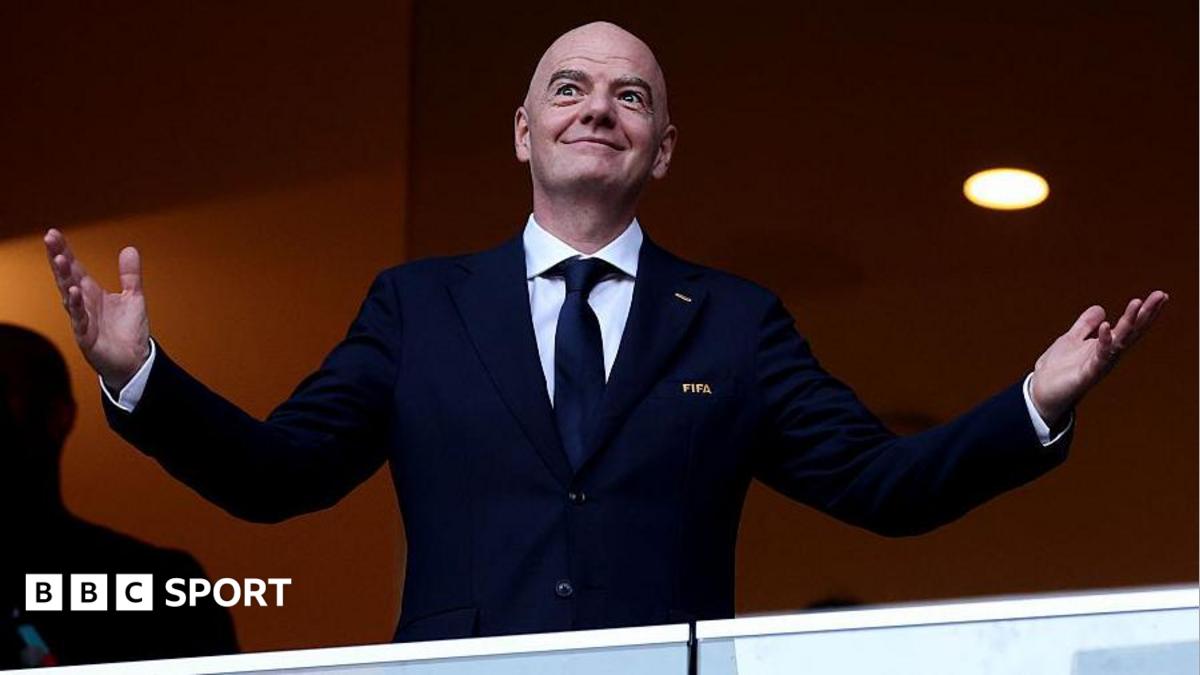
The host problem nobody can solve yet
Even before the sporting arguments, the structural ones are daunting. 2026 needed three host nations to absorb 48 teams. 2030 will need six — with the centenary opening matches in Argentina, Paraguay and Uruguay bolted on to a Morocco–Portugal–Spain core. 2034 is locked into Saudi Arabia, a single-host format that has never accommodated anywhere close to a 64-team field. As BBC Sport's Dale Johnson put it bluntly: Just how Saudi Arabia would be able to cope with a 64-team tournament, featuring 128 games, in 2034 is unknown.
For Infantino, the trade-off has always been a feature rather than a flaw. A bigger World Cup means more countries playing, and more revenue distributed to the 211 member federations who keep re-electing him. The universal-language framing is, in that sense, a precise pitch: it tells every federation in the room that expansion is a dividend, not a dilution.
Whether the football agrees will not really be settled by 19 July's quotation, however neatly it travelled. It will be settled in the group-stage tables of 2030, when the expansion winners are no longer the question but the answer.
Sources
These sources formed the evidence pack for this article. Links open the original publisher; inclusion does not imply endorsement.
- lequipe.fr original
- Damien Da Silva original
- Kevin Massampu original
- abc.net.au original
- fr.news.yahoo.com original
- bbc.co.uk original
- Reuters original