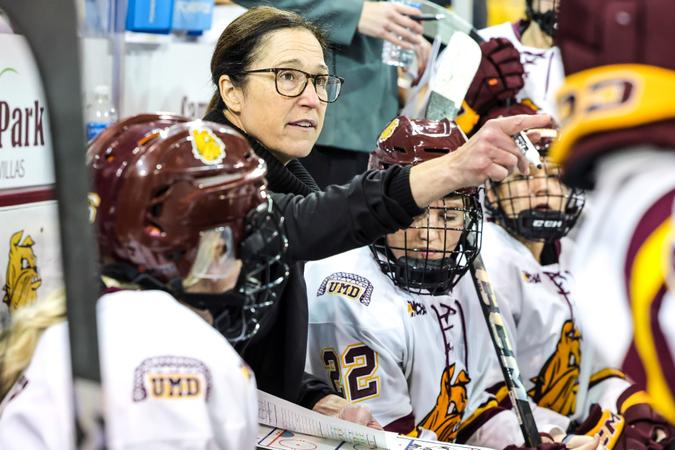
The ghost of 2010 still haunts the ice at Amsoil Arena. Since Minnesota Duluth’s last national championship, the program has drifted from its era of absolute dominance—securing titles in 2001, 2002, 2003, 2008, and 2010—into a cycle of competitive but ultimately incomplete seasons. After three consecutive years of finishing fourth in the WCHA and exiting in the NCAA regional finals, the Bulldogs are no longer content with being a perennial contender. They are building a machine designed to win it all.
Under head coach Laura Schuler, the strategy has shifted from local accumulation to aggressive, global curation. The blueprint is clear: utilize the transfer portal to inject immediate veteran maturity and leverage international recruiting to secure high-ceiling talent from the world's most elite developmental pipelines.
While much of the WCHA has played it safe with smaller freshman cohorts, Schuler has remained unapologetically aggressive in the transfer market. The goal isn't just to fill roster spots, but to find players who bring a specific, high-level pedigree that can bridge the gap between good and championship-ready.
The results are visible in the roster's makeup. Four of the five transfers brought in for the 2025-26 campaign arrived with international playing experience. This isn't just about adding bodies; it is about adding tactical nuance. The Bulldogs have secured Finnish national team member Krista Parkkonen and Swedish national team member Thea Johansson—players who understand the pressure of international competition. They are joined by Ashley Messier, who brings Canadian U-18 and national development experience, and Josie St. Martin, a former Ohio State Buckeye and USA U-18 top scorer who left Columbus to return to her Minnesota roots.
This infusion of veterans is intended to stabilize a roster that is undergoing significant turnover. With a heavy reliance on freshmen and the looming possibility of key players being away for international duty, the transfers provide the necessary backbone to maintain competitive continuity.
If the transfer portal is the Bulldogs' immediate fix, their recruiting class is their long-term statement of intent. The 2026-27 class is a definitive departure from the traditional collegiate model, characterized by an international flare that positions UMD as a destination for the world's best young talent.

The depth of this incoming talent is staggering, spanning multiple continents and elite leagues:
- The Crease: Marilou Grenier (Quebec City, Canada) arrives following a decorated stint that includes backstopping Canada to a U-18 World Championship gold medal. Her high-level developmental background with the Cégep Limoilou Titans makes her a cornerstone of the program's future.
- The Blueline: The defensive unit will be anchored by Tuuli Tallinen (Kouvola, Finland), a 5-foot-10 powerhouse and former U-18 Finnish captain, and Renee Lapointe (Ontario, Canada), a defenseman who will be just 17 years old when she arrives in Duluth next year.
- The Skill: The forward corps will be bolstered by Finnish standout Pauliina Salonen, a center who has starred in the Auroraliiga. Adding her is Edit Danielsson (Vaxjo, Sweden), a high-speed winger coming off title-winning experience in Sweden.
- The Domestic Core: To maintain the program's Minnesota identity, the class includes Alaina and Brooke Gnetz—the program's first-ever pair of sisters—and Lizzy Callahan.
This isn't merely a collection of talent; it is a collection of proven winners. Schuler's ability to recruit players with U-18 World Championship and senior national team experience suggests that the Bulldogs are no longer just recruiting athletes—they are recruiting professionals in waiting.
The ultimate metric for any elite collegiate program is its ability to produce professional-grade talent. UMD’s recent success in the professional draft serves as a powerful validation of their developmental environment. The professional ranks have seen the names of Tova Henderson, Ashley Messier, Thea Johansson, and Mary Kate O’Brien all called into service.
This pipeline creates a virtuous cycle. As stars move toward the pros, the program's prestige grows, making it an even more attractive destination for the next wave of international phenoms. The presence of established alumni in the professional ranks reinforces the narrative that a stint in Duluth is a direct pathway to the highest level of the sport.
Building a championship culture is rarely a clean process. It is often as messy and unpredictable as a practice session where a rogue puck strikes a head coach square in the face. Schuler, sporting four stitches and a black eye during media sessions, used the moment to illustrate the intensity of the program's current state.
“It was a spectacular defensive play, I must say,” Schuler remarked of the play that led to her injury. “One of our young freshmen, Rae Mayer, what a play to deflect a puck to prevent a pass going across the seam.”
That level of defensive desperation and high-speed intensity is exactly what the Bulldogs' leadership believes will define this new era. Between the international sophistication of their new recruits and the tactical grit of their returning veterans, Minnesota Duluth is no longer just participating in the WCHA—they are attempting to rewrite its hierarchy.
Sources
These sources formed the evidence pack for this article. Links open the original publisher; inclusion does not imply endorsement.