When narrative expectations collide with high-sample execution, the Eastern Conference hierarchy reveals its true fault lines six weeks into the 2025-26 season. While preseason forecasts projected an open battle among traditional heavyweights, quarter-season data establishes a far more selective reality. The New York Knicks have quietly carved out an elite profile against top-tier opposition, while projected contenders like the Cleveland Cavaliers and Boston Celtics navigate rotational turbulence and dangerous structural dependencies.
The High-Efficiency Standard: New York’s Elite Metric Split
Performance against standout competition provides the cleanest test for title contention. Against top-10 defenses across the league, New York produces the third-ranked offensive rating. Concurrently, when facing top-10 offenses, the Knicks lock down the seventh-best defensive mark. That dual top-seven threshold is shared by only one other franchise in basketball: the reigning champion Oklahoma City Thunder.
New York’s profile is particularly striking given their persistent rotational turbulence. Between managing Mitchell Robinson’s workload, integrating Karl-Anthony Towns, and navigating Jalen Brunson’s recovery timeline following last season's championship run over Victor Wembanyama's San Antonio Spurs, the Knicks have lacked rotational stability. Yet, having secured 10 victories across a 12-game stretch, their underlying metrics confirm an ability to execute against the league's top tier that eludes every other Eastern rival.
Injury Fractures and Internal Friction in Cleveland
In Cleveland, a 64-win baseline from last season has given way to severe continuity issues. Injury paralysis has completely disrupted chemistry and team dynamics. Max Strus has yet to log a single minute this season, Darius Garland has been capped at seven appearances, and Jarrett Allen has suited up just 14 times. Key depth contributors including Sam Merrill, Lonzo Ball, Larry Nance Jr., and De'Andre Hunter have each missed at least four games.
The Cavaliers' preferred primary lineup—Donovan Mitchell, Garland, Hunter, Evan Mobley, and Allen—has managed a total of just 43 minutes together on the floor. Following a third consecutive loss, capped by a setback against Boston, frustration spilled into the open.
blockquote"We're not hungry enough," Jaylon Tyson stated. "Toughness, it's a common theme… I feel like teams want it more than us."
blockquoteWhile Cleveland retains one of the conference's premier talent clusters, their inability to establish habits or maintain physical intensity leaves them vulnerable against disciplined opponents.
Boston’s High-Wire Math and the Shot-Profile Trap
The Boston Celtics maintain a top-five offensive rating under Joe Mazzulla, but their offensive framework relies on narrow margins. Operating around a league-average three-point benchmark of roughly 36 percent, Boston’s outcomes are direct slaves to their perimeter variance. When connecting above that 36 percent threshold, the Celtics are unblemished at 8-0. When falling below it, their record plummets to 3-8.
Individual shotmaking has temporarily disguised broader floor-spacing slumps from Payton Pritchard and Derrick White. Jaylen Brown has sustained an astounding 60 percent conversion rate from 15 to 19 feet, keeping Boston competitive after an 0-3 start without Jayson Tatum or a starting-caliber center. However, the team's interior metrics expose significant structural vulnerability:
- Defensive Rebounding: Boston owns the lowest defensive rebounding percentage in the NBA, ranking fourth-worst in total offensive rebounds surrendered per game with only three teams giving up more.
- Interior Production: The Celtics sit in the bottom five in both points in the paint and fast-break points per contest.
When perimeter jumpers stop falling, Boston lacks secondary avenues to generate high-efficiency scoring, forcing them to survive strictly on high-difficulty shotmaking.
Bully Ball in Motown and the Hawks' Unlikely Pivot
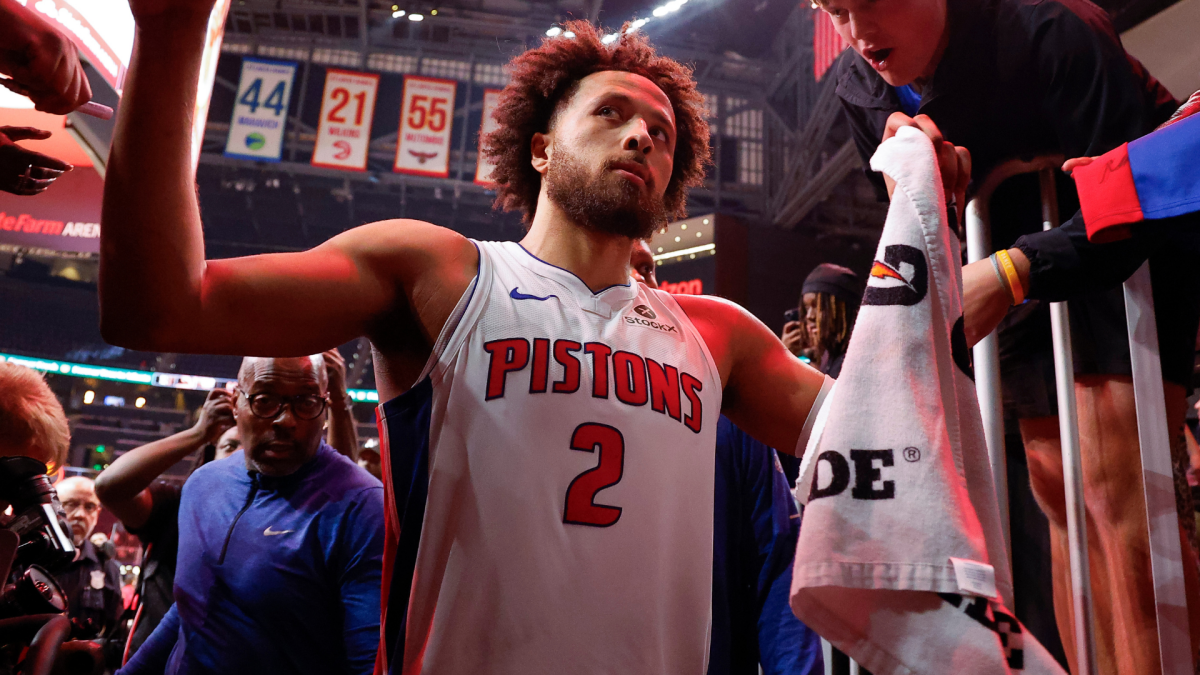
Beyond the established narrative, physical re-tooling has shifted the conference standings. In Detroit, JB Bickerstaff has engineered a complete identity overhaul. Anchored by a top-five defense and bully-ball rebound control, the Pistons assembled a 13-game winning streak—matching a franchise record—to hold first place in the East at Dec. 1 for the first time since 2005. Cade Cunningham is driving the engine with career-high averages of 28.8 points, 6.4 rebounds, and 9.4 assists, though spacing limitations present an eventual playoff test.
In Atlanta, the Hawks hold fifth place in the conference despite star guard Trae Young appearing in only five games. In his absence, Jalen Johnson has ascended to stardom, averaging 22.9 points, 9.8 rebounds, 7.3 assists, and 1.6 steals per game on 53.9/40.3/78.3 shooting splits alongside complementary growth from Nickeil Alexander-Walker. Atlanta’s immediate challenge centers on frontcourt size—where Onyeka Okongwu shines but Kristaps Porziņģis remains in and out—and seamlessly re-integrating Young without disrupting their established ball movement.
Conversely, early-season pretenders have collapsed. The Chicago Bulls opened 5-0 before dropping 10 of their next 14 games, undone by a defense that ranks last in opponent turnover rate (11.9 percent), 29th in paint points allowed (55.7), and 29th in second-chance points allowed (17.4).
blockquote"We just didn't play up to NBA standards," Nikola Vučević noted following a narrow win over Washington. "We gave up 41 points in the first quarter … We talk about it, but I don't think we really understand it's not sustainable to play this way."
blockquoteIn Indiana, an unprecedented injury cascade has rendered tactical evaluations moot. The Pacers have deployed 21 different players, with key pieces like T.J. McConnell, Bennedict Mathurin, Andrew Nembhard, Aaron Nesmith, and Obi Toppin missing extensive time. No single five-man unit has played more than 46 minutes together, locking Indiana into a lost season near the bottom of the standings.
Tactical Forecast: East Contender Trajectories
Likely Tactical Pattern: Expect New York’s dual-ranked efficiency profile to hold firm as their primary rotation stabilizes. Their ability to generate quality looks against elite defenses while maintaining paint discipline will separate them during head-to-head stretches against perimeter-dependent teams like Boston.
Decisive Matchup: Cleveland’s interior health versus Detroit’s physical frontcourt. If Cleveland cannot get Jarrett Allen and Evan Mobley extended minutes together to match the physical rebounding force of Jalen Duren and the Pistons, the Cavaliers will continue to leak second-chance points against physical rosters.
Strongest Counter-Case: A regression in Jaylen Brown’s mid-range shooting efficiency paired with continued perimeter cold spells from Pritchard and White could push Boston into a play-in battle, particularly given their fourth-worst ranking in offensive rebounds allowed per game.
What Would Change the Read: Trae Young’s full-time return in Atlanta. If Young accepts an off-ball usage shift to complement Jalen Johnson's playmaking leap, Atlanta’s offensive ceiling elevates dramatically; if he demands total ball-dominant control, the Hawks' collective synergy risks immediate erosion.
Sources
These sources formed the evidence pack for this article. Links open the original publisher; inclusion does not imply endorsement.
- cbssports.com original
- hoopshype.com original
- dailyknicks.com original
- nytimes.com original